Uketsu writes under a mask. He is a Japanese YouTuber of undisclosed identity, known for a white papier-mâché face and a voice run through a pitch shifter, who built an audience on short videos where ordinary objects sit slightly wrong. Strange Houses (2021), his first novel, carried that same trick onto the page: floor plans, drawings, and case files appear as literal images the reader studies, not prose describing them. Jim Rion's English translation reached UK and US shelves in 2025 through Pushkin Vertigo and HarperVia, and the two novels that followed, Strange Pictures and Strange Buildings, kept the mechanic and pushed it further.
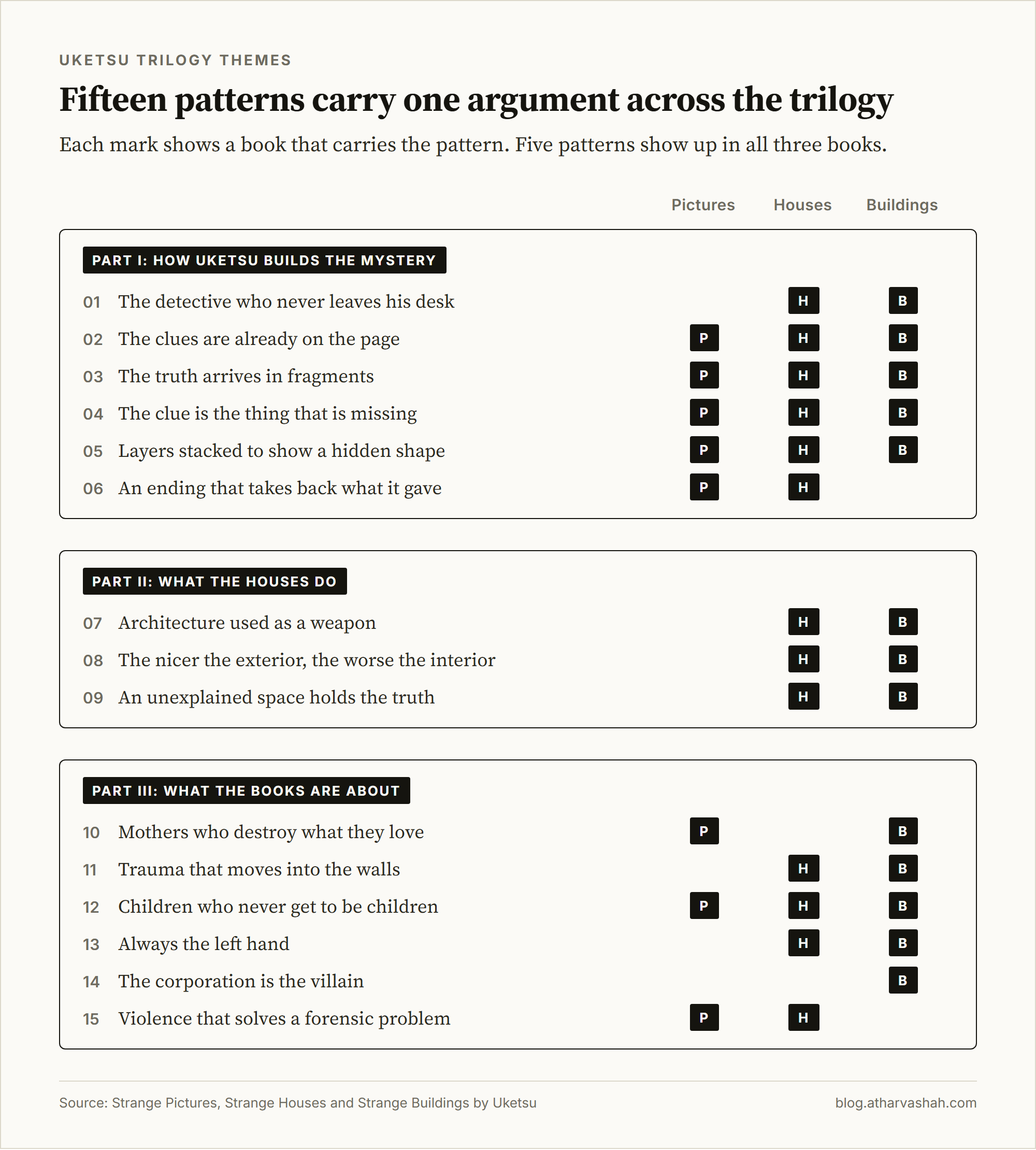
Read the three back to back and one argument runs under the puzzles: the spaces people live in record what happens inside them, love does more damage than hatred does, and the truth sits one layer beneath whatever a witness is looking at. Fifteen patterns carry that argument across the trilogy.
Part I: How Uketsu Builds the Mystery
1. The detective who never leaves his desk
In Strange Buildings, Kurihara solves a nationwide cult conspiracy without visiting a single site. He plots eleven reader-submitted case locations on a map of Japan, finds they trace a perfect circle, and reads the center point as the cult's Hall of Rebirth. A compass and a set of coordinates did the work.
That is how every Uketsu investigation runs. Two people carry each case: one who goes to the scene, and one who never does. In Strange Houses and Strange Buildings, the Author, as the narrator is called, is the field agent, visiting houses and interviewing witnesses. His friend Kurihara, an architectural draughtsman, works from a desk and turns a geometric anomaly on a blueprint into a full hypothesis, a hidden room or a murder scene, without ever leaving his chair.
2. The clues are already on the page
Uketsu puts his evidence directly on the page rather than describing it. Floor plans appear as floor plans. Drawings appear as drawings. The reader holds the same physical evidence the characters hold, at the same moment they hold it.
In Strange Pictures, a reader can perform the layer composition alone: stack the three drawings over their circled axes and watch an innocent sketch resolve into the murder image Yuki, the blogger's wife, hid inside it. In Strange Houses, a reader can overlay the two floor plans and find the dead space before Kurihara names it.
The mystery is solvable before the characters solve it.
3. The truth arrives in fragments, never straight
Strange Pictures opens inside a defunct blog, using a husband's cheerful domestic posts as the primary record for a murder investigation. Strange Buildings pieces its conspiracy together from a 1940 travelogue and a 1994 undercover tabloid article, then confirms it against the published diary of a nine-year-old boy who died of neglect mid-sentence. His entries get shorter as the book goes on, the handwriting deteriorates, then they stop.
Uketsu never narrates events directly. Every fact in these books gets rebuilt from documents, and every document is incomplete, unreliable, or filtered through a narrator with a reason to omit something. Each fragment carries someone's version of events, not the events themselves.
4. The clue is the thing that's missing
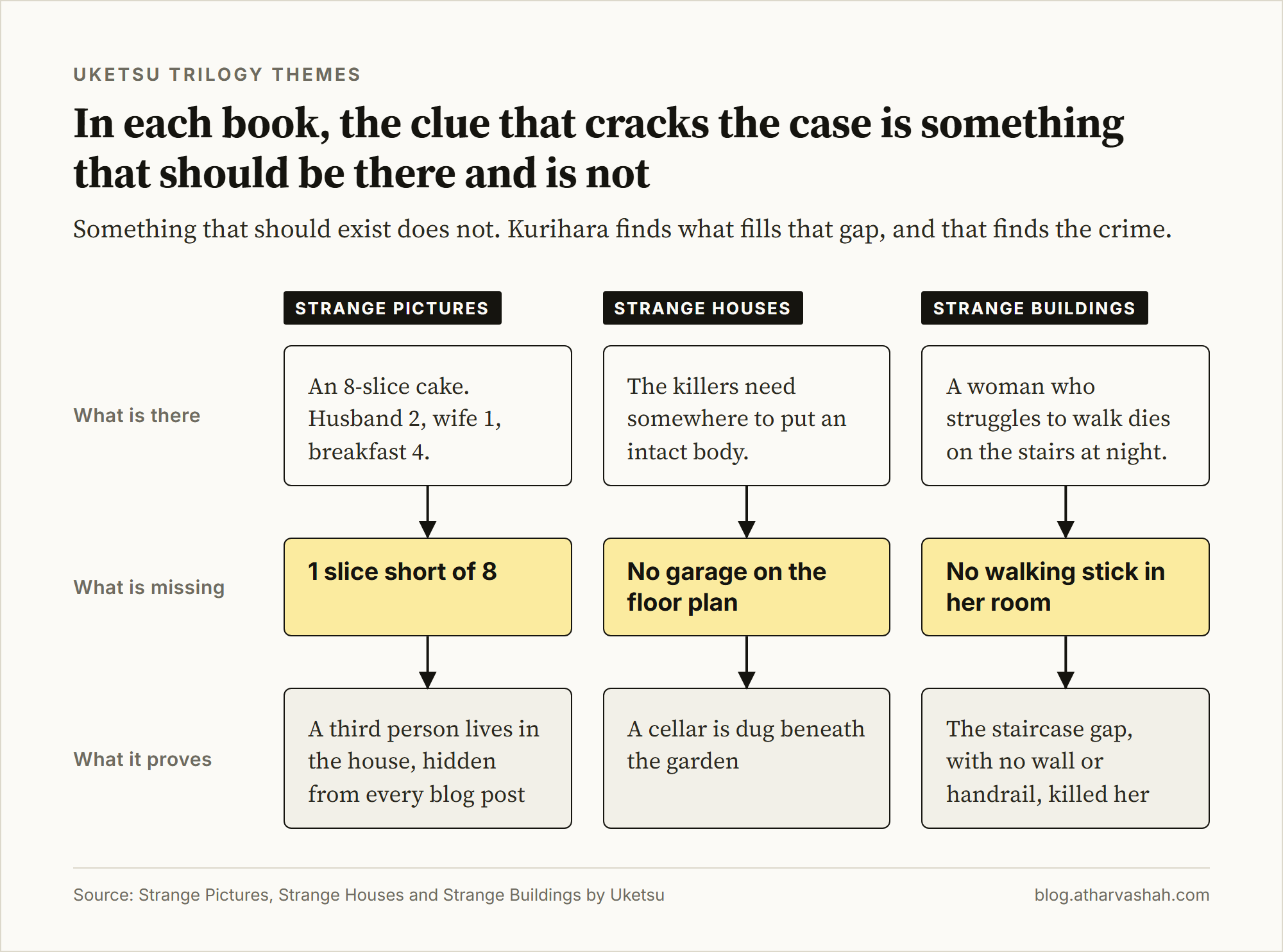
In Strange Pictures, a husband buys an eight-slice anniversary cake. He eats two slices and his wife eats one. Four more go into the fridge for breakfast, which brings the count to seven, one short of eight. Kurihara reads that missing slice as evidence of a third person living in the house, hidden from every blog post.
In Strange Houses, the Saitama floor plan has no garage, and the killers needed somewhere to put an intact body. Kurihara works backward from that missing room and finds the underground cellar dug beneath the garden. In Strange Buildings, a walking stick goes missing from a mobility-impaired woman's room the night she dies on the stairs.
Uketsu's key clues are almost always absences. Something that should exist does not, and finding what fills that gap finds the crime.
5. Layer one thing over another and the hidden shape appears
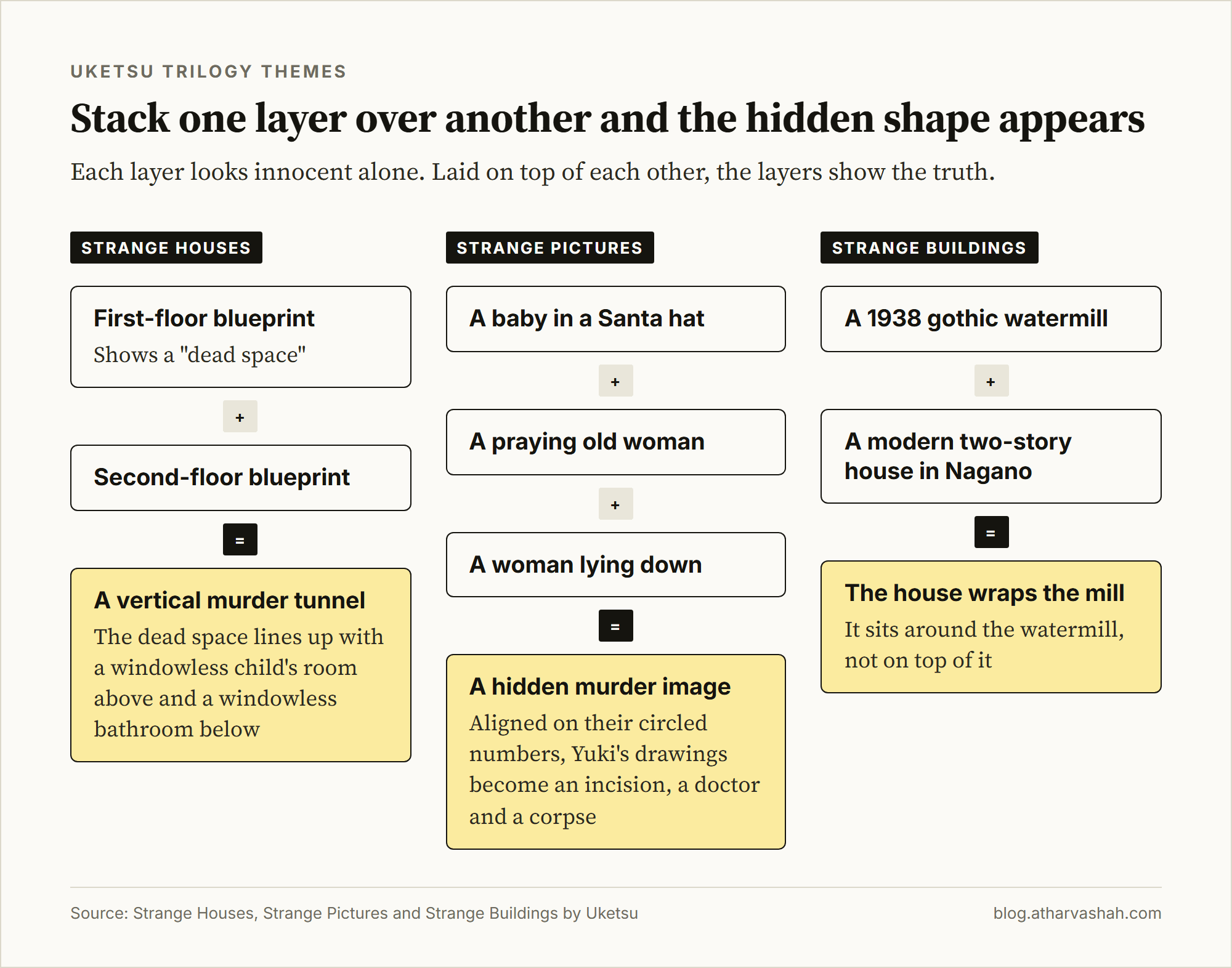
Reality in Uketsu's work hides under a transparency, not behind a wall.
Stack the first-floor blueprint over the second-floor blueprint in Strange Houses and the "dead space" lines up exactly with the windowless child's room above and the windowless bathroom below. What looked like a wasted pocket of air is a vertical murder tunnel.
Stack the three drawings in Strange Pictures, aligning their circled numbers, and a baby in a Santa hat becomes a surgical incision, a praying old woman becomes a doctor pulling a baby out of a body, and a woman lying down becomes a corpse.
In Strange Buildings, a modern two-story house in Nagano sits around, not on top of, a 1938 gothic watermill. The house is the second layer, placed over history nobody wanted to acknowledge.
6. An ending that takes back what it just gave you
Each book earns a resolution, then reverses it.
In Strange Houses, Keita Katabuchi's confession letter reads as tragic and decent: he built the trap-houses to fake ritual murders and protect his imprisoned son from a cult that demanded real kills, then surrendered himself so his family could survive. Then Kurihara points at one detail on the Tokyo floor plan, a small interior window between the living room and the bedroom. Interior windows exist to let someone watch the room, not to let in light. Kurihara asks whether Keita was the protector in his own story, or the prisoner his wife, Ayano, watched constantly. The letter does not change. What the reader does with it does.
In Strange Pictures, Doctor Hagio reads a child's drawing of a bird inside a thorny tree as evidence of nurturing love strong enough to overcome the patient's aggression. The ending reveals the thorns were there to protect the bird, and Hagio was right about the love. She missed what it was defending against.
Part II: What the Houses Do
7. One company, two kinds of violence
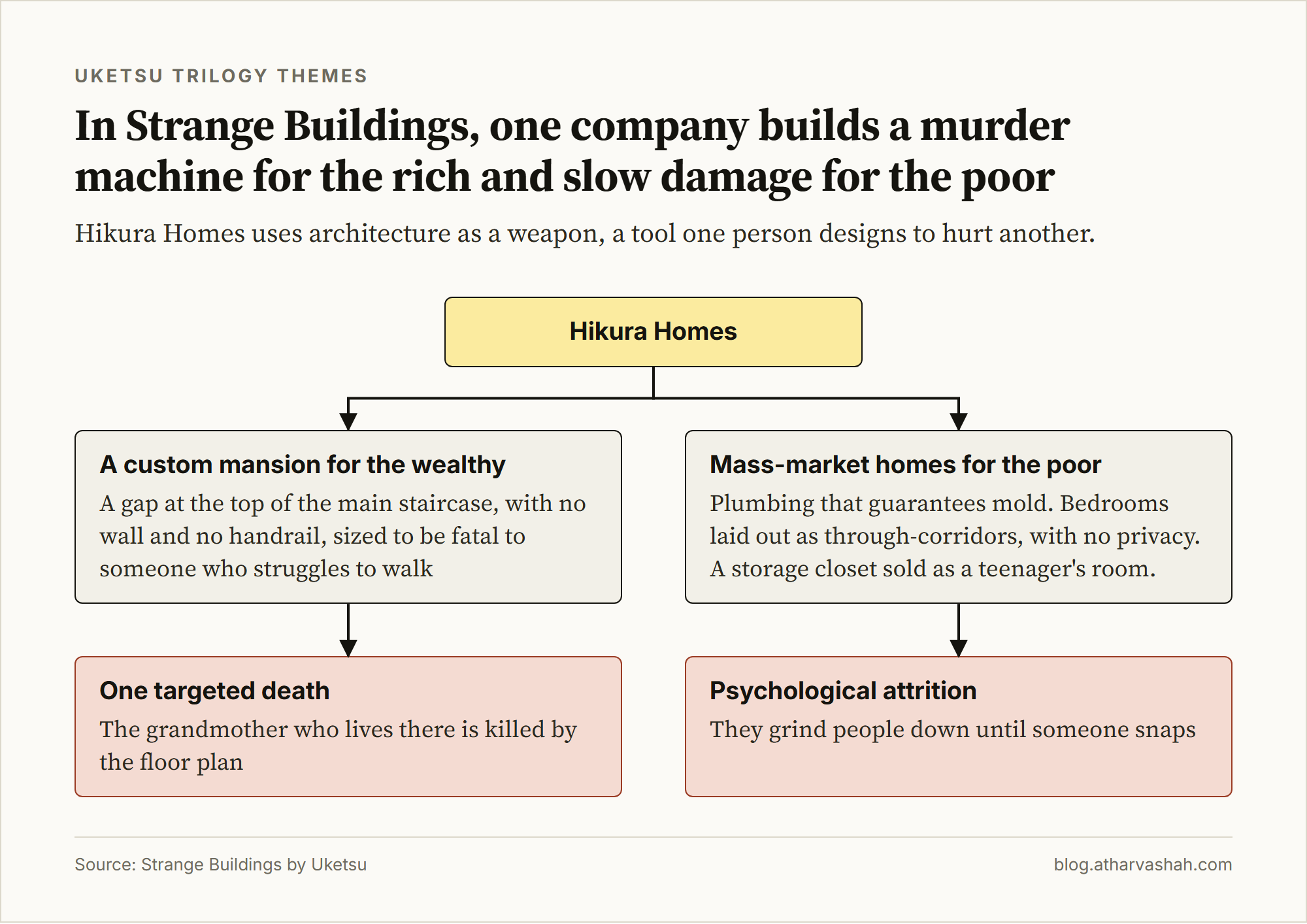
Uketsu treats architecture the way thriller writers treat guns, as a tool one person designs to hurt another person.
In Strange Buildings, Hikura Homes builds a mansion for a wealthy client with a deliberate gap at the top of the main staircase, no wall and no handrail, sized to be fatal to someone with a mobility impairment. The grandmother who lives there and struggles to walk was killed by the floor plan, not by a person.
The same company also builds mass-market homes with plumbing that guarantees mold and bedrooms with no privacy, laid out as through-corridors. It converts storage closets into bedrooms and calls one a teenager's room. These houses do not kill on a schedule. They grind people down until someone snaps.
One company builds custom murder machines for the wealthy and mass-produces psychological attrition for the poor. The product changes. The contempt does not change.
8. The nicer the exterior, the worse the interior
The more Uketsu hides inside a building, the more the outside performs welcome.
The Katabuchi murder house in Strange Houses has sixteen exterior windows, which Kurihara flags as deliberate. Sixteen windows serve no functional purpose. They are a performance, telling anyone who looks that there is nothing to see. The windowless rooms sit at the center, and the light show stays on the outside.
Toho adapted Strange Houses into a 2024 film.
In Strange Houses, the retrofitted triangular sunroom on the Saitama house has large windows facing the garden, immediately blocked by the walls framing the room, with no functional access from inside. It was built as a cover story for the underground cellar excavated beneath it. Someone needed a reason to be digging in the garden, and the sunroom is that reason.
9. A space with no explanation is where the truth lives
The ancestral Katabuchi estate in Strange Houses runs a hidden passage system behind a massive, immovable Buddhist altar at the center of the house. The sliding doors that would open onto that passage are jammed shut, so from outside that wing simply reads as closed. Behind the altar sits a confinement room nobody is supposed to know exists.
In Strange Buildings, Yayoi Negishi grew up with a hallway that dead-ended at a blank wall between her bedroom and her parents'. It led nowhere, and her mother built her daughter's whole life around a corridor with no destination.
In Strange Houses, the dead space between the kitchen and the living room of the Tokyo house is a vertical shaft, not a construction error, an interior the floor plan never mentions.
That's the shared premise across all three books: the space with no official explanation is the space where the truth lives.
Part III: What the Books Are Actually About
10. Mothers who destroy the thing they love
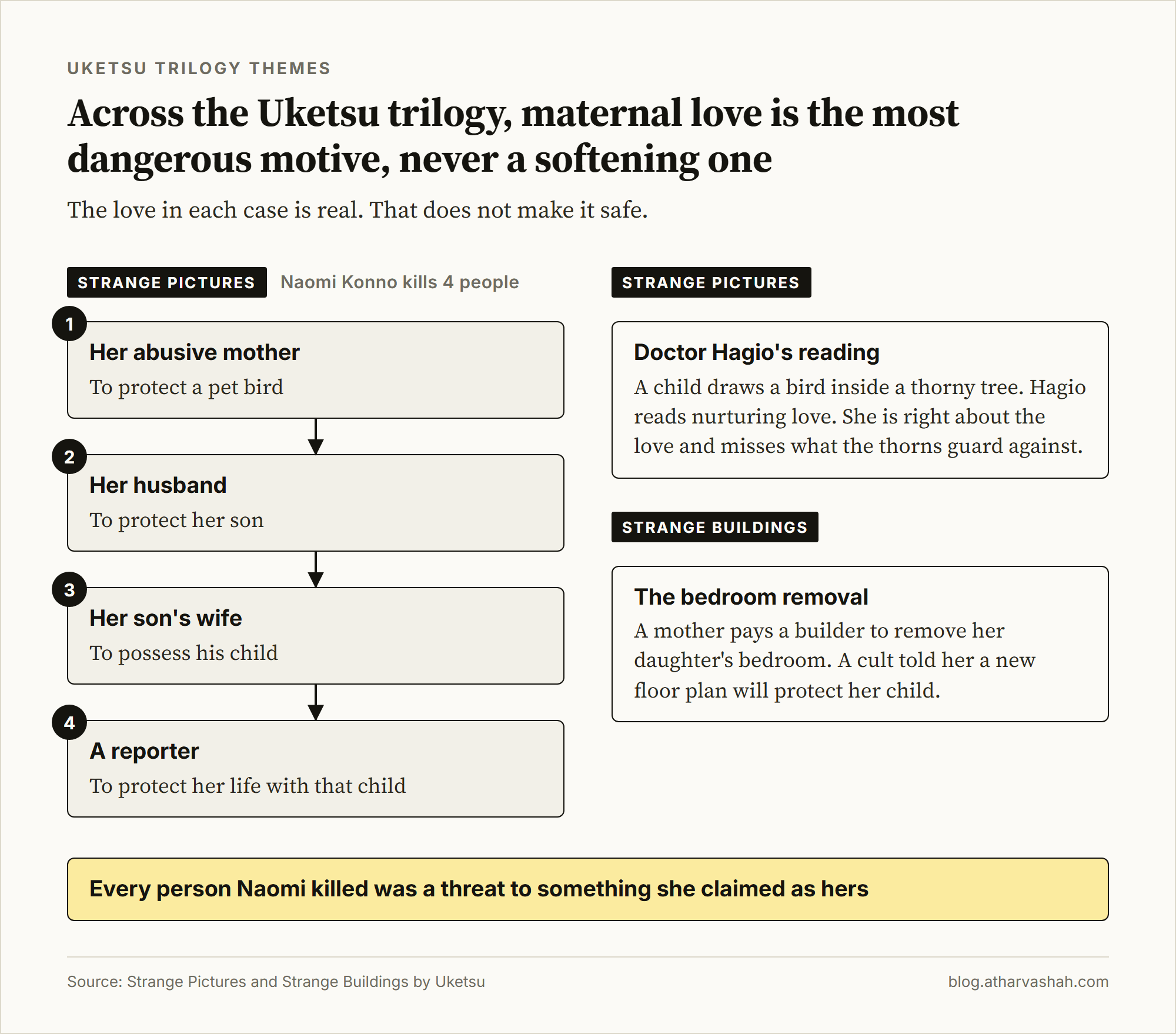
Maternal love in Uketsu's work is the most dangerous motivation in the trilogy, never a softening one.
In Strange Pictures, Naomi Konno killed her abusive mother to protect a pet bird, killed her husband to protect her son, killed her son's wife to possess his child, and killed a reporter to protect her life with that child. Every person she killed was a threat to something she claimed as hers.
Doctor Hagio looked at a child's drawing of a bird inside a thorny tree and read it as evidence of nurturing love. She was right about the love. She missed what the thorns were guarding against.
In Strange Buildings, a mother tries to pay a construction company to surgically remove her daughter's bedroom from the house, not out of cruelty but from a cult-driven belief that reshaping the floor plan will protect her child. The love in both cases is real. That does not make it safe.
11. Trauma that moves into the walls
Horror in these books gets inherited, moving down the family line into the buildings instead of staying with the person who first felt it.
The Katabuchi family in Strange Houses had already been building hidden rooms and secret passages for generations before the story starts. The ancestral estate, built decades earlier, already held the jammed sliding doors and the confinement room behind the altar. The modern Tokyo house did not invent any of it. Each generation built a new version of the same structure because no one in the family had found a way to stop.
In Strange Buildings, the Rebirth Congregation targets people carrying inherited guilt, an affair or a child born with a disability, and sells the architectural reformation of their homes as a cure for the sins that produced them. The transaction only works if the guilt stays permanent and transferable. The business model needs the wound to stay open.
12. Children who never get to be children
In Strange Houses, Momoya is raised from infancy in a windowless room behind double doors, with an en-suite toilet so he never has to leave. He is given a chute and a task. He is ten years old.
The first time he uses the secret passage built for him, he does not go to hurt anyone. He goes to the master bedroom to press a damp cloth on a sick baby's forehead.
In Strange Buildings, the nine-year-old boy Naruki keeps a journal. He writes about being locked in a closet and not being fed. He writes that his stomach does not hurt anymore, only feels tight. His entries get shorter, then they stop. The journal was later published as The Lonely Death of Naruki Mitsuhashi.
In Strange Pictures, a five-year-old boy draws his dead mother's gravestone on a Mother's Day card. His kindergarten teacher reports his mother for abuse.
13. Why it is always the left hand
In Strange Houses, the Katabuchi family curse demands the "Offering of the Left Hand." Every child born into the family without a left hand must, between ages ten and thirteen, murder a member of the rival branch and sever the victim's left hand for the altar. A manipulator invented the ritual generations ago, and the family kept obeying it anyway.
In Strange Buildings, the Hall of Rebirth is built in the exact shape of a woman missing her left arm and right leg, an amputated body made into architecture. Cult members remodel their own homes to match the same proportions, bricking over windows and removing rooms until their floor plans mirror the limbless idol.
14. The corporation is the villain, not a person
Uketsu does not confine evil to individual people. In Strange Buildings, the primary antagonist is a corporation.
Hikura Homes builds the Tsuhara house with total disregard for what its cramped, no-privacy design will do to the people living inside it. It builds the mousetrap mansion knowing exactly what the staircase gap will do. It constructs the Hall of Rebirth as physical headquarters for the cult it founded and operates, then sends salespeople to congregation members the morning after their religious sacrament to sell them remodeling packages.
The cult and the construction company are the same organization. The guilt is the product, and the house is what you buy to manage it. Cure the guilt, and the business ends.
15. Violence that solves a forensic problem, not an emotional one
The gore in these books works as forensic logic, rarely as emotion.
In Strange Houses, the Katabuchi family dismembers their victims because an intact adult body cannot fit through the narrow architectural chutes connecting the child's prison to the garage. The house demanded the dismemberment. It was logistics, not sadism.
In Strange Pictures, Naomi Konno beats a man's body more than two hundred times with a rock, and the mutilation is a technical requirement rather than an act of rage. It destroys the physical evidence a pathologist would use to calculate time of death from rigor mortis or body temperature. With that evidence gone, the only method left is stomach contents, which Naomi has already controlled by force-feeding her victim a specific meal at a specific time.
The two hundred blows are a calculation, not a loss of control. The body is a clock she needed to stop.
Naruki's journal entries get shorter for the same reason the dead space in the Tokyo house never appears on paper: nobody recorded either one while there was still time to do something about it. That gap between what a floor plan admits to and what actually happened inside it is where Uketsu has now built three novels, and it is still standing open at the end of the third one.