Who Is Uketsu?
Almost nothing is known about the person behind the name. Uketsu (雨穴, which translates to "rain hole") is a Japanese author and YouTuber. He appears in public in a white papier-mache mask and a black bodysuit. A voice changer modulates his voice to sound between mechanical and childlike. About 30 people know his true identity: his family, his publisher, and a small group of collaborators.
He is a man. He lives in Kanagawa Prefecture, southwest of Tokyo. He spent part of his childhood in Surrey, England. He worked at a supermarket when he began to post online. That is more or less the complete profile.
His early YouTube videos were surreal. Asparagus turned into severed fingers under the knife, strips of raw meat hung on a washing line, and eight human ears spun on a wheel. Then in 2020 he posted a 21-minute mystery story built around a series of architectural floor plans. The response was overwhelming. His publisher told him to turn it into a novel.
The rest followed quickly. By 2024, three books by Uketsu held slots in Japan's top 10 fiction bestsellers at the same time. Strange Pictures (変な絵, Hen na e) came out in Japan in 2022. Jim Rion translated it into English in January 2025. It sold over 1.5 million copies in Japan alone, and it now exists in more than 30 languages.
It was shortlisted for Waterstones' 2025 Book of the Year and topped Germany's May 2025 Krimibestenliste. A manga adaptation by Aiba Kiko launched in 2024.
Futabasha, the manga publisher, released this promo for the adaptation.
Why This Summary and Analysis Exists
Nobody has put up a truly detailed, chapter-level breakdown of Strange Pictures in English. Reviews exist and plot summaries exist. Nothing maps the structural puzzle, traces the planted clues back to their payoffs, and explains why this book works. That is what this piece is.
It is the complete summary and analysis, chapter by chapter. A full master map of narrative threads sits at the end. If you have already read the book, this is the deepest dive available. If you have not, this will tell you exactly how it was built and why it is worth your time.
Fair warning: this is the kind of analysis that only works with full spoilers. Everything is revealed.
Prologue: The Drawing Test
Plot Summary
The novel opens in a university lecture hall. Dr. Tomiko Hagio is a former practicing psychologist. She presents her students with a drawing by an eleven-year-old patient she calls "Little A." The child was institutionalized after murdering her abusive mother. The drawing came from a standard HTP (House-Tree-Person) test, one of the oldest tools in psychological evaluation.
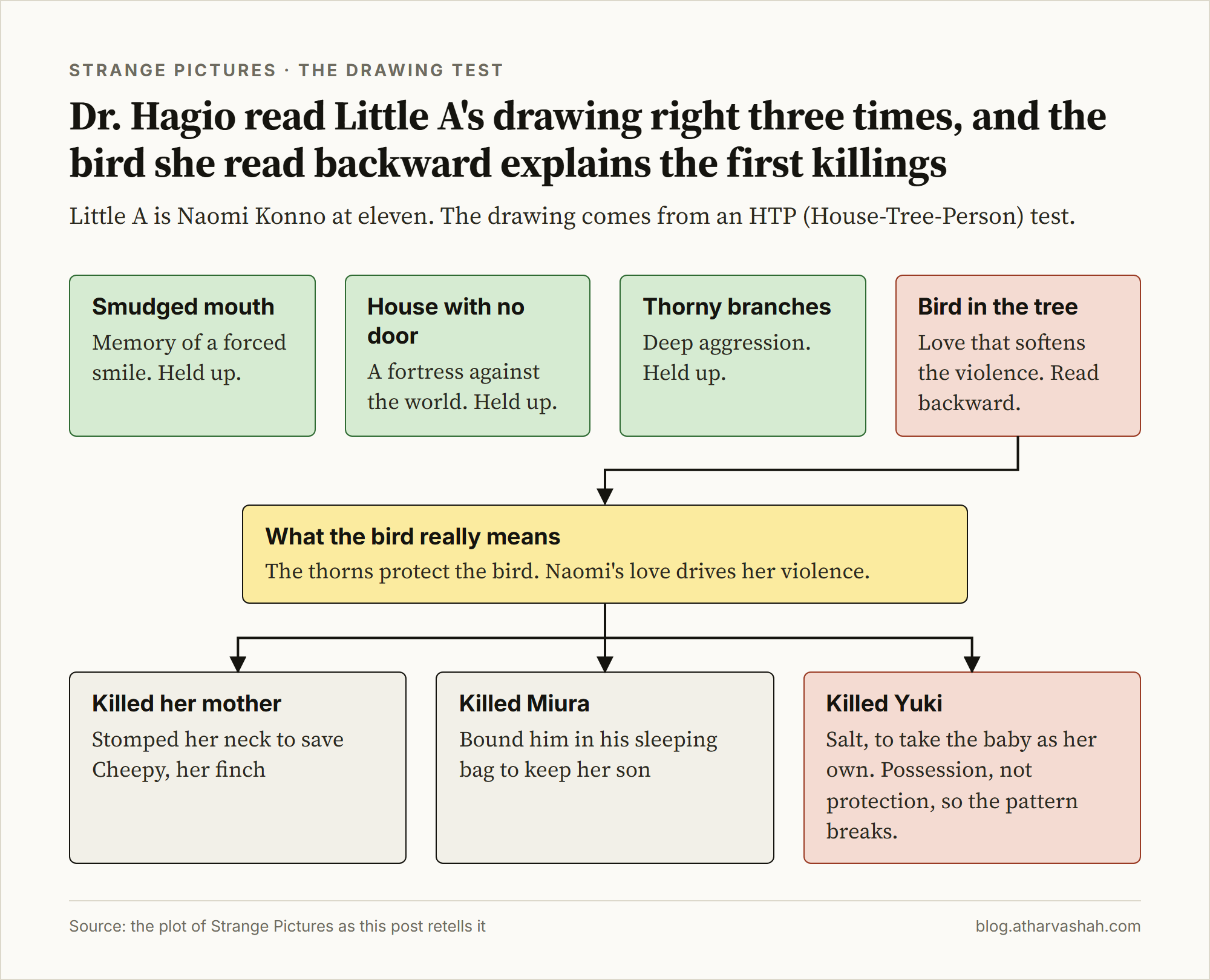
Dr. Hagio walks her students through three anomalies in the drawing. First, the figure's mouth is heavily smudged. Hagio reads this as physical trauma memory. The child's hands trembled as she recalled a forced, constant smile that appeased her abuser.
Second, the house lacks a door. Hagio interprets this as a fortress mentality, a desire to lock the world out. Third, the tree's branches end in sharp, thorny points. Drawings by violent offenders show that trait often, and it indicates deep aggression.
Then comes the pivot. Little A drew a small bird resting safely inside a hollow in the tree's trunk. Hagio seizes on this as a profound "desire to protect," a capacity for nurturing love underneath the violence. She closes the lecture by telling her students that Little A is now living happily as a mother.
Literary Analysis
Uketsu builds the prologue on ekphrasis: a drawing carries the narrative's evidence instead of dialogue or testimony. Dr. Hagio sets the rule for the rest of the book in one lecture. A drawing tells you what a person cannot say out loud.
Her authority comes from being right three times before she is wrong once. The smudged mouth, the doorless house, and the thorny branches: she reads all three correctly, and the reader has no reason yet to doubt her. Then she reaches the bird resting in the hollow of the tree and calls it proof of a hidden capacity for love, evidence that violence and nurturing can coexist inside the same child.
That reading is wrong, and it stays wrong for the rest of the novel. Little A grows up to become Naomi Konno, the woman whose case drives every chapter that follows, and what looks like a hopeful detail in an eleven-year-old's drawing is the first clue nobody in the room was equipped to read correctly.
Chapter One: The Old Woman's Prayer
Plot Summary
On May 19, 2014, Shuhei Sasaki investigates a defunct blog. He is a 21-year-old college student. Kurihara, a junior in his Paranormal Club, recommended the blog. It is titled "Oh No, Not Raku!", and a man using the pseudonym "Raku" wrote it. Its subject is his life with his wife Yuki, a former professional illustrator six years his senior. The posts begin in October 2008, cheerful and domestic, covering their daily life and Yuki's pregnancy.
Uketsu first told this chapter as a video on his channel.
The final post, dated November 28, 2012, appears after a three-year silence in the archive. It is addressed "To the one I love most." Raku says he has finally decoded "the secret of those three drawings." He cannot forgive his wife's "sin," and he still loves her. Then the blog goes silent.
Reading backward through the archive, Sasaki learns that in May 2009, Yuki was diagnosed with a breech pregnancy. The hospital recommended natural delivery. As the due date approached, Yuki drank excessive amounts of juice, citing uncontrollable thirst.
To manage her anxiety, she drew five cryptic images she called "visions of the future". They show a baby in a Santa hat, an old woman praying, an adult woman with flowing hair, a young boy, and an adult man. On October 11, 2009, the blog ends: Yuki died of a brain hemorrhage during an emergency C-section. The baby survived.
Kurihara and Sasaki work through the archive. Kurihara spots a mathematical impossibility in a post about an anniversary cake. It has 8 slices. Raku eats 2, Yuki eats 1, and 4 are saved. One slice is unaccounted for.
Someone else was living in that apartment. Raku never mentioned a third resident.
Sasaki cracks the drawings. He notices that each has a circled number. Yuki was a professional illustrator. She would know layer composition.
Sasaki stacks drawings 1, 2, and 3, aligning their circles as central axes and scaling accordingly. Stacked, the three drawings resolve into one scene.
Drawing 1's "Santa hat" becomes a bloody incision in a pregnant belly. Drawing 2's "praying old woman" becomes a doctor in scrubs pulling a baby from the wound. Drawing 3's "adult woman with flowing hair" becomes a stiff corpse on an operating table. Yuki had drawn a picture of her own murder, embedded across three innocent-looking images.
Stacking drawings 4 and 5 yields a second image. A man and a young boy walk away together, hand in hand. Yuki drew a future she would not be alive to see.
The Slow Read That Sasaki and the Reader Share
Uketsu tells this chapter entirely through Raku's blog, so the reader does the same forensic work Sasaki does, in the same order, at the same pace. An ordinary domestic blog turns sinister one post at a time, and neither Sasaki nor the reader ever gets ahead of the other.
Kurihara barely functions as a character. He exists to spot the one thing Sasaki missed: the math on the anniversary cake. Eight slices, two for Raku, one for Yuki, four saved, and one left over with no owner. That extra slice belongs to someone the blog never named. She is Naomi Konno, Raku's mother, living in the apartment the entire time the blog ran and never once mentioned across three years of posts.
The blog's own title carries a second clue nobody inside the story catches. "Oh No, Not Raku!" rearranges into "Haruto Konno": Raku was really Haruto Konno, father of the surviving baby Yuta, and the drawings his dead wife left behind are what finally break him. Yuki's strange thirst and the hospital's push for a natural breech delivery both read as small, forgivable details on a first pass. Neither one is forgivable. Both come back, with their full weight, in the Final Chapter.
Chapter Two: The Smudged Room
Plot Summary
Point of view shifts to Naomi Konno: widowed, raising her five-year-old son Yuta in a sixth-floor apartment. The chapter opens with a harsh scolding. Yuta used a geometric stencil ruler to draw in permanent marker on the apartment walls.
A concurrent storyline: Naomi notices a man in a grey coat following her and Yuta home. He drives a compact car. She cannot place him but feels the threat clearly.
At Yuta's nursery school, homeroom teacher Miho Haruoka examines Yuta's Mother's Day drawing. He drew their apartment building in reasonable detail. Their specific sixth-floor room carries a violent grey blotch over it. Haruoka investigates the mechanics. Yuta did not use a grey crayon.
He used a white crayon over a black underdrawing. The pressing and smearing mixed the pigments into an opaque grey. A classmate, Miu Yonezawa, volunteers one detail. Yuta's original drawing showed a large rectangle with a small triangle inside, and he erased it.
Haruoka connects the shape to the stencil ruler Naomi punished Yuta for using. She draws on child psychology research, which holds that children draw the idea of trauma rather than literal objects. She concludes that Yuta drew the implement his mother struck him with. She phones Naomi to report suspected abuse.
Naomi realizes Haruoka has misread the drawing. The rectangle and triangle are the kanji 今野, the characters for "Konno," which looks like a triangle sitting above a rectangle, not a stencil ruler.
Yuta was attempting to draw a gravestone, his mother's gravestone. Naomi deduces that Yuta has been sneaking to Sakura Memorial Garden. He holds a faint memory of his father once taking him to visit "Mummy's" grave. She goes to the cemetery.
She finds Yuta at the headstone of Yuki Konno.
That evening, the grey-coated man follows Naomi into her apartment building. She has anticipated this. She waits behind her door with a kitchen knife. When he steps inside, she stabs him. As he falls, his hood drops: the wrinkled face of an old man she dimly recognizes.
Sympathy Built on Purpose
By the time Naomi picks up a knife, the reader has known for a full chapter that she is dangerous, and Uketsu spends this entire chapter making that knowledge useless. He puts her through a harsh, unfair accusation from her son's teacher and an exhausting stretch of solo parenthood, and the effect is real sympathy for a woman who ends the chapter stabbing a man in her own doorway.
Haruoka examines Yuta's drawing with the exact tool Dr. Hagio used in the prologue, art as a window into subconscious trauma, and reaches the exact wrong conclusion Hagio nearly reached. She reads the grey blotch as a stencil ruler standing in for abuse, when Yuta is drawing his mother's name over the shape of a gravestone. He is trying to erase what is in front of him and reach what is buried under it. Nobody in his life has told him his mother is dead, let alone that she has a name he could draw.
This chapter confirms two identities. Yuta is the baby who survived Yuki's murder on the operating table in Chapter One, and Naomi is Haruto's mother, not Yuki's, which makes her the "old woman praying" in Yuki's composite drawing, the figure with both hands reaching into the incision.
Haruto's own sequence resolves here too. He worked out what his mother had done, took Yuta to his real mother's grave, wrote his last blog post, and hanged himself.
The man Naomi stabs is Isamu Kumai, a veteran reporter who appears formally in Chapter Three. He survives. His stalking was deliberate provocation, meant to push Naomi into a violent act his police contact could arrest her for. She never calls the police when she feels threatened. She picks up a knife, the same way she always has.
Chapter Three: The Art Teacher's Final Drawing
Plot Summary
The timeline shifts to August 1995. Shunsuke Iwata is a 19-year-old high school graduate. He failed to land a reporting position, so the L-Daily newspaper placed him in its administrative department. He wants one specific story: the 1992 unsolved murder of his high school art teacher and personal mentor, Yoshiharu Miura.
His boss in the admin department is Isamu Kumai, a veteran reporter demoted after a bout with esophageal cancer. Kumai was the lead reporter on the Miura case and shares his confidential files with Iwata.
The physical evidence from the 1992 murder on Mt. K is strange. Miura's body was discovered at the mountain's eighth-station clearing. A rock beat it more than two hundred times, which made it completely unidentifiable. The degree of mutilation forced the pathologist to estimate the time of death from stomach contents alone. Miura ate a Hanayagi bento box, and digestion placed his death at 5:00 PM on September 20.
This timeline cleared two people. Miura's wife had an alibi for the morning of the 21st. A student named Yuki Kameido had an alibi for the evening of the 20th. The prime suspect became Nobuo Toyokawa, a resentful college friend of Miura's who had no alibi for that evening.
Two details continued to bother investigators: Miura's sleeping bag was stolen, and some of his food was missing. Miura had also drawn a crude picture of the mountain range on the back of a folded supermarket receipt.
Iwata pursues an independent lead to his old school. There he meets a blind student drawing on a "pierced canvas," a surface with tactile gridlines. The image clicks. Miura folded the receipt into a grid and drew the mountains by touch, without seeing his own hands.
Iwata hikes Mt. K on the anniversary of the murder to test the theory. At the eighth station at 5:00 PM, he looks at the mountain range and sees nothing. The setting sun is directly behind it. The mountains are completely backlit, invisible against the glare. Miura could not have drawn a detailed mountain range in those conditions.
He deduces the actual sequence. The killer captured Miura and restrained him in his own sleeping bag through the night. The next morning the killer force-fed him the Hanayagi bento, which then looked like normal consumption. Two and a half hours after the meal, the killer murdered Miura.
The killer destroyed the body beyond recognition to eliminate rigor mortis as a time-of-death indicator. The bento's digestion level did the rest. It placed the death ten hours early, inside the window where the killer had an alibi.
Iwata realizes the brutal mutilation was never about rage. It was a forensic necessity. With his theory proven, Iwata sits in his tent on the mountain.
That night, Naomi Miura, the art teacher's widow, binds him in his sleeping bag and force-feeds him.
Iwata realizes what is happening and why. He folds a piece of paper and draws one last blind picture of the mountains against his restrained hands. Then she kills him. Naomi then murders Toyokawa. She types a fabricated suicide note on a brand-new word processor to frame him for both deaths, and closes the police file for good.
A Genre Change Mid-Book
The story drops its epistolary, domestic frame here and becomes a hardboiled forensic procedural, tracking a nineteen-year-old cub reporter who dies for getting too close to a three-year-old mountain murder. Nothing about the case is what it first looks like once Iwata rebuilds the timeline. Miura's body took more than two hundred blows from a rock because a beaten, unrecognizable body gives a pathologist no way to read body temperature or rigor mortis, not because of rage. That leaves exactly one piece of forensic evidence, the digested bento, and the killer controlled that evidence completely by force-feeding Miura the next morning and killing him hours later.
Iwata's proof comes from a blind student's pierced canvas, a drawing surface worked by touch through a tactile grid rather than by sight. Miura folded his own receipt into the same kind of grid so he could draw the mountain range with his hands bound inside a sleeping bag, in the dark, without looking. A sighted man's drawing was made exactly like a blind one, and that mismatch is what breaks the alibi.
This chapter also reveals who Kumai is: the grey-coated stalker from Chapter Two. He survives. His cancer keeps progressing. His stalking was deliberate provocation, meant to trigger a violent reaction from Naomi that his police contact could use to arrest her, one last case he wanted to close before running out of time.
The fake suicide note is typed on a brand-new word processor. A real suicide note would be handwritten, so the note's own format is what proves it was forged to avoid a handwriting match.
The Final Chapter: The Bird, Safe in the Tree
Plot Summary
Following her 2015 arrest, Naomi Konno's history is reconstructed in full.
As a child, her father's suicide left her alone with a deeply abusive and sociopathic mother. Naomi found one source of comfort: a pet finch she named Cheepy. Her mother tried to crush Cheepy to death. Eleven-year-old Naomi fought back and stomped on her mother's neck until she died. She was committed to a juvenile reformatory.
That girl was "Little A."
Naomi eventually became a midwife, married Yoshiharu Miura (the murdered art teacher), and had a son, Haruto. Miura was a harsh disciplinarian who struck the introverted Haruto and forced him outside.
Naomi feared that her juvenile record would cost her custody of Haruto in any divorce. So she planned and executed the elaborate murder on Mt. K. She killed Toyokawa later when he deduced the method and attempted to blackmail her into a sexual relationship. She killed Iwata when he got too close.
Years later, the adult Haruto reconnected with Yuki Kameido, Miura's former art student, and married her. They moved in with Naomi. Yuki became pregnant.
Naomi began to want the baby as something to own, not something to help raise.
Using her medical knowledge, she replaced Yuki's prenatal iron supplements with 15-gram daily doses of sodium chloride, which is pure salt. Ingested throughout a pregnancy, this level of sodium induces progressively worsening hypertension.
Naomi, as senior midwife at the clinic, falsified Yuki's blood pressure charts and arranged for the dangerous natural breech delivery. On the operating table, Yuki's blood pressure spiked to fatal levels. She died of a brain hemorrhage. Naomi took the baby.
Three years later, Haruto decoded Yuki's composite drawings. He understood what his mother had done. The blog's final post was a goodbye, written to Haruto's wife, who was already dead. He took Yuta to Yuki's grave. Then he hanged himself.
In the aftermath of Naomi's arrest, Dr. Hagio realizes her diagnosis of "Little A" was wrong. The smudging, the doorless house, and the thorny branches all held up. The bird did not hold up: she had read it as proof of a capacity for nurturing that would soften the aggression, and she had the causality backwards.
The thorns exist to protect the bird. Naomi's maternal love drives her violence rather than redeeming it.
Kumai, recovering in the hospital, shares a room with Kurihara (from Chapter One). Kurihara explains the blog's mysteries. Kumai's cancer is advanced and his life is effectively over. He adopts the newly orphaned Yuta to break the cycle.
The Pattern That Breaks on Purpose
The Final Chapter treats Naomi as a psychological profile to understand, not a mystery to solve, and the understanding does not bring comfort. Her first three killings are built to earn sympathy: she kills an abusive mother to save a bird, an abusive husband to protect her son, and a blackmailer to protect an innocent life. The pattern holds together well enough that a reader has to work to resist rooting for her. Naomi killed Yuki simply because Yuki stood between her and a new person to possess, and that murder breaks the pattern the first three built.
The book's only comfort comes through substitution rather than justice. Nobody punishes Naomi for what she did to Yuta's family. Kumai, a dying man with nothing left to protect, adopts the boy instead, and that quiet, unglamorous act is the closest thing the story offers to an ending that heals anything.
Master Map: Planted Clues and Their Payoffs
Three Clues Worth Rereading For
The clue I missed on a first pass is the cake. Raku's post about their wedding anniversary mentions an eight-slice cake: two for him, one for Yuki, four saved for later. That is seven. The eighth slice belongs to nobody the blog ever names, and it sat there for three years before I noticed it, proof that Naomi Konno had been living in that apartment the entire time the blog ran, eating from a cake she was never once mentioned eating.
Yuki's thirst reads as a throwaway domestic detail the first time through, one more small complaint in a blog full of small complaints. It is the murder weapon. Naomi replaced Yuki's iron supplements with fifteen grams of salt a day, and the uncontrollable thirst was Yuki's body trying to survive its own poisoning. The American College of Obstetricians and Gynecologists treats a planned cesarean as the safer default for a term breech pregnancy and reserves vaginal delivery for hospitals that document strict protocols and informed consent, because the mortality gap between the two paths is real. Naomi, as the clinic's senior midwife, had exactly the standing to override that guidance and steer Yuki toward the delivery that would kill her.
The cleanest single clue in the book is the mountain. The eighth station of Mt. K faces west, so at five in the afternoon in September the sun sits directly behind the range and the mountains go black against the glare. Miura's drawing shows detail no one could see under those conditions. He drew it in the morning, with the sun behind him instead of in front of him, which puts the entire official timeline for his death off by roughly fourteen hours. One fact about where the sun sits at 5 p.m. undoes an entire police file.
A few more clues do the same work in miniature.
Yuta's Mother's Day drawing hides the kanji for the Konno family name inside a shape his teacher misreads as evidence of abuse.
Miura's blind, tactile drawing on a folded receipt breaks his own murderer's alibi, because a sighted man could not have drawn it under the lighting conditions the police assumed.
The blog's title, "Oh No, Not Raku!," rearranges letter for letter into "Haruto Konno," the real name of the man writing it, months before the text confirms it directly.
Thematic Resonance: How the Ending Shatters the Beginning
Strange Pictures widens its scope with every chapter. Chapter One is pure archive work, solved entirely from behind a screen. It turns physical and domestic in Chapter Two, then historical and procedural in Chapter Three, with a body found on a mountain. The Final Chapter pulls all three back into one woman's history, which is the actual shape of the book: four separate cases that were always the same case, viewed from four distances.

Dr. Hagio's lecture in the prologue states the book's real argument before the plot even starts: a drawing reveals what a person cannot say. She proves that argument three times over, then gets the fourth reading backward, showing what her own correct method does in the hands of someone who wants a hopeful answer badly enough. The thorns around the bird were never something the bird earned by being gentle. They exist because the bird needed defending, and Naomi's love for what she claims as hers is the same violence wearing a gentler face.
Kumai closes the book by adopting Yuta. He is a dying man with nothing left to lose and one decent thing left to do, and that is enough to break a cycle three generations deep.
If you have read this far and have not picked up the book yet, start with the English translation by Jim Rion (HarperVia, January 2025).
Related reading: Strange Buildings by Uketsu: Summary and Analysis and Strange Houses by Uketsu: Summary and Analysis.