Uketsu writes mysteries in which the murder weapon is a floor plan. He means a real architectural drawing, printed on the page. The reader is expected to solve it before the narrator does. Strange Buildings is the second novel built that way. In this one the trick stops being a gimmick and becomes a genre.
Who Uketsu Is
Uketsu (雨穴, "rain hole") is a Japanese author and YouTuber whose real identity is known to approximately 30 people. He appears in public in a white papier-mache mask, a black bodysuit, and a voice changer. He lives in Kanagawa Prefecture. He worked at a supermarket when he started to post surreal videos online: asparagus turning into severed fingers, raw meat hung on a washing line, eight human ears spinning on a wheel.
In 2020, he posted a 21-minute mystery built around a series of architectural floor plans. Publishers told him to make it a novel. That novel became Strange Houses (2021).
This is the 2020 video by Uketsu that became Strange Houses.
Strange Pictures followed in 2022. Strange Buildings (変な家2, Hen na ie 2) came out in Japan in 2023. The English translation arrives in 2026. It is a direct sequel to Strange Houses, keeping the same Author-narrator and the same Kurihara. Kurihara is an architectural draughtsman who decodes the floor plans. It also keeps the same project of using architectural floor plans as forensic evidence.
Jim Rion translated both Strange Houses and Strange Pictures into English for Pushkin Vertigo and HarperVia. He has lived and worked as a translator in Japan since 2004, and the same publisher pairing is the likely home for Strange Buildings when it reaches English readers.
John Hill, an architecture writer, reviewed the English translation in March 2026.

By 2024, three of Uketsu's novels sat in Japan's top 10 fiction bestsellers at the same time. Strange Pictures alone sold over 1.5 million copies in Japan. Translators took it into 30-plus languages.
Strange Buildings is the most ambitious of the three novels covered in this series. It drops the single central case of Strange Houses and the four interlocking stories of Strange Pictures. It presents eleven separate reader-submitted files about architectural anomalies. Each file looks isolated, and each one connects secretly to every other. The final reveal is larger than anything Uketsu attempted before. A nationwide cult conspiracy sits encoded in the floor plans of ordinary Japanese homes.
Why This Summary and Analysis Exists
No complete, chapter-level English-language breakdown of Strange Buildings exists. The book still lacks wide coverage outside Japan. This is the full summary and analysis. It covers all eleven files, the climactic deductions, and the master map of every planted clue. This page carries complete spoilers throughout.
Prologue
The Author, the same freelance writer who investigated the Katabuchi family in Strange Houses, receives eleven new files from readers. Each file describes a bizarre architectural anomaly. One case is a hallway that goes nowhere, another is a building shaped wrong, and a third is a room with a door that should not exist. At first glance the cases are unrelated, and on examination they reveal one story of interconnected crimes across decades.
File 1: The Hallway to Nowhere
The House Yayoi Grew Up In
Yayoi Negishi is a woman in her thirties. She consults the Author about her childhood home in Toyama Prefecture. A company called Housemaker Misaki built it in 1990. The single-story house had a dead-end hallway between her parents' room and her own. It led to a wall.
Uketsu adapted this first file as a video on his own channel.
Her mother was cold and distant toward Yayoi. She was obsessively protective about one thing. Yayoi could never walk on the main road south of the house. The mother was not anxious in general. She was anxious about that road alone.
After her parents died, Yayoi found two strange objects among their belongings. One was a hidden stash of 680,000 yen in cash. The other was a wooden doll missing its left arm and right leg.
Yayoi has a theory. The hallway was meant for a twin sibling who died in utero. The Author investigates local newspaper archives and disproves this through architectural logic.
He finds something else. A Housemaker Misaki construction truck struck and killed a child in 1990. It happened right in front of the home plot, just before the house went up. The original entrance was planned to face the road where the accident happened. Yayoi's mother paid to have the entrance moved.
The representative from Housemaker Misaki adds one final detail. Five years after the move, Yayoi's mother returned to the company. She tried to hire them to remove Yayoi's bedroom from the house. That job was expensive and structurally significant. The mother could barely afford it. She kept asking anyway.
A Floor Plan as a Confession
The "hallway to nowhere" is the novel's entry point into its governing theme. Houses are physical confessions of psychological guilt. The mother cannot walk past the place where a child died. She cannot live in a house whose front door opens onto that site. She is willing to destroy her daughter's bedroom to correct the floor plan of her guilt.
At this stage of the novel, the amputated wooden doll is a grotesque non sequitur. By the final chapter, it is the key to everything.
Where the Doll Leads
The amputated wooden doll prefigures the "Holy Mother" of the Rebirth Congregation, introduced in File 6. She is a woman missing her left arm and right leg. She is the figurehead of a cult that exploits parental guilt.
Yayoi's premature birth blocked the newborn blood test. As Kurihara later deduces, Yayoi was conceived in an affair. The mother's road prohibition was not about the accident. It came from fear that any hospital visit with a blood transfusion would reveal Yayoi's blood type to her husband.
The mother's attempt to remove Yayoi's bedroom was an act of cult devotion. The Rebirth Congregation instructed members to alter their homes physically, so that each home matched the amputated form of the Holy Mother as a ritual of penance.
File 2: Nurturing Darkness
The Tsuhara House Killings, Reconstructed
Tatsuyuki Iimura is a forensic cleaner. He recounts the "Tsuhara house" in Shizuoka, a 2020 crime scene. A 16-year-old boy allegedly took a kitchen knife and stabbed his mother. He then killed his bedridden grandmother and younger brother.
Iimura provides the floor plan. A corporation called Hikura Homes built the house as a mass-produced "commodity home". Plumbing crammed into the north side caused mold and persistent odors, and nobody had real privacy. The bedrooms worked as through-corridors, so everyone passed through everyone else's space constantly. The 16-year-old lived in a converted, windowless storage room. Iimura argues the suffocating architecture "nurtured the darkness" in the boy.
The Author re-examines the forensic record. The grandmother's eyes were closed at death. The mother had no defensive wounds except the knife entry point. The teenager had multiple slash wounds on his hands and arms.
The Author reconstructs the actual sequence. The mother cared for a bedridden relative in an intolerable home, and the weight shattered her. She attacked the grandmother in her sleep. The teenager fought his mother to stop her, and she cut him repeatedly. He killed her by accident in the struggle. Then panic and shock made him attack his younger brother.
The teenager's "kills" were a consequence of someone else's snap, in a house designed to make everyone inside it worse.
A House Built to Fail Everyone Inside It
This chapter expands the novel's thesis from the individual scale to the systemic. The Tsuhara house is a product, mass-manufactured by a corporation optimizing for cost and profit, not a deviant design. Hikura Homes built it this way, and everyone who lived in it has since died.
The media used a "killer teen" framing, and Iimura adopted it at first. The Author's forensic re-reading rejects it.
Hikura Homes' First Appearance
Hikura Homes enters here as a corporation with a troubling history. Rumors in the 1980s said the president abused "some little girl." The company answered those rumors with aggressive media management and reputation control rather than accountability. That rumor pays off in File 10 as something far worse: Masahiko Hikura, the future chairman, bought a child from a yakuza-operated brothel.
File 3: The Watermill in the Woods
Uki Mizunashi's 1938 Discovery
The Author presents an excerpt from a 1938 travelogue by Uki Mizunashi. She is a steel magnate's daughter, and she visits her uncle's rural property in Nagano. She discovers a watermill in the forest that has no water source. She turns the massive exterior wheel by hand, and an interior wall slides forward. That opens a hidden, doorless confinement room.
Outside the mill stands a small shrine with a statue of Kishimojin, the goddess of children's protection. The statue holds fruit and no baby. The mill's second room holds a square alcove, exactly the size for a person to curl up in.
Uki uses the wheel to open the hidden room. She finds a rotting body, and she describes it as a "female egret" missing the tip of one wing.
She flees. Her written theory calls the mill a gothic execution chamber, built by a cult to crush sinners against the goddess's image as the mechanical wall advanced.
A Machine Needs Someone to Run It
This chapter drops the novel into gothic horror without explanation. The watermill is a machine, and machines require operators. Someone built this. Someone used it. The statue of Kishimojin missing her baby does not represent abstract spiritual emptiness. Something happened to the baby that the goddess was supposed to protect.
The Egret Is Okinu
The "female egret" is the body of Okinu, a maid of the Azuma family. File 5 identifies her. The "missing wingtip" is her severed wrist, consistent with the mechanical wall closing on her arm.
The square alcove inside the mill existed for protection, not execution. Someone hid a baby there. That baby is Yaeko. The mechanical wall closes on her as an infant and takes her left arm. Decades later she becomes the "Holy Mother" of the Rebirth Congregation.
File 4: The Mousetrap House
The Staircase Shiori Witnessed
Shiori Hayasaka is a wealthy CEO who grew up poor, and she recounts a middle school trauma. She went to a sleepover at the palatial Tokyo mansion of her classmate Mitsuko Hikura. Mitsuko is the daughter of the Hikura Homes president. The house had grand dual staircases and a massive locked bookcase in Mitsuko's room. A grandmother occupied a central windowless room. The grandmother was beautiful, but she moved stiffly and hid her body under long skirts and white gloves.
That night, while Shiori was present in the house, she heard the grandmother tumble down the stairs to her death.
Years later, Shiori examines the floor plan and identifies the kill mechanism. The area at the top of the main staircase carried a wide gap with no wall and no handrail. The size made it hazardous to anyone with a mobility impairment.
Shiori theorizes that Mitsuko stole her grandmother's walking stick during the night, locked it in the bookcase, and let Shiori witness the locked bookcase as an alibi. The old woman then descended the staircase unaided.
A House Built to Kill Its Own Owner
The "mousetrap" architecture proves that Hikura Homes designs murder into residential structures. The family weaponizes space for clients, and it weaponizes space for itself. They killed their own grandmother with a floor plan.
At that age Shiori could not weigh what she witnessed. She went to that sleepover as a socially ambitious teenager trying to make friends with a rich classmate. She left as an unwitting accomplice to a family assassination.
What Mitsuko Actually Stole
The grandmother in the long skirts and white gloves is Yaeko, the Holy Mother from File 3 and the founding figurehead of the Rebirth Congregation. She conceals a missing left arm and a prosthetic right leg.
Shiori's misidentification of the "walking stick" as the murder weapon is a red herring. Kurihara later determines that Mitsuko stole Yaeko's prosthetic leg while she slept. The old woman then descended the staircase on one real limb and a stump. The locked bookcase held the prosthetic, not a cane.
The first theory is that Akinaga Hikura, the Hikura Homes president, ordered his daughter Mitsuko to kill Yaeko. After the Rebirth Congregation dissolved, Yaeko became a reputational liability for the corporation. The builders designed the house to do the job cleanly.
File 5: The House Where It Happened
Kenji Hirauchi bought a pre-owned house in the Nagano woods. He checks a crowdsourced dark history app. Real Japan-specific services do the same job and log crime and death locations at residential addresses. He finds his exact lot marked: "23 August 1938, Woman's corpse found."
The Author and Kenji research local archives. In 1938, the land belonged to the Azuma family. The lord of the manor, Kiyochika, had an affair with a maid named Okinu. His wife discovered the affair and ordered Okinu killed. Okinu fled into the forest.
Back at Kenji's house, the Author notices that the ground floor has no windows. One room has abnormally thick exterior walls. He taps the walls and finds a hollow space. He concludes that someone built this house around the watermill from File 3. The modern residential structure is a shell enclosing an 88-year-old gothic execution chamber.
Okinu fled to the watermill, gave birth, and died there. Decades later, someone enclosed the watermill inside a conventional structure, added a second floor, and sold it as a home. The buyers had no idea what sat inside the walls.
The House That Enclosed Its Own Crime Scene
File 5 is the novel's "architectural uncanny" thesis in its purest form. A modern house sits on modern land. Behind walls too thick for structural need sits a machine. That machine killed a woman nearly a century ago. The house did not demolish its own history. It enveloped it.
The people who built the shell around the watermill knew what was inside it, and so did the people who bought the shell and added the second floor. Kenji had no idea. Each layer of construction is a new generation that stays silent.
Confirming the Egret
The "female egret" of File 3 is Okinu, confirmed. The baby in the alcove was Yaeko, and she survived. File 10 explains the rest. The Hikura family bought this land and built the modern shell around the watermill. It became a pilgrimage site for the cult, a visit to the Holy Mother's birthplace. When the cult collapsed, they simply sold the property to an ordinary civilian.
File 6: The Hall of Rebirth
Inside the Hall of Rebirth
The Author presents an unfinished 1994 tabloid exposé from an undercover reporter named Ikaze. The cult's primary facility in Nagano is the "Hall of Rebirth," a misshapen white building. Inside, Masahiko Hikura, the future Hikura Homes chairman, delivers sermons. He warns wealthy congregants that their children inherited their "sin." A dark spiral path leads through a subterranean shrine to the "Holy Mother," a motionless, beautiful woman missing her left arm and right leg.
A man bursts into the shrine and screams at the Holy Mother. He calls her a fraud and blames her for his son Naruki's death. He threatens to "seal her heart forever." Guards drag him away.
The cult's "sacrament" is an overnight sleep in a large, dimly lit communal room. The next morning, members meet with acolytes, effectively Hikura Homes salespeople, to review architectural floor plans.
The Author analyzes Ikaze's crude building sketches and finds the Hall of Rebirth's architectural secret. The building is more than a worship space. It is an exact architectural replica of the Holy Mother's mutilated body, at building scale. The floor plan is shaped like a woman missing her left arm and right leg.
The Building Is Shaped Like the Goddess It Worships
This is the structural keystone of the entire novel, placed in the center of eleven files on purpose. Everything in Files 1 through 5 radiates outward from this revelation. Files 7 through 11 fill in the consequences.
Hikura's sermon follows the standard cult mechanics. First it instills guilt, so a child's suffering becomes the parent's punishment for sin. Then it provides a proprietary cure: reshape the home to match the Holy Mother's body, with Hikura Homes contractors, at significant expense. The architecture is the product. The guilt is the marketing.
The "sacrament room," positioned in the building's central belly, performs spatial indoctrination. The cult sells a sleep in the architecture's "womb" as spiritual rebirth. It is a Hikura Homes product placement delivered as a religious experience.
Where Every Earlier File Lands
The Holy Mother's missing left arm and right leg connect to Yayoi's amputated wooden doll from File 1, to the mechanical wall injury from File 3, and to the grandmother under long skirts in File 4. File 10 then names her as Yaeko.
Kurihara identifies the angry man who threatens to "seal her heart forever." He is Mr. Kasahara, the father from Files 7 and 8. His son Naruki is the child whose journal fills File 7. He fulfils the threat literally, later committing suicide in the sealed shrine room of his own remodeled home.
The morning architectural consultations explain File 1. The cult instructed members to amputate architectural space to match the Holy Mother's missing limbs, seeking absolution for the sin that produced their child. That is why Yayoi's mother wanted Housemaker Misaki to remove an entire room from her house.
File 7: Uncle's House
Naruki's Journal
File 7 is the published journal of Naruki Mitsuhashi. He was nine, and he died of severe neglect and abuse in 1994. His entries describe his mother pinching his nose shut when he asks for food. They also describe visits to a wealthy man he calls "Uncle," who feeds him and gives him a bedroom. Naruki notices that "Uncle's" house changes between visits. A room with a river view disappears.
Uncle warns Naruki about a specific room: "This is the heart of my house. Never lock this door."
Uncle tries to take custody of Naruki, to give him a permanent home. Naruki's mother and her boyfriend Eiji arrive and remove him. Eiji locks Naruki in a closet. The journal entries get shorter and the handwriting deteriorates, until the entries stop.
A Child's Architecture of Survival
The shift to a nine-year-old's perspective is the most emotionally brutal turn in the entire novel. Naruki's prose is concrete and simple. "My tummy doesn't hurt anymore but it feels all tight now." The child does not understand that this sensation is starvation. The reader does.
The architecture in File 7 is a stark binary. Uncle's house is all windows and space and food and a river view. Eiji's flat reduces Naruki's spatial existence to a closet. The novel spent six files building a theory of architecture as psychology. Here that theory becomes unbearable. The spaces children inhabit determine whether they survive.
Who Uncle Is
"Uncle" is Mr. Kasahara, the father from File 8. Naruki is the illegitimate child Kasahara fathered with a mistress. The vanishing room in Uncle's house mirrors the architectural alterations in Files 1 and 11. Kasahara removed interior space to reshape his home into the Holy Mother's amputated form. His warning about the "heart room" reflects a cult belief: a locked shrine room "seals the heart" and kills everything inside.
File 8: The String Phone
What Chie Heard Through the String
Chie Kasahara describes her childhood in a suburban development of identical houses. Her father, a wealthy but philandering car salesman, largely ignored his family. He made one act of paternal warmth. He strung a paper-cup string phone between his room and Chie's for nighttime conversations.
One night, on the string phone, her father's voice went incoherent. A strange rustling followed. Minutes later, the house next door burst into flames. It belonged to the Matsue family. Searchers found Mrs. Matsue dead in her closet. The ruling was suicide.
Her father became withdrawn, divorced, left his family a fortune, and disappeared. Years later, Chie tests the string phone. The string is far too long for two adjacent rooms. Pulled taut, it reaches the tatami room of the Matsue house.
Chie concludes that her father used the string phone to fake an alibi. He climbed through a window, murdered Mrs. Matsue, and set the fire.
An Object of Tenderness Turned Into an Alibi
The string phone is a precisely selected symbol. It is the most innocent childhood object and an artifact of parental tenderness. The book turns it into a tool of deception. Kasahara used his daughter's fear of the dark and her need for comfort to build an alibi. The alibi may not cover what Chie believes it covers.
The identical clone houses carry the same logic as the mass-produced Tsuhara house. The exteriors are uniform and the interiors are fractured. Everyone in these identical houses lives through something nobody else can see.
Kurihara Corrects the Alibi
Kurihara resolves Chie's theory. She had the facts right and the conclusion wrong. Her father was in Mrs. Matsue's house because they were having an affair, not to murder her from the room next door. The rustling incoherence Chie heard through the string phone was Kasahara finding his mistress's suicide note and her dead body, and panicking.
Kasahara then withdrew from his family. He died in a sealed room, with a strange doll and a photo of Naruki. That is the direct aftermath of File 7. The death of his illegitimate son devastated him, and he could not stop the people who did it. He sealed the shrine room, the "heart" of his own house, against the cult's fiction, then killed himself.
File 9: Footsteps to Murder
Hiroki's Account of the Same Night
Hiroki Matsue, the boy who survived the fire in File 8, provides his own account and rejects the suicide ruling. His father was a devoutly Christian pacifist, and he behaved strangely that night. He went to his wife's room at an unusual hour and stayed for 30 minutes. He then rushed downstairs and handed Hiroki his crucifix and a coin. He told Hiroki to call the fire brigade, because "for some reason, she wasn't in her room." He then ran back into the burning house.
Hiroki has a theory. His father drugged his mother and carried her to the closet. He set the fire and staged the discovery to explain his failure to save her, so Hiroki would assume she suffocated where she slept.
In a final revelation, Hiroki notes that he and Chie Kasahara stay in contact. Both suspect their own fathers. He also knows that the Author hid part of his journalistic purpose in contacting them.
Two Children, Two Different Murders That Never Happened
The competing narratives of Files 8 and 9 are Uketsu's Rashomon. Chie names her father as a killer because a string phone's slack length outran her trust in him. Hiroki names his father as a killer because a 30-minute absence and a locked closet outran his grief. Neither father committed the murder his own child assigned him. The crucifix handed to Hiroki is the novel's most pointed religious symbol: his father's faith weighed so heavily that it drove him toward the very act he was trying to prevent anyone from suspecting.
What Mr. Matsue Actually Did
Kurihara reconstructs it. Mrs. Matsue was pregnant with Kasahara's child. She committed suicide and left a note. Mr. Matsue found the note during his 30-minute visit, discovered his wife's body, and realized that another man fathered the child.
His Christian devoutness could not tolerate his son growing up with that knowledge on the family name. He burned the house to destroy the forensic evidence of the pregnancy, using the closet as an impromptu crematorium. He died the way a man dies who runs back into a fire to save his wife.
File 10: No Escape
Akemi's Story, Then Mitsuru's Correction
Akemi Nishiharu is an elderly izakaya owner. Bankruptcy hit her in her twenties. Yakuza debt collectors then forced her into an "okito," a concealed brothel disguised as an ordinary residential building. The architectural design of the okito prevented escape. A mother could leave only if she gave the operators another resident's child as collateral.
Akemi's neighbor in the okito was Yaeko, a woman missing her left arm, with a daughter of about 11 years. One day, Yaeko took Akemi's son Mitsuru out to run errands. Mitsuru ran into traffic. Yaeko pushed him aside and lost her right leg under the wheels.
Shortly after, Masahiko Hikura, the future Hikura Homes chairman, paid off Yaeko's debt and took her and her daughter away.
In a follow-up interview, Mitsuru corrects his mother's version. The okito catered to pedophiles, and he was the one they prostituted. His run into traffic was a suicide attempt. Hikura bought Yaeko's 11-year-old daughter, not Yaeko herself.
A Building Engineered Around a Single Threat
The unreliable narrator reveals itself slowly here. Akemi's sanitized memory is the protective narrative a mother builds to survive what happened to her child, not deception. Mitsuru's correction does not condemn his mother. He explains her.
The okito's architectural design is the novel's most concentrated statement on systemic oppression. The building is engineered for captivity with the one lever available: children as collateral. The architecture does not hold people with walls. It holds them with a threat against someone else's child.
The Holy Mother's Origin
This file provides the complete origin story for the Holy Mother. Yaeko enters the narrative with one missing arm, from the mechanical wall injury in File 3. She loses a second limb to save a child. Masahiko Hikura then buys her, installs her as the figurehead of the Rebirth Congregation, and presents her real mutilation as sacred stigmata.
File 2 introduces the "dark rumors" about Hikura's abuse of a young girl as a whisper. This file confirms something far more specific and criminal.
File 11: The Vanishing Room
The Door Ren Iruma Found at Six
Freelance designer Ren Iruma reports a childhood memory. At age six, during a dizzy spell, a door appeared in his hallway. Behind it lay a freezing one-square-meter room with a terrifying object in a wooden box. The next day the door was gone. He never found it again.
The Author visits Iruma's childhood home with him. The dead-end hallway is still there. He deduces that the 2004 Chuetsu Earthquake vibrated a mechanism in the wall open. That mechanism is a metal plate that acts as a magnetic latch. With a strong neodymium magnet, the Author slides the hidden door open.
Inside stands a wooden effigy of a beautiful woman missing her left arm and right leg.
A House Built as a Shrine
Iruma realizes the doll's proportional shape matches the architectural layout of his childhood home exactly. His father was a product designer who worked with rare earth elements, and he used his knowledge of neodymium magnets to build a magnetic concealment mechanism into his own wall. The dead-end hallway is a penitential architectural prayer.
File 11 brings the unheimlich, the uncanny, full circle. The domestic space Iruma grew up in was a cult devotional object shaped to look like an ordinary home. His father built it around the amputated form of the Holy Mother, with a hidden room at its "heart" holding her effigy. Iruma crawled around that effigy as a six-year-old with a dizzy spell, then lived beside it for decades while it stayed invisible in the wall.
The neodymium magnet is the satisfying technical payoff for a detail planted many files earlier, when Iruma mentions offhand that his father worked in product design with rare earth materials.
Kurihara's Deductions
Kurihara Maps Every Address
The Author presents all eleven files to Kurihara. Kurihara maps the geographic location of every house and building. All of them orbit the Hall of Rebirth in Nagano at various distances. The architecture is a web, and the Hall of Rebirth is the anchor point.
Kurihara reconstructs the complete history.
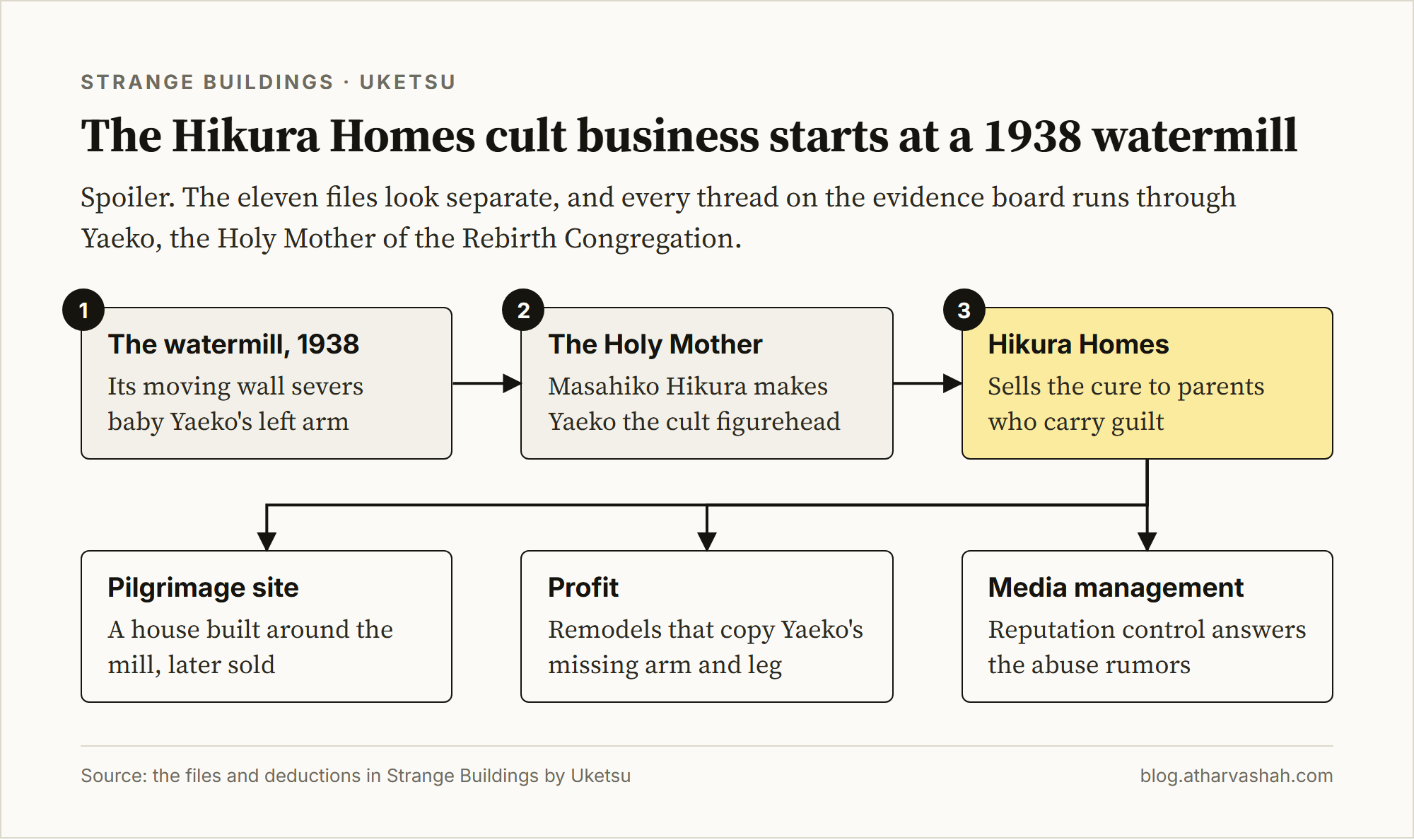
Masahiko Hikura founded the Rebirth Congregation and installed Yaeko as the "Holy Mother." His own family bought her from a brothel as a child. The congregation exploited parents who carried guilt over illegitimate children, affairs, or children born with disabilities.
Hikura Homes sold them an architectural solution: remodel the home to resemble Yaeko's mutilated body, so the child receives spiritual purification by sleeping in the building's "womb." The sacrament room was the uterus. The overnight stay was rebirth.
Kurihara traces Yaeko back to the watermill. Okinu gave birth to her inside the mechanical wall chamber. The wall reactivated as her dying mother tried to hide her, and it severed the baby's arm. Hikura Homes later bought the Nagano land and built a house around the watermill to create a pilgrimage site. When the cult dissolved, they sold the property as a residential house.
The Author tracks down Mitsuko Hikura from File 4. She confesses. On the night of her grandmother Yaeko's "accident," she hid Yaeko's prosthetic leg while Yaeko slept. She acted in self-defense, not on her parents' instructions.
Her parents were abusive and dangerous, and the one person in the house who protected Mitsuko was Yaeko. By killing the only person who cared for her, Mitsuko secured her own survival. She carries that calculus to this day.
Mitsuko's Confession Closes the Loop
Mitsuko's confession completes the novel's moral geometry. She was not following orders. She was a child who protected herself from abusive parents, eliminating Yaeko, the one person in the house who loved her.
Masahiko Hikura started the cycle of abuse when he bought a child from a brothel and installed her as a goddess. That cycle ends with his own granddaughter, who kills the only person who ever protected her.
Two Endings to the Kasahara and Matsue Story
Mr. Kasahara from File 8 is confirmed as "Uncle" from File 7. His suicide happened in the sealed room, with the strange doll and the photo of Naruki. Two events met there: the cult's collapse and his son's death. The cult was a fraud, and he could not save Naruki. He sealed the "heart" of his own shrine-house as a final act, a symbolic killing of the fiction that failed everyone.
Files 8 and 9 resolve the Matsue fire the same way, from two directions. Mrs. Matsue learned that her pregnancy with Kasahara's child would destroy her family, and she committed suicide. Mr. Matsue burned the house to destroy the forensic evidence of the affair. He hid no murder. He was protecting his son from the knowledge attached to both his parents' deaths.
The Clue Payoffs, and What File 6 Changes on a Second Read
A handful of details planted early in the book only make sense once File 6 names the Holy Mother's mutilated body as the cult's central icon.
The amputated wooden doll in the Negishi family's belongings (File 1) is the physical representation of Yaeko's mutilated body, and it marks Yayoi's mother as a cult member.
The mother's ban on the main road (File 1) traces back to a fear that a hospital blood transfusion would expose Yayoi's real paternity, not to the truck accident itself.
The Hikura Homes abuse rumor (File 2) is Masahiko Hikura buying an 11-year-old girl from a yakuza-run brothel, confirmed in File 10.
The windowless rooms, dead-end hallways, and blocked windows across Files 1, 5, and 11 all trace to the same source: the Rebirth Congregation's instruction to alter a home's architecture to match the Holy Mother's missing limbs.
Read in order, File 6 sits at the center of the book on purpose. Files 1 through 5 hand the reader an amputated doll, a mechanical wall injury, and a grandmother in long gloves with no explanation for any of them. A reader who finishes File 6 and goes back to reread those five files sees the same objects differently: no longer strange details a case happened to include, but a body shape the book was teaching the reader to recognize before it had a name.
Files 7, 8, and 9 read like three separate cases, but they cover the same neighborhood and the same night: a dying child's journal, then the daughter next door, then the son who lived through the fire. Geographic proximity turns three individually plausible theories, an alibi, a suicide, an affair, into three fragments of one event nobody involved could see whole.
Strange Buildings starts as a set of quirky, isolated puzzles about odd houses. By the time Kurihara finishes, every puzzle is a node in one corporation's business model. Houses are neutral. They mean what the people who design them intend. Hikura Homes decided to industrialize guilt and sell architectural penance as a product, and everyone who lived inside a house it touched paid for that decision in shame, fear, or money for the rest of their life.
Not every reader agrees that the eleven files pay off.
Strange Buildings is the most structural of Uketsu's three novels in the "Strange" series. It asks the reader to hold eleven separate cases in memory at once and trust that they connect. They do, and tracing that connection is the point: a company that sells floor plans can sell guilt through the same floor plans, and the people living inside them may never know which one they bought.