Who Is Uketsu?
Uketsu (雨穴, "rain hole") is a Japanese author and YouTuber. About 30 people know his real identity. In public he wears a white papier-mache mask and a black bodysuit. His voice never appears unfiltered. A voice changer handles that.
He lives in Kanagawa Prefecture and spent part of his childhood in Surrey, England. He worked at a supermarket when he started to post on YouTube.
His early videos were surreal. Asparagus turned into severed fingers, strips of raw meat hung on a washing line, and human ears spun on screen. In 2020, he posted a 21-minute mystery story built around a series of architectural floor plans. Readers and publishers told him to expand it into a novel. The result was Strange Houses (変な家, Hen na ie), published in Japan in 2021.
Strange Houses was the first novel. Uketsu followed it with Strange Pictures in 2022, then Strange Buildings in 2023, which is a direct sequel to this book. By 2024, three novels by Uketsu sat in Japan's top 10 fiction bestsellers at the same time. Pushkin Press published the English translation of Strange Houses in 2025. The breakout success of Strange Pictures had already primed the anglophone market for it.
The formal concept behind Strange Houses made Uketsu's YouTube channel successful. That concept treats architecture as a text. Read a house floor plan properly and it tells you things about its designers. They would never say those things aloud.
Why This Summary and Analysis Exists
No thorough English-language, chapter-level breakdown of Strange Houses exists. The book's premise sounds like a puzzle box, and it is one. The puzzle also runs deeper than most reviews suggest, in architecture and in psychology. This is the complete summary and analysis, from Chapter One through the Afterword.
This piece contains complete spoilers for the entire novel.
Chapter One: A Strange House
Plot Summary
The Author is a freelance writer who specializes in the macabre. His acquaintance Yanaoka approaches him. Yanaoka wants to buy a newly built two-story home in Tokyo for his growing family. Yanaoka has a problem.
On the first floor, between the kitchen and the living room, sits a section of the house that nothing opens into. That is a dead space, sealed on every side. Somebody built it in, walled it off and sealed it.
The Author lacks architectural training. So he brings the floor plans to Kurihara, an architectural draughtsman and fellow mystery enthusiast. Kurihara is methodical. He notes that somebody created the dead space on purpose. Two additional walls block it off, and they cost the kitchen part of its floor area. Why would a builder shrink a kitchen to seal off an empty section of the house?
Kurihara then directs the Author to the second floor. The child's bedroom is in the corner farthest from the staircase. It has no windows at all. An en-suite toilet means the child never needs to leave.
One route reaches the room, and that is a double-door vestibule. A pair of sequential doors makes an airlock-style buffer between the child's room and the rest of the house. Kurihara calls this design a solitary confinement cell. The architectural language communicates obsessive control over a child's movement and presence.
The contradiction: the parents' bedroom is bright and open. Their dressing room is completely exposed to the bed, with no privacy partition. And the house has 16 exterior windows, an unusual number for a residential build.
Kurihara reads the 16 windows as intentional. The house is performing normalcy to anyone looking at it from outside. All those windows say: nothing to hide here. Meanwhile, the interior hides its most important spaces completely.
The Author overlays the two floor plans and makes the key discovery. The walled-off dead space on the first floor aligns precisely with two corners, one from the child's windowless room and one from the windowless bathroom below it. Kurihara traces where it leads: straight up, a vertical tunnel connecting the two.
Kurihara constructs a scenario. The parents bring someone home, get them drunk, suggest a bath. The imprisoned child drops through a trapdoor in the bedroom. The dead space works as a vertical access shaft. The child enters the bathroom from below and kills the naked and defenseless guest.
Dismemberment occurs. Body parts pass back through the tunnel to a storage room near the garage. A vehicle takes them away.
Yanaoka pulls out of the purchase.
Shortly after, a dismembered body is found in the wooded hills near the property. All parts present except the left hand.
Architecture Testifies Before Anyone Does
A floor plan with a section walled off and left blank is the whole premise of this novel, compressed into one drawing. Uketsu makes architecture the antagonist and the floor plans the evidence, and the trick works because Kurihara cannot actually be certain. He is constructing a narrative from empty geometric shapes. He may be wrong. The dismembered body at the chapter's end does not confirm his specific murder scenario. It only confirms that something terrible happened near that house, and everything else is inference laid on top of a blueprint.
The chapter sets the template Uketsu repeats for the rest of the book: the Author presents a floor plan, Kurihara decodes it, and the two of them arrive at a horrifying conclusion together, one they cannot fully prove. The 16 windows are what lift the chapter from puzzle to statement. A house that decorates its exterior with abundance while hiding its interior in darkness has thought carefully about the optics of concealment, which means someone inside it already knew what the house needed to hide.
That decision to perform normalcy becomes the Katabuchi family's survival strategy for the rest of the book, foreshadowed here and confirmed later. The Katabuchis are the family who designed the Tokyo house, and Chapter Two names them. So does the missing left hand. The Author's first instinct is that the body was dismembered simply to fit through the tunnel's narrow passageways. That is a reasonable guess and a red herring. Chapter Four names the real reason: a ritual called the Offering of the Left Hand, which becomes the structural center of the novel's second half. The sealed dead space also foreshadows the jammed fusuma doors in Chapter Three and the broader pattern behind them, hidden passages as standard operating procedure across generations of one family.
Chapter Two: Another Warped Floor Plan
Plot Summary
Unable to let the case go, the Author publishes a vague article about the floor plans. He receives a letter from Yuzuki Miyae, an office worker from Saitama. Her husband, Kyoichi Miyae, vanished three years ago (in 2016). His body was recently found on a mountainside. The body was intact. His left hand was severed.
Yuzuki believes the murder connects to the Tokyo house. She found the floor plan of a home in Saitama where she believes the Tokyo family previously lived. The Saitama house was built in 2016 and recently burned to the ground.
The Author takes the Saitama floor plan to Kurihara. The similarities are clear. A windowless child's room sits on the second floor. A windowless bathroom sits on the first floor. A dead space connects them. But there are significant differences.
The Saitama house has no garage. This explains why Kyoichi's body was found intact rather than dismembered. The Saitama house had no good vehicle route for dismemberment and disposal.
The parents slept in separate single beds.
The child's room had only one door, not the double vestibule of the Tokyo house.
On the first floor sits a bizarre retrofitted triangular room. It has large windows, walls block those windows, and the room is completely useless. It occupies space that previously opened onto the garden.
Kurihara identifies the triangular room's function. Somebody built it over a section of the garden after the original building was complete. Below it, in what used to be open ground, is an excavated cellar used to store intact bodies. No garage needed. The cellar is the cold storage.
Then the Author visits the empty Tokyo house and speaks to a neighbor. The family's name was Katabuchi. They had a beloved one-year-old baby named Hiroto. They fled suddenly after the neighbor's husband spotted something at a window. He saw a pale, strange boy of about ten years old. The boy sat in the parents' bedroom window late at night.
Kurihara synthesizes the data. There are two children. The first is Child X, the imprisoned assassin in the windowless cell. The second is Hiroto, the infant the parents clearly adore. The timeline tells the story of the house's evolution. Somebody built the Saitama house for the parents and Child X.
When Hiroto was born, they added the triangular nursery room. That kept the baby separate from the murder mechanics. Later they designed the Tokyo house to manage both children at once. The heavy double vestibule stops X and Hiroto from ever sharing the same space. The double bed in Tokyo is for the mother and Hiroto. She becomes a human barrier between the infant and the door to X's room.
The Author presents these conclusions to Yuzuki. She breaks down when she hears the family fled. The Author confronts her. Kurihara has established that the real Kyoichi Miyae was a bachelor. The woman calling herself Yuzuki Miyae is not who she says she is.
She confesses. She is Yuzuki Katabuchi. The woman in the murder house, the mother of Hiroto and warden of X, is her estranged older sister, Ayano.
Two Houses Record One Escalating Crisis
The Saitama house and the Tokyo house record the same crisis at two different moments, three years apart. Each floor plan reflects the exact state of the parents' psychology at the time it was built, which is why the differences matter as much as the similarities. No garage, single beds, one door on the child's room: read those against the Tokyo house's garage, double bed, and double vestibule, and the escalation is a family adapting its architecture to an expanding moral problem, not repeating one.
Yuzuki's false identity runs the same trick as the houses. She presents a false floor plan of her own life to reach the investigation, and the Katabuchi family builds false floor plans to hide their crimes. Even the humans in this novel perform spatial deception, not just the buildings.
Hiroto's arrival does more damage to the reader's assumptions than anything Kurihara has decoded so far. The parents are not simply sociopathic architects running a murder factory. They also raise a baby with apparent tenderness, building him a sunny nursery and sleeping close enough to keep him safe. Both things are true inside the same square footage, and the book has no interest in resolving which one is the real family.
The Vestibule's Meaning Changes on a Second Read
The double vestibule's meaning shifts decisively here. In Chapter One, it read as a mechanism to keep the imprisoned child inside. In Chapter Two, it becomes a quarantine to keep that child away from the innocent infant. The architecture has not changed. The interpretation has, and that is the novel's own structural project running one level up: the same floor plan means something different on the second pass.
Chapter Four explains the pale boy seen through the window. He is Momoya, the imprisoned child, and he uses the hidden passage to reach the mother's room, where he places a damp cloth on the feverish baby's forehead. His goal was never to kill. This is the first sign, three chapters early, that Momoya is a boy and not the killer the setup trained readers to expect.
Chapter Three: Drawn From Memory
Plot Summary
With her deception exposed, Yuzuki Katabuchi shares a piece of her family's history that she has never told anyone. In 2006, her extended family gathered at the ancestral Katabuchi estate in the mountains. The estate is large and highly symmetrical. A long central corridor divides it evenly. A massive, immovable black Buddhist altar stands at the exact midpoint.
During that stay, Yuzuki's seven-year-old cousin Yoichi was found dead in front of the altar. His head was covered in clotted blood. The family ruled it an accident, because he must have climbed the altar and fallen. They also suppressed his mother Misaki's attempts to call the police.
Kurihara analyzes Yuzuki's hand-drawn floor plan of the estate. He identifies several anomalies. All the rooms on the right side of the house lack windows entirely. A set of fusuma (Japanese sliding doors) is permanently jammed shut. Kurihara traces the structure's hidden layout.
A confinement room sits behind the altar. One route reaches it, and that is the secondary passage masked by the jammed fusuma.
His reconstruction: a family member took Yoichi in the night and pulled him through the passage into the hidden confinement room, which had no windows and muffled sound completely. He killed him there, then placed the body at the altar to stage the accident.
No police investigated the death. The family closed the matter cleanly.
Yuzuki acknowledges this. Her own father was likely responsible. He worked to manipulate the family's line of inheritance. The plan surrendered her sister Ayano to the main Katabuchi family. They indoctrinated Ayano and tasked her with serving as a warden for disabled children.
Her father eventually lost his mind and died by suicide.
The Estate the Family Couldn't Stop Building
Chapter Three shifts the novel from modern procedural mystery into Gothic horror, and the transition is earned, because it answers a question the first two chapters never asked: where did any of this come from? The ancestral estate is the architectural origin myth. The jammed fusuma, the hidden room, and the windowless wing aren't recent innovations. They're centuries of accumulated spatial habit passed down like a family trait.
The altar at the center of the house does real symbolic work rather than merely looking ominous. It sits at the geometric center of the corridor, so every walk from one end of the house to the other passes around it. The family cannot cross its own home without acknowledging what stands at its middle. Ancestral weight becomes something you physically have to route around.
Yuzuki's father is the chapter's most tragic figure precisely because he is ordinary. He committed a monstrous act while believing he protected his family, and the delusion did not survive contact with what he had actually done. He reads as an early, less patient version of Keita, the man Chapter Four spends far longer trying to understand.
The estate is the direct architectural prototype for every house in the novel. The jammed fusuma is the same hidden-passage system the modern Tokyo and Saitama houses reuse. The windowless rooms on the right side of the estate become the template every later Katabuchi dwelling copies for its child's prison, and the confinement room behind the altar is the prototype for the whole murder-tunnel concept. The family did not invent any of this. They inherited it, and nobody in three generations found a way to stop building it.
Chapter Four: House of Chains
Plot Summary
The Author and Yuzuki visit her estranged mother, Yoshie. Yoshie produces a letter. Ayano's husband, Keita, wrote all of it as a complete confession to the history of the Katabuchi family's madness.
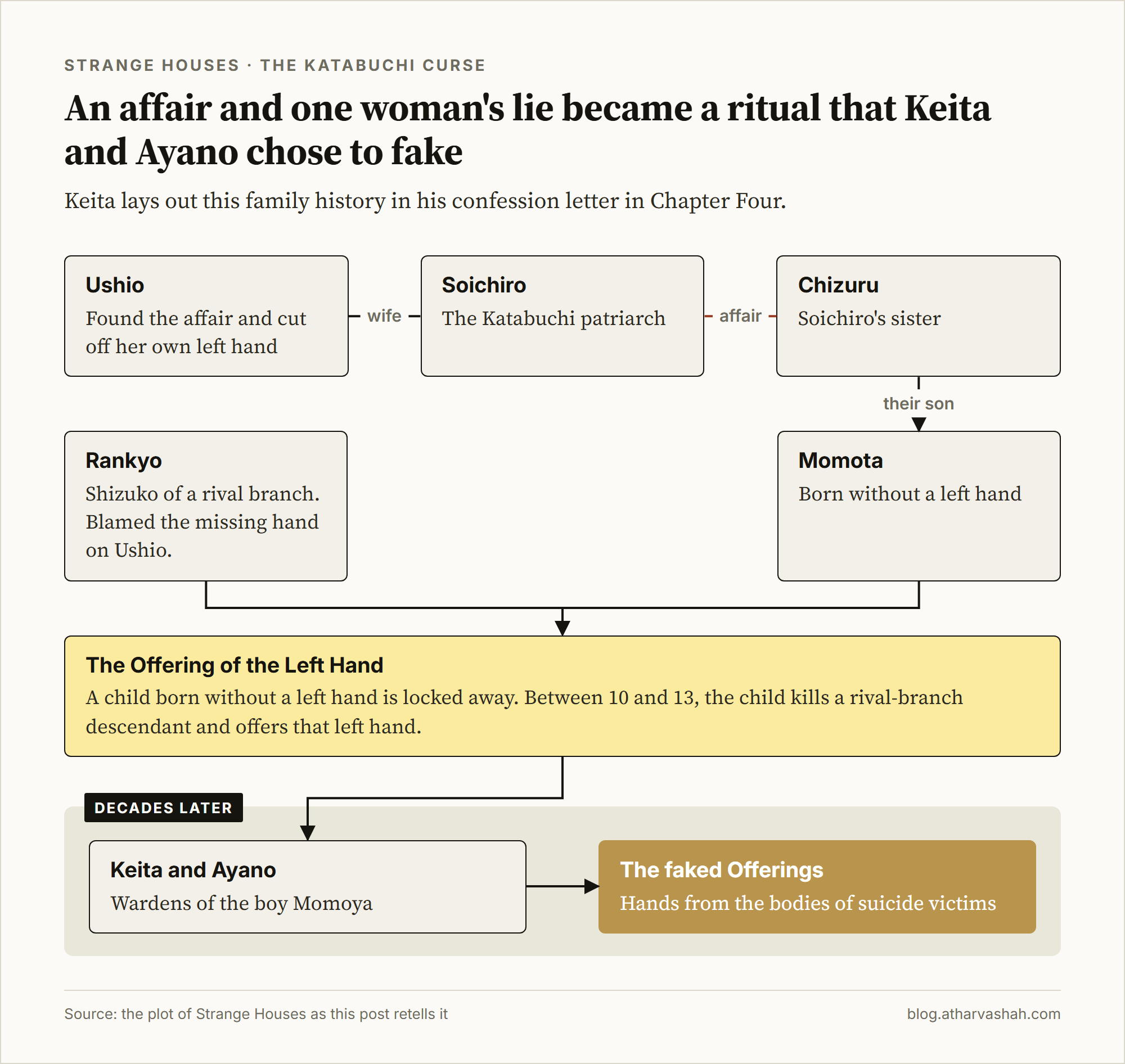
The origin: decades ago, the Katabuchi patriarch Soichiro entered into an incestuous relationship with his own sister, Chizuru. Soichiro's neglected wife, Ushio, discovered the affair and, in a state of dissociation, severed her own left hand. Shortly after, Chizuru gave birth to a son, Momota, who was born missing his left hand.
The curse attribution: a manipulator named Rankyo convinced Soichiro that Momota's deformity was Ushio's supernatural punishment. Rankyo was actually a woman named Shizuko from a rival branch of the family, and she orchestrated generational revenge. Rankyo established what became the Offering of the Left Hand. Any Katabuchi child born with a missing left hand must be imprisoned from childhood. Between the ages of 10 and 13 that child must murder a descendant of the rival branch, then present the victim's severed left hand at the family altar.
Enter Keita and Ayano, the present-day wardens assigned to a disabled child named Momoya. They refused to become killers. They built the Saitama and Tokyo houses as theatrical sets that simulated compliance with the ritual and faked it entirely. Keita scavenged the intact bodies of suicide victims.
One was Kyoichi Miyae, a bachelor who jumped from a bridge. Keita presented their severed left hands to the family enforcer, Kiyotsugu, as the required Offerings.
The deception holds until Kyoichi's body surfaces and the police investigate. Kiyotsugu confronts Keita: he knows the rituals were faked. He threatens to take Momoya back to the main family compound and force the boy to perform an actual murder.
During this confrontation, Momoya escapes his room through the hidden passage. He does not go to the bathroom. He goes to the mother's room, where the feverish baby Hiroto lies sick in bed. Momoya places a damp cloth on the infant's forehead and stays with him until the fever breaks. The neighbor who glimpsed the pale boy at the master bedroom window saw Momoya nursing a sick baby.
Keita kills Kiyotsugu. Then he kills the family patriarch, Shigeharu. He takes full responsibility and disappears, leaving his wife and children with the story that absolves them.
Keita Builds the Same Prisons to Save Instead of Kill
Keita and Ayano spend three chapters looking like the monstrous wardens of a murder house. Chapter Four spends its entire length insisting they, and the child they guarded, were prisoners of the same architecture. The structures were designed to imprison and kill. Keita repurposed them into a theatrical prop, a stage set for a performance of compliance that kept his family alive.
He is the inverse of every Katabuchi ancestor before him. They built prisons to enforce the ritual. He built identical prisons to fake it. The structural language is the same. The moral content is opposite, and that is the whole argument of the chapter compressed into one man's floor plan.
Momoya nursing the sick baby does more damage to the reader's assumptions than any single reveal so far. The narrative spent three chapters training readers to see him as a dangerous unknown, a pale figure glimpsed through windows, the engine of a murder factory. He is 10 years old and he has never killed anyone. The first time he escapes his room, he tends to a sick infant.
The catharsis here is deliberately incomplete. Keita's disappearance resolves nothing except the immediate threat. The houses are destroyed and the enforcers are dead, but the family structure that produced the ritual continues, and so does the incestuous origin story underneath it.
Every Missing Hand Is Accounted For, Except One
Only one of the two severed left hands from the early chapters now has an explanation. Kyoichi's came from a scavenged suicide victim, presented as an Offering. What Keita's letter never explains is the unidentified body from Chapter One, the one whose missing left hand started this whole investigation. His confession resolves the Kyoichi case and deliberately leaves that first one open.
By Chapter Four, the double vestibule's function is settled: quarantine in two directions. It protected Hiroto from what sat behind that door, and it protected Momoya from the full weight of how differently the two children were being raised.
Afterword: Kurihara
Plot Summary
Kurihara meets the Author one final time. He says the investigation is finished, except for one thing.
He points to a detail in the Tokyo house floor plan that nobody examined: a small interior window between the living room and the first-floor bedroom.
The Window Nobody Checked, Including Me
Interior windows destroy privacy. They exist for one purpose, observation. Keita's letter describes a man who built the houses to protect his family. Kurihara asks whether Keita was a prisoner himself, watched constantly by Ayano through that same window.
I had the floor plan of the Tokyo house from page one of this book, and I missed that window too. That is the real trick of the Afterword: after two hundred pages spent earning a comfortable ending, Kurihara hands the reader evidence they already had and asks why they stopped reading it. I do not think the sacrifice-and-redemption reading of Chapter Four collapses under this. It just has to share the page with an uglier one now, and Uketsu never picks a side between them. That refusal is the strongest writing in the book, stronger than any single reveal in the four chapters before it.
Kurihara also notes the other unresolved thread: the dismembered body from Chapter One remains completely unidentified. Keita's confession accounts for Kyoichi Miyae's intact body. It says nothing about the person who was dismembered, whose left hand is somewhere nobody has looked.
The interior window loops the novel back to its own opening instruction, look at the floor plan again, something is wrong, you missed it. The reader had the Tokyo house's floor plan from Chapter One. The window was there the whole time.
The novel does not close.
How the Ending Reframes the Beginning
Strange Houses begins as a cool, clinical puzzle about malevolent architecture. By the end, it is a study in how generational trauma becomes structural. The incest and suicide of the founding generation produced a deformed child. The deformed child produced a ritual. The ritual produced a building type. The building type became tradition, and the tradition imprisoned every generation that followed, because nobody in the family ever found a way to say stop.
Keita's theatrical set is the first act of genuine refusal in the entire lineage. He built the same kind of structures his ancestors built, and he built them to protect a child instead of destroying one. The structures looked identical. The moral content underneath them was entirely different, and that distinction costs him everything.
Five Chapters, Each Zooming Out Further
Chapter One stays inside one house and one unsolved detail, the floor plan with a section that shouldn't exist.
In Chapter Two, a second house forces a second timeline, and the two floor plans start to argue with each other. The chapter introduces the human beings behind the architecture for the first time.
In Chapter Three, the estate that started it all holds one murdered child and one room built to hide the killing. The novel zooms back decades to the source of the family's obsession.
Chapter Four zooms out all the way. It lays out the complete family tree and the complete history of the ritual, and it explains every house in the novel. The houses were not designed by killers. They were designed by trapped people, in houses that had already designed them.
The Afterword zooms in on one small window and one question it raises. The floor plan of the entire novel gets pulled back one more time, to reveal a dead space the reader walked past five times.
The English translation of Strange Houses (Pushkin Press, 2025) embeds the original floor plan diagrams in the text as intended, and that matters. This is a novel you read with a pen, because the floor plans work as evidence rather than illustration.