



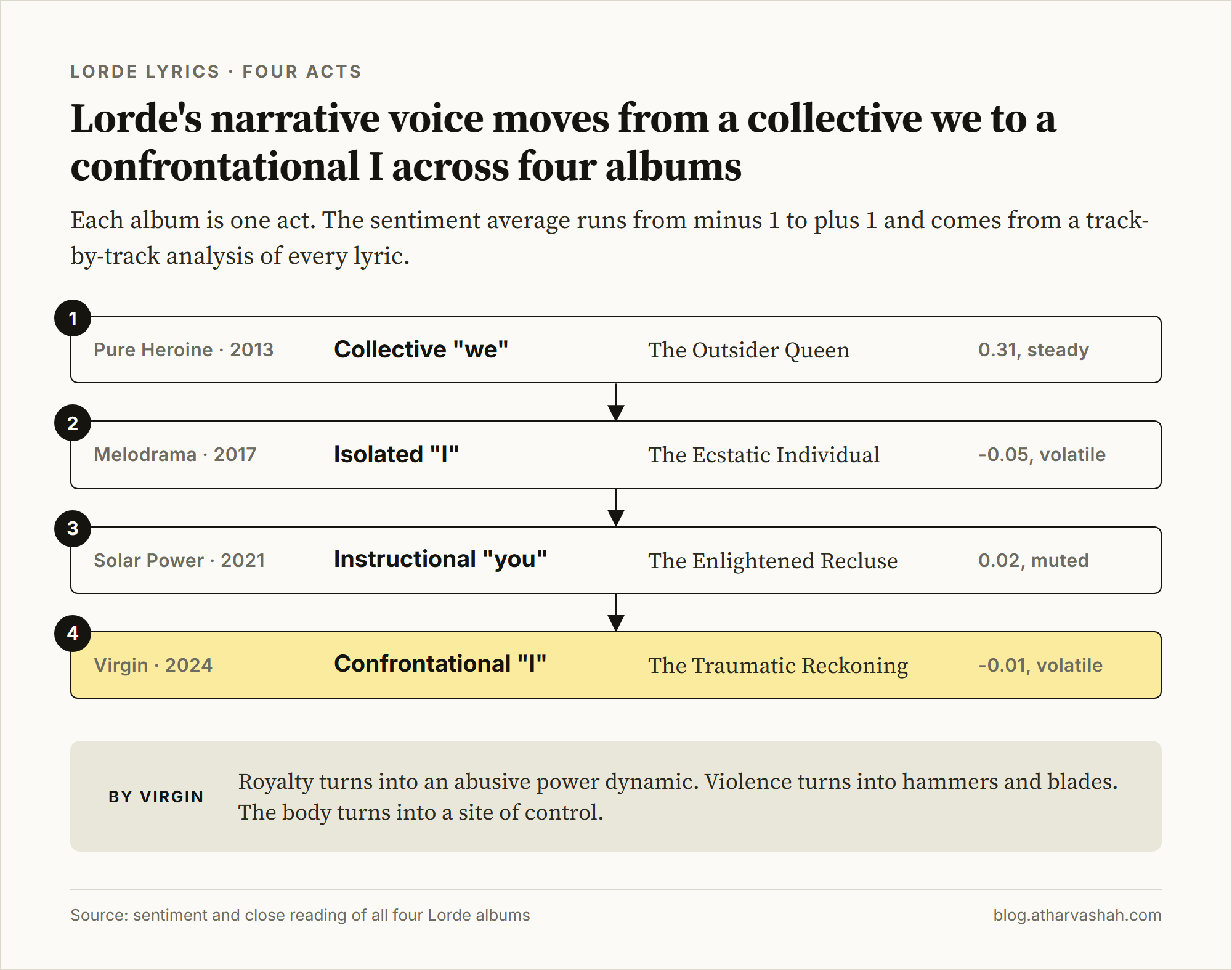
Lorde spent four albums becoming the thing her first album attacked. The pronouns give it away before the lyrics do. "We'll never be royals" in 2013 was a collective, a suburban teenage we drawn deliberately against celebrity culture. By the fourth record the we is gone. What remains is a fractured first person with no one beside it.
PREFER WATCHING A VIDEO ESSAY INSTEAD? HERE YOU GO!
Run the complete discography through computational text analysis and that shift is the strongest signal in the data. It reads as a character arc rather than a set of sonic reinventions. The arc runs from outsider to survivor and from critique to confrontation. Each album is a consequence of the one before it, so the story could not arrive in any other order.
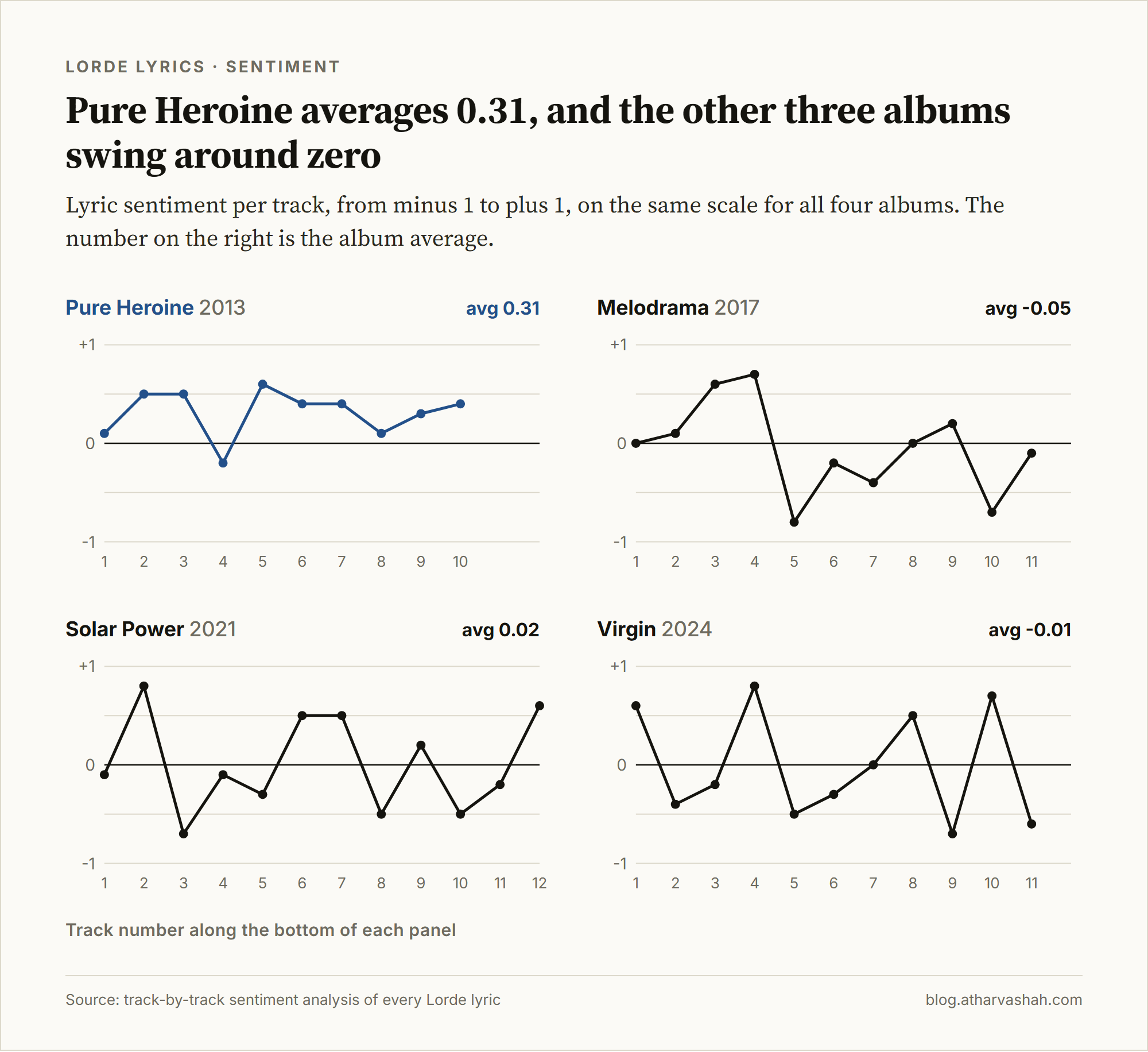
The arc shows someone digging out something buried, not someone mellowing with age.

The Four Acts of Lorde
Act I: Pure Heroine (2013), The Outsider Queen

The debut is a minimalist manifesto. The world it constructs is insular: suburban parking lots, driving at night with friends, boredom as a lifestyle. The pronoun of choice is "we," as in "we're on each other's team" from "Team." This is a defensive posture. The outside world, represented by the luxury brands name-checked in "Royals" (Grey Goose, Cristal, Maybachs), gets rejected collectively.
But beneath the defiance lurks anxiety. In "Ribs," she confronts the terror of time's passage with visceral clarity. The future is inevitable, adulthood is coming, and this moment of adolescent brotherhood can't last. The album's core tension runs between Lorde and time itself. Sentiment analysis across the ten tracks averages +0.31, the most positive score of the four records, because the us-versus-them framing gives the defiance somewhere safe to stand. The voice stays "we" from "Royals" through the closing track, "A World Alone."
Act II: Melodrama (2017), The Ecstatic Individual

The collective shatters. Melodrama follows a solitary "I" through the wreckage of a relationship, and the house party becomes a grand metaphor for one night running from ecstatic arrival to lonely comedown.
In "Homemade Dynamite," love is reckless and dangerous. In "The Louvre," it's grand enough to hang in a museum. But by "Liability," she's alone in a taxi, too much for anyone to handle. The writer in the dark from the album's eighth track knows her art is both weapon and wound: she'll immortalize this pain, and her ex will regret it.
The volatility here is the point. Sentiment swings from +0.7 on "The Louvre" to -0.8 on "Liability," a range wide enough that the -0.05 average hides more than it shows. The spread, not the mean, is the album's real signature.
Defining tracks: "Green Light," "Liability," "The Louvre," "Writer In the Dark" Narrative voice: Isolated "I"

Act III: Solar Power (2021), The Enlightened Recluse

After Melodrama and the pressures of fame, Lorde retreats. The party ends. The beach begins. Solar Power trades neon for natural light and celebrity for mock-spiritual tranquility, and the sentiment score flatlines at +0.01. The flat number comes from muting, not from balance: the highs stop being ecstatic, and the lows stop being crushing.
The opening track, "The Path," rejects the savior role fans and critics gave her. She won't take calls from the label or the radio. The title track positions her as something like a guide, a prettier Jesus who opted out of the game entirely. "Fallen Fruit" addresses generational inheritance directly: the dreams of earlier generations were too big, and the consequences land on the generation after. The pronoun shifts again here, from Melodrama's wounded "I" to an instructional "you" that keeps the listener at arm's length. Four songs carry this arc: "The Path," "Solar Power," "California," and "Oceanic Feeling."

Act IV: Virgin (2024), The Traumatic Reckoning

Virgin answers Solar Power's peace with trauma. The retreat came from somewhere. This album reframes Lorde's entire career, suggesting her early critique of "luxe" operated as self-protection all along.
The central revelation lands in "David," an allegorical confrontation with an abuser: was she just material to exploit? The admission that follows is worse than the question. She made this person God because it was all she knew how to do. Lorde gave the real-world version of that line to Rolling Stone in 2025, describing a pattern that ran through her adult relationships: always choosing someone to be "God." The song's title never once appears in its own lyrics, which is about as close as the album gets to naming the person without naming him.
The motifs that once defined her take a darker twist. Royalty becomes a power imbalance. The body once celebrated in dance and sun becomes a site of obsessive control: in "Broken Glass" she describes a summer lost in math and in making weight, and in "GRWM" she ties her physical form to inherited pain, down to her mother's trauma. The once-romanticized imagery of violence, where glory and gore were synonymous, turns literal here: hammers and blades replace metaphor outright. The sentiment average lands at +0.08, barely positive, and every point of it is earned through confrontation rather than avoidance. The album's arc runs through four songs: "David," "Hammer," "Broken Glass," and "Man of the Year."

The Lorde Universe at a Glance


The Lines That Carry the Argument
Twenty lines made the original shortlist for this piece. Six of them carry the argument the rest only illustrate.
"I made you God 'cause it was all that I knew how to do," from "David," is the sentence the whole album reorganizes itself around. It turns a metaphor the catalog has used since "Royals" (power, worship, hierarchy) into a literal confession: she built a religion around a person because she didn't know another way to hold on.
"Was I just young blood to get on tape?" from the same song, asks the question the God line then answers. Read in order, the two lines are the album's real thesis, stated first as accusation and then as guilt.
"Baby really hurt me, crying in the taxi," from "Liability," does more in five words than most of the record's longer verses. The scene is specific enough to picture and vague enough to belong to anyone who has ever had it.
"It drives you crazy, getting old," from "Ribs," is Pure Heroine's plainest statement of what the whole record is actually afraid of. Most sixteen-year-old narrators don't write this directly about mortality.
"Bet you rue the day you kissed a writer in the dark," from "Writer In the Dark," turns songwriting into a threat. The relationship ends, but she keeps control over how it gets told to the world.
"When you're holding a hammer, everything looks like a nail," from "Hammer," names the album's own method. That line is the closest Virgin comes to explaining why trauma reorganizes how a person reads everything that happens after it.
The other fourteen lines still matter. They cover the rejection of California, the wait for a green light outside a party, the toy that people enjoy, the axe that fells a person clean as a pine. But these six are where the argument actually lives, and everything else on the shortlist is decoration around them.
How Lorde's Symbols Evolve
Lorde reuses a small set of images across four albums, and the same symbol rarely means the same thing twice.
Light starts as an external goal, the green light Melodrama chases for forty minutes, becomes an all-encompassing environment on Solar Power, and fractures into specific, memory-sized flashes on Virgin and the songs that followed it.
Violence carries the longest arc in the catalog. "Glory and Gore" romanticizes it as teenage bravado. "Homemade Dynamite" weaponizes it as love. "The Man with the Axe" domesticates it, being felled like a tree by someone gentle. Virgin drops the metaphor and names the tools directly: hammers, blades, an admission that the damage was real.
Royalty and divinity move in one straight line, from a youthful metaphor for power ("we'll never be royals") to a burden imposed by fans and critics, to a dark symbol of an abusive dynamic in "David."
The body resists a clean arc more than any other symbol here. It is defiant in Pure Heroine, celebrated in Melodrama, quietly questioned in Solar Power's aging and changing, and by Virgin it has become a site of weight, control, and trauma passed down a generation.
Water barely shows up before Solar Power. Pure Heroine's suburbs are landlocked. Melodrama's party is urban and dry. Then it takes over: the beach spirituality of Solar Power, carried into Virgin as a place for cleansing and memory.
The Real Places and Products Behind the Lyrics
Lorde's lyrics are unusually specific about place and product. She names Grey Goose and Cristal in "Royals." She rejects California by name. The Louvre, in her telling, is where great tragic romances belong, not just where the Mona Lisa hangs.
Places that matter:
The Louvre (Paris), California/Hollywood, Canal Street (NYC), Baby’s All Right (NYC music venue), Indio (Coachella), Bulli (Australian beach town), Jungle City Studios (where Melodrama was made)
People referenced:
Dexta Daps (Jamaican artist in “Current Affairs”), Robyn (Swedish pop legend in “Secrets from a Girl”), Carole King and Uma Thurman’s mother (in Solar Power), and the allegorical David (biblical giant-slayer inverted)
Products & substances:
Beyond the luxury brands of “Royals,” we get MDMA explicitly named in “What Was That,” Clearblue pregnancy tests as song titles, pseudo-ephedrine in “Writer In the Dark,” OxyContin in “The Path,” Supreme clothing in “California”
These are anchors, specific enough to feel real, symbolic enough to mean more than themselves.
The Emotional Arc From Confidence to Confrontation
Sentiment analysis and close listening agree on one thing: this discography swings between extremes, then narrows toward almost nothing, then swings again.
Pure Heroine holds a steady +0.31 because the us-versus-them mentality holds. The outside world may be threatening, but the internal team stays strong the whole record.
Melodrama nets out at -0.05, and the average hides the whiplash underneath it: +0.7 on "The Louvre" against -0.8 on "Liability." That's the album's title working exactly as promised, feelings so big they border on parody, except they're real.
Solar Power flatlines near zero at +0.01, not because the record is balanced but because it's muted. The highs stop being ecstatic and the lows stop being crushing.
Virgin returns to volatility and ends positive at +0.08. "Broken Glass" drops to -0.7 and "David" to -0.6, while "Man of the Year" climbs to +0.8. She confronts the trauma instead of avoiding it, and the positive average is the receipt for that confrontation.
The Devices Lorde Reuses Album to Album
The whole discography hinges on pronoun usage: "we" in Pure Heroine, "I" in Melodrama and Virgin, an instructional "you" in Solar Power. Track the pronoun and you can track the story without reading a single lyric.
Color does similar work. Green lights, red and blue veins, acid-green aquamarine, the blue light of bars: color carries memory and emotional weight across four albums that otherwise sound nothing alike.
Place as metaphor. The Louvre stands for grand romance. California stands for toxic aspiration. The suburbs stand for outsider identity. Named New York locations mark trauma and memory specifically enough to look up on a map.
Religious and royal imagery juxtaposes divine or royal status against vulnerability throughout, from "Royals" to "savior" to "I made you God." It's the one device that runs unbroken across all four records without changing shape.
The violence imagery gets its full treatment in the symbols section above, so it isn't repeated here. Four devices, one habit: Lorde keeps building with the same small set of tools and asking them to carry heavier weight each time.

The Arc Bends Toward Confrontation
Read the four albums as one narrative and a single story emerges. A young woman builds a protective identity around critique and distance. She meets the chaos of vulnerability. She attempts peace through retreat. She finally confronts the trauma that made the retreat necessary in the first place.
That trajectory is messier than the standard arc from wild youth to mature wisdom. Peace, in this catalog, needed the buried pain dug up first.
Lorde's own account backs the data up. The pattern she named in that 2025 interview, always choosing someone to be "God," is the same pattern the pronouns and the sentiment scores trace across four records: whoever she attached to eventually became the person she had to survive.
She started as a queen who ruled a world of suburban make-believe. She ends as a woman who rebuilds herself after that fantasy shattered. The distance between the teenage outsider and the adult survivor exposes what "Royals" could not see at sixteen: the power dynamics she mocked from the outside looked far more predatory once she was inside one.
Paid Subscribers Get the Complete Data Set
Paid subscribers get the line-by-line sentiment scores behind every number in this piece, plus the full reference database of every person, place, and product named across four albums. The methodology behind both is included too, so you can check the +0.31 and the -0.8 yourself instead of taking them on faith.
This analysis belongs to a series that uses computational text analysis on complete bodies of work. Each essay rests on a full lyrical analysis, sentiment mapping, and thematic clustering across the artist's work.
Related reading: Beach House Lyrics Analyzed by AI and How Spotify's Recommendation Algorithm Works.

Computational text analysis was a brilliant lens. Truely insightful.
Curious about this framing: why position the tension with time as the 'real' one versus the tension with mainstream pop? Couldn't both be equally central to the album? I'd love to see Lana Del Rey's sentiment analysis, but I guess all of her songs carry the same sentiment.