



Most artists think Spotify is a lottery. Spotify is a machine. You can study how it works.
100,000 New Tracks Land on Spotify Every Day
675 million users need music.
The real question is not "Will anyone hear my song?" The real question is "Will the right people hear it?" Spotify's whole system exists to answer that question, billions of times a day.
If you are an artist chasing your first real break on Spotify, that question is the one worth studying. Pay attention to how the system decides.
There Is No "The Algorithm"
Stop saying "the algorithm." Spotify runs dozens of algorithms, not one.
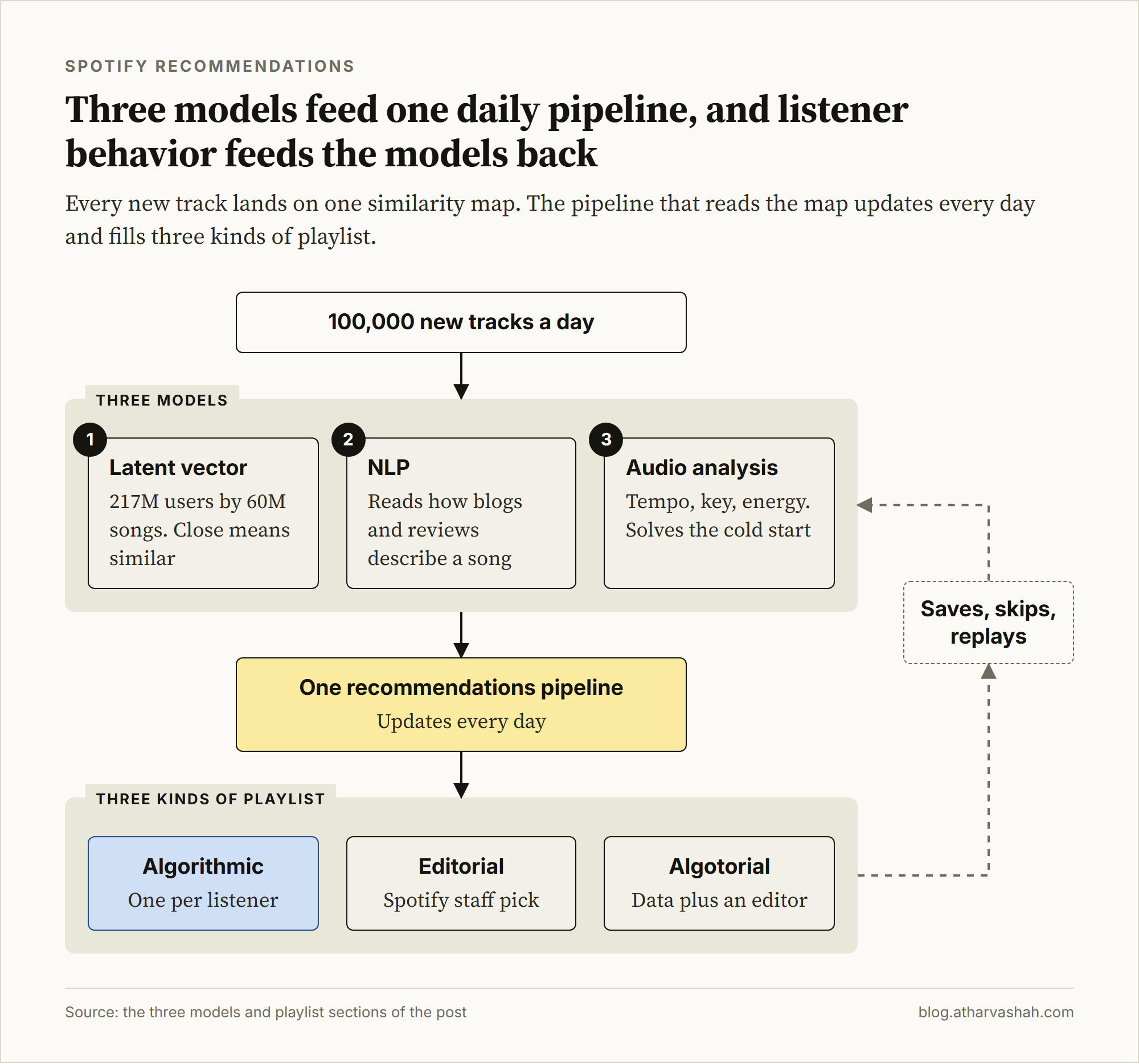
They feed into a single recommendations pipeline that updates every day. This pipeline builds Discover Weekly, Release Radar, Daily Mix, and every other personalized surface you see.
Systems, not human curators, generate these playlists. They predict what you will enjoy based on similarity and behavior.
The Algorithmic Playlist Does the Heavy Lifting
Spotify sorts recommendations into three kinds of playlists, and they do not carry equal weight.
Algorithmic playlists are fully automated. Spotify builds one for each listener, and it scales with no ceiling. On raw stream count, an algorithmic placement can beat an editorial one by as much as 300,000 streams.
Editorial playlists are curated by Spotify staff. They carry real credibility, and they are hard to land. They help visibility, but they do not always drive volume.
Algotorial playlists sit between the two. An editor starts from data signals, like saves and shares, then hand-picks from there.
Of the three, the algorithmic playlists are where sustained growth happens.
Spotify Weighs Intent Over Stream Count
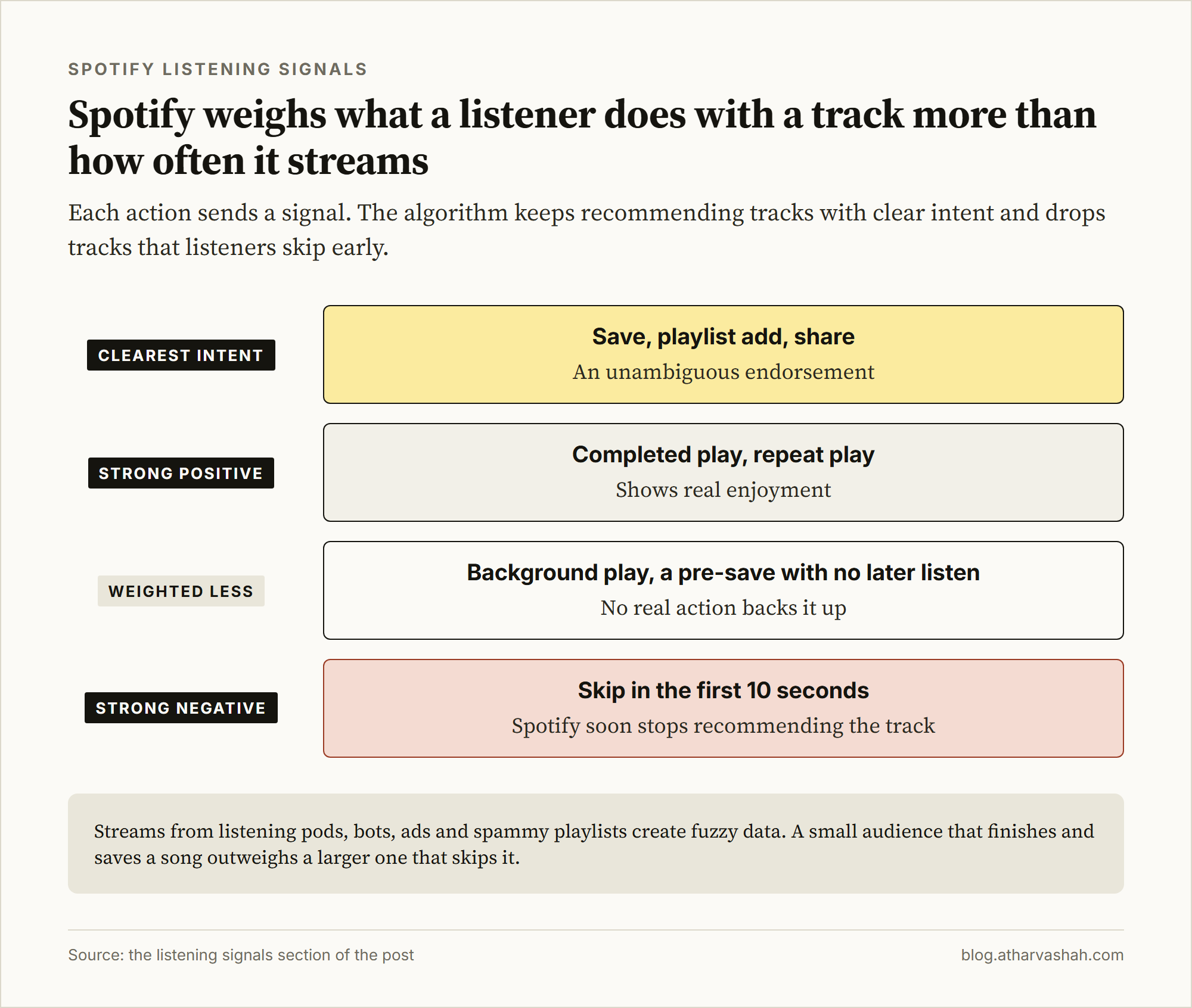
Stream count is not the primary metric. Spotify cares about behavioral intent instead.
A skip within the first 10 seconds counts as a strong negative signal, and the algorithm quickly stops recommending that track. A completed play, especially a repeat play, counts as a strong positive signal, because it shows real enjoyment. A playlist add, a save, or a share counts as an unambiguous endorsement, the clearest high-intent action a listener can take. Passive listening, the kind that plays as background noise, gets weighted less, because no real action backs it up. Time of day, session length, and listening context work as environmental metadata, and they help Spotify read the mood around a listen.
A track that listeners skip early and rarely finish gets deprioritized, even when its stream count looks high. The system optimizes for satisfaction, not raw plays.
Three Models Place Every Song on One Map
Every song, user, and artist sits inside a dynamic system that updates daily. Three models build that system.
1. The latent vector model maps similarity
This is the foundation.
Spotify maps every song, user, and artist in multidimensional space, using matrix factorization across billions of data points. Think of it as a massive grid, where being close together means being similar.
The matrix has roughly 217 million rows for users and 60 million columns for songs. Each cell marks whether a user has streamed a track.
From this, Spotify calculates closeness. Say you've played the same 100 songs as someone else, but not the 101st. Spotify assumes you might like that one too.
Erik Bernhardsson, who built Spotify's early recommendation system, explains how it works.
You can even do math on music styles. Nirvana + Clapton - grunge = acoustic blues rock. The system finds it.
2. The NLP model reads how music gets described
Spotify also reads how music gets described, the same way it reads how you behave.
A Natural Language Processing model reads blogs, reviews, forums, and social media. If multiple sources describe your song as dark, cinematic, or Trent Reznor-esque, those terms shift your position in vector space, the similarity map the first model builds.
PR matters. The algorithm reads that coverage. Editors do not need to.
Ten blog mentions can shift your music closer to major reference artists inside Spotify's internal map.
3. The audio analysis engine solves the cold start
A brand new track with zero plays presents a real problem, known as the cold start. Spotify solves it by listening to the track directly.
It analyzes the waveform and the spectrogram, and estimates:
Tempo
Key
Pitch
Chord progression
Melody
Energy and aggressiveness
This is how Spotify recommends a completely new song before anyone has heard it. The output feeds into the latent vector model, giving the song an approximate location on the map.
Upload at least 7 days before release. That gives the system time to analyze the audio signature and include the song in Release Radar when it drops.
Quality of Engagement > Quantity of Streams
The most misunderstood idea in Spotify marketing is simple. More streams are not always better.
If your streams come from uninterested listeners, ads, listening pods (groups of artists who stream each other's songs), or spammy playlists, you create fuzzy data: skips, low replays, and no saves. The algorithm cannot confidently tell who will enjoy your music, so it stops recommending it.
What you want instead is clean data: streams and saves from people who actually enjoy your music. Even at a smaller scale, the system can learn who your real audience is, and then expand from there.
A small audience that finishes and saves your song outweighs a larger one that skips it.
Four Things You Control Before Release
The first 30 seconds decide whether a stream counts at all. Spotify only pays out, and only registers the stream algorithmically, after 30 seconds. A drop-off before that point counts for nothing.
A steady release schedule keeps your profile visible. Releasing every 4 to 6 weeks keeps your artist page active inside the system.
An early submission window helps your odds. Submit to Spotify for Artists at least 7 days before release, and you get considered for Release Radar and for editorial slots.
Former Spotify data alchemist Glenn McDonald on how few followed artists Release Radar actually surfaces.


Accurate metadata matters. Choose the right genre and mood tags, because Spotify uses those tags to decide which audiences to test your music with.
Pre-Saves Are Overrated
Pre-saves create anticipation, but Spotify weighs them cautiously. A pre-save without a later listen might signal hype rather than real interest, and Spotify may discount that signal if the listener never follows through.
The better move is using pre-save campaigns to find fans who are already excited, then getting them to finish the song once it drops. The listen after release pushes a track forward. The pre-save alone does not.
Your Profile Matters
A verified Spotify for Artists account unlocks features that feed directly into the algorithm.
Upload a real bio and artist image.
Feature a song or playlist through Artist Pick.
Connect tour dates and merch.
Build your own playlists.
When you curate a playlist or engage with your own music on the platform, Spotify reads that as a confidence signal. Pitching directly to editors through Spotify for Artists helps too, but do it early, so the algorithm and the editorial team both get time to process your submission.
Gaming the System Always Backfires
Some artists reach for shortcuts.
Buying playlist placements.
Joining listen pods.
Running traffic through botted ads.
Each of these raises your stream count for a while, but they pollute your data. Once the algorithm links your track to disinterested or mismatched listeners, that association is hard to undo. Spotify learns to treat your music as unrecommendable, and it can no longer tell who actually likes it.
Recovering from that can take months of clean engagement, even after you stop the shortcuts.
Spotify offers its own paid promotion tools as the sanctioned alternative.


Build a System, Not a Hack
Spotify rewards a feedback loop. It does not reward a single viral moment.
The more clearly the system understands who loves your music, the better it can serve you to people just like them. That takes time. Most sustainable growth on Spotify plays out over 24 to 36 months. Consistency and intent matter more than any single trick.
This is not a game you win overnight.
This is a system you learn to work with.
And once you understand it, the machine works for you.
The System Rewards Patience, Not Popularity
Algorithmic playlists do not ask how famous you already are. They ask whether the data around your track is clean.
Feed the system clean data, and skip the growth hacks. That is how you earn long-term trust with the platform.
Your position in that matrix moves with what you skip and what you replay. The map already holds roughly 217 million listeners and 60 million songs. Feed it clean signals, and it finds your people.
Related reading: Beach House Lyrics Analyzed by AI and Lorde Lyrics Analyzed: Data From Every Album.



Most artists misunderstand how discovery actually works. This should be required reading.
Here's the TL;DR version of this:
• Spotify optimizes for engagement, not raw streams.
• Skips and saves matter more than play counts.
• Bots permanently damage recommendation signals.
• The system learns listener taste clusters over time.
• The right audience compounds discovery.