



Seven of Beach House's eight albums sound like comfort and read like a trap. I ran seventeen years of lyrics through a sentiment model, then read every result by hand, and the prettiness fell away. What remains is a body of work about fate, illusion, and the failure to escape.
PREFER WATCHING A VIDEO ESSAY INSTEAD? HERE YOU GO!
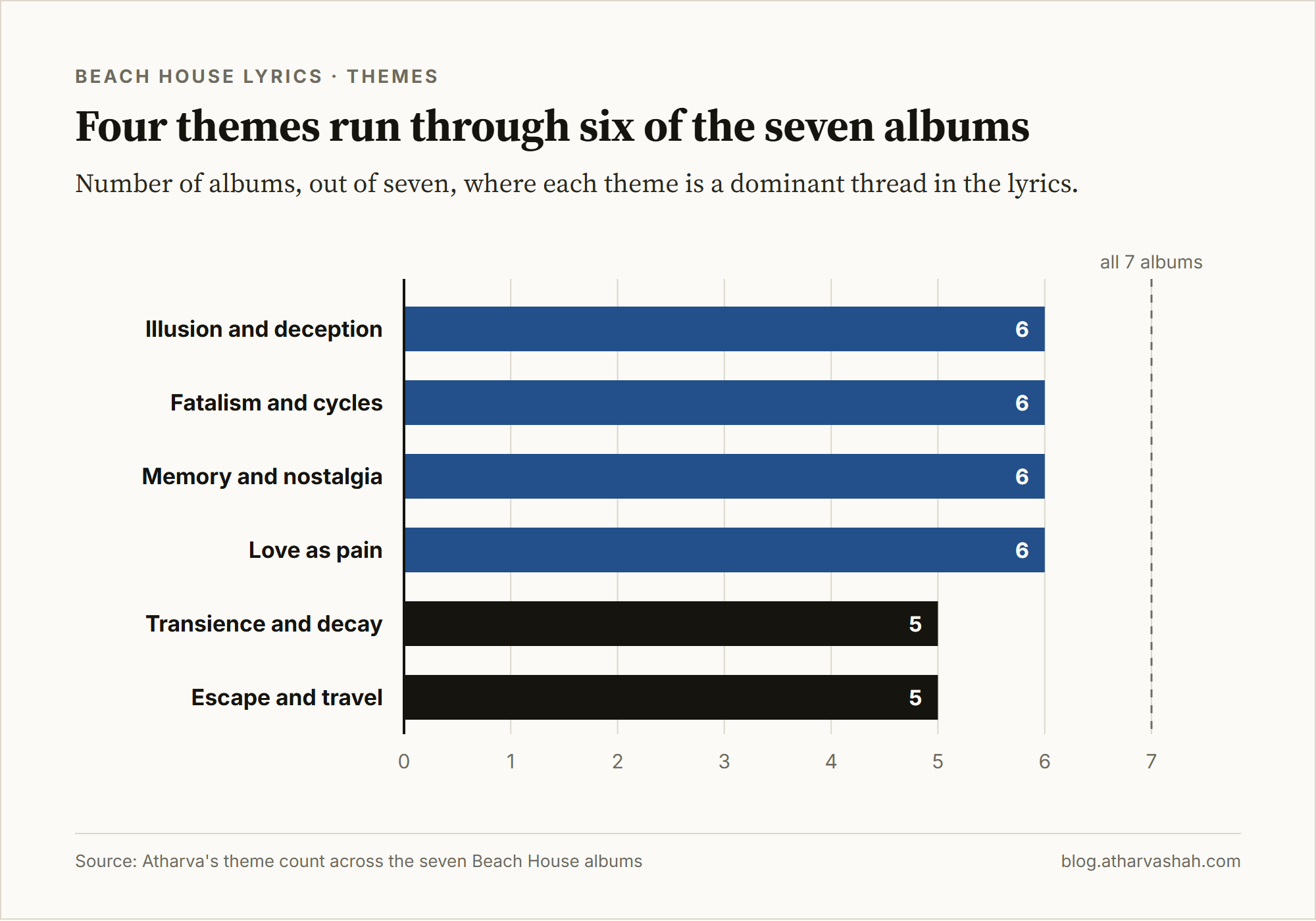
Four themes carry across six of the seven records: illusion and deception, fatalism and cyclical failure, memory and nostalgia, and love as pain. They held this thesis for seventeen years. The beautiful thing and the thing that destroys you keep turning out to be the same thing.
Their reputation as dream pop comes from the reverb. Underneath the reverb, this band writes horror. That was true from the first record, in 2006. Horror is the genre about characters who cannot leave.
Mapping Obsession With the Hero Chart
The chart below plots each theme against every album, and the shape barely moves even as the sound changes completely. The debut is sparse and haunted. Once Twice Melody, six albums and sixteen years later, is expansive and orchestral. The emotional architecture underneath stays the same in both. Victoria Legrand and Alex Scally are not so much revisiting these four ideas as digging further into them. They work the same questions about fate, identity, and time from angles that get more specific with each record.
A Synthesis of the Constrained Universe
The lyrical project starts from one premise. The music looks for no answer and no resolution. It documents life inside an emotionally constrained universe, where every escape fails and every pattern repeats. Beauty exists because of those constraints.
The earliest work sets the ground rules. The self-titled debut looks inward, diagnosing personal failure with unflinching clarity. The narrator of "Master of None" does many things and masters nothing, and the folk wisdom lands as a diagnosis of permanent mediocrity. In "Heart and Lungs," the physical body becomes a burden. The machinery of existence exhausts the narrator rather than sustaining her.
Teen Dream expands the scope outward, into relationships built on dishonesty. The opening track "Zebra" sets the tone immediately, built entirely around betrayal and falsehood. The album introduces high-contrast settings too. "Real Love" describes a meeting in darkness beneath the stairs, and that sets a pattern. Connection keeps appearing only in restrictive or ominous spaces.
With Bloom, the project turns self-aware. "Myth" opens the album with a provocative idea: personal narrative is a conscious construction with real consequences. Build your own mythology, and it decides what you have to offer. That idea marks a turning point. Beach House accepts here that identity is performative, chosen, and binding. The album also introduces agonizing temporal experience, where waiting and watching become forms of suffering.
Depression Cherry crystallizes the metaphor that defines the later work: the spark that vanishes the moment it appears. "Sparks" states it plainly. Moments of transcendence exist, and their certain, quick extinction defines them. When "Levitation" describes bodies lifting slowly, the lift never resolves into triumph, only a pause before the inevitable fall.

The Deep Cuts, Album by Album
Beach House (2006), The Body Betrays

The debut is the most physically grounded record, returning again and again to anatomy as a site of vulnerability. The heart and lungs are material facts here, organs that labor without reward. "Childhood" shows broken toys scattered on the stairs, an image that says someone dismantled this innocence rather than simply lost it. The album's fatalism feels personal, small-scale, domestic. The geography backs this up too. The Tokyo Witch lives in winter darkness, the first sign of a habit this band keeps for the next six records: pin a feeling to a named place until the abstraction gets teeth.

Teen Dream (2010), The Search for Something Real

This is their most volatile record, swinging between real hope for a monumental connection and the immediate sight of deception. "10 Mile Stereo" carries their most ambitious declaration, comparing love to a pantheon that carries on forever. The next image cuts that permanence down to size. The heart becomes a stone, heavy, something you have to throw.
"Walk in the Park" is the album's lowest point, and the record holds no single melancholic register. Wilderness and animal imagery shows up here too, zebras and beasts, building an Edenic frame where relationships exist in primal, untamed spaces.

Bloom (2012), Consequence and Construction

Identity becomes the central concern. The album asks whether constructing your own mythology liberates you or imprisons you. "Myth" answers with the second option. The narratives we build decide how others see us, and they decide what we can give.
"On the Sea" holds the most unsettling image in the whole discography. The world becomes a thing that swallows the narrator whole. The risk here is absorption, losing selfhood entirely to something outside it. Time becomes a character too. "The Hours," and the album's recurring focus on waiting, treat temporality as actively hostile rather than neutral.

Depression Cherry (2015), The Ephemeral Made Explicit

This album systematizes transience as the basic condition of experience. Every moment of beauty carries its own expiration inside it. The "spark" metaphor becomes definitional. Consciousness itself might be a flash before darkness.
There's also a suggestion of absolution. "On the Sea" proposes that distance offers forgiveness, that removal from normal life brings relief from judgment out on the water. The universe stops being scenery too. "Days of Candy" has it "riding off" with someone, cosmic forces taking a direct hand in one person's fate.

Thank Your Lucky Stars (2015), The Exhausted Performer

Released the same year as Depression Cherry, this record focuses relentlessly on the gap between inner experience and outward presentation. The Majorette performs despite having nothing left. The Common Girl makes movies where she cries on command, her emotional labor commodified and scripted.
The Traveller archetype appears here in full, someone perpetually displaced, unable to find comfort or light. Saturn turns overhead, indifferent to human struggle. "Elegy to the Void" makes the record's obsession with repetition explicit. "Again and again" sits at its emotional center.

7 (2018), Memory as Material

This album treats recollection as substance. The phrase from "Drunk in LA" is hard to shake, memory described as sacred meat that's drying all the time. It's grotesque and beautiful at once, turning nostalgia into something physical, perishable, precious.
Female identity arrives pre-categorized on this record. French lyrical fragments name the saint, the sex worker, the ingénue, a short list of available roles. Legrand has named Edie Sedgwick, Andy Warhol's fatalistic 1960s muse, as a central inspiration for the record, a connection she discussed with both Stereogum and Billboard around its release. That context sharpens "Black Car," which calls something tomb-like and also something to hold, the album's clearest statement that constraint itself can feel like security.

Once Twice Melody (2022), Cosmic Fatalism Achieved

Once Twice Melody is the culminating statement. Here the cyclical nature of suffering becomes universal law, and the band embraces it. "Modern Love Stories" declares plainly that endings are beginnings and beginnings are endings, the ouroboros made explicit.
The album holds the most celestial imagery in the discography. Ten of its songs bring in stars, planets, or cosmic forces directly. Personal drama goes planetary here, written in orbital mechanics instead of psychology.
"Hurts to Love" contains the closest thing to a Beach House thesis statement: if it hurts to love, do it anyway. The proclamation reads as recognition, not resignation. Victoria Legrand has described her own songwriting as heartbreak pulled from "the whole world," not just one failed romance, in an interview on the podcast LSQ. On this record, pain is what makes the love legible. "ESP" explores the gap between what everyone knows and what everyone shows, the performance anxiety that has haunted this project since the debut.


Thematic Frequency Across Albums

Sentiment Rankings (Most to Least Negative)

The Twenty Lines That Define the Catalog
These fragments show the approach at its most compressed. They treat abstract concepts as material objects, and they let beauty and decay share a sentence. Some need no explanation at all. Each code names an album: BH is Beach House, TD Teen Dream, B Bloom. DC is Depression Cherry, TYS Thank Your Lucky Stars, OTM Once Twice Melody.
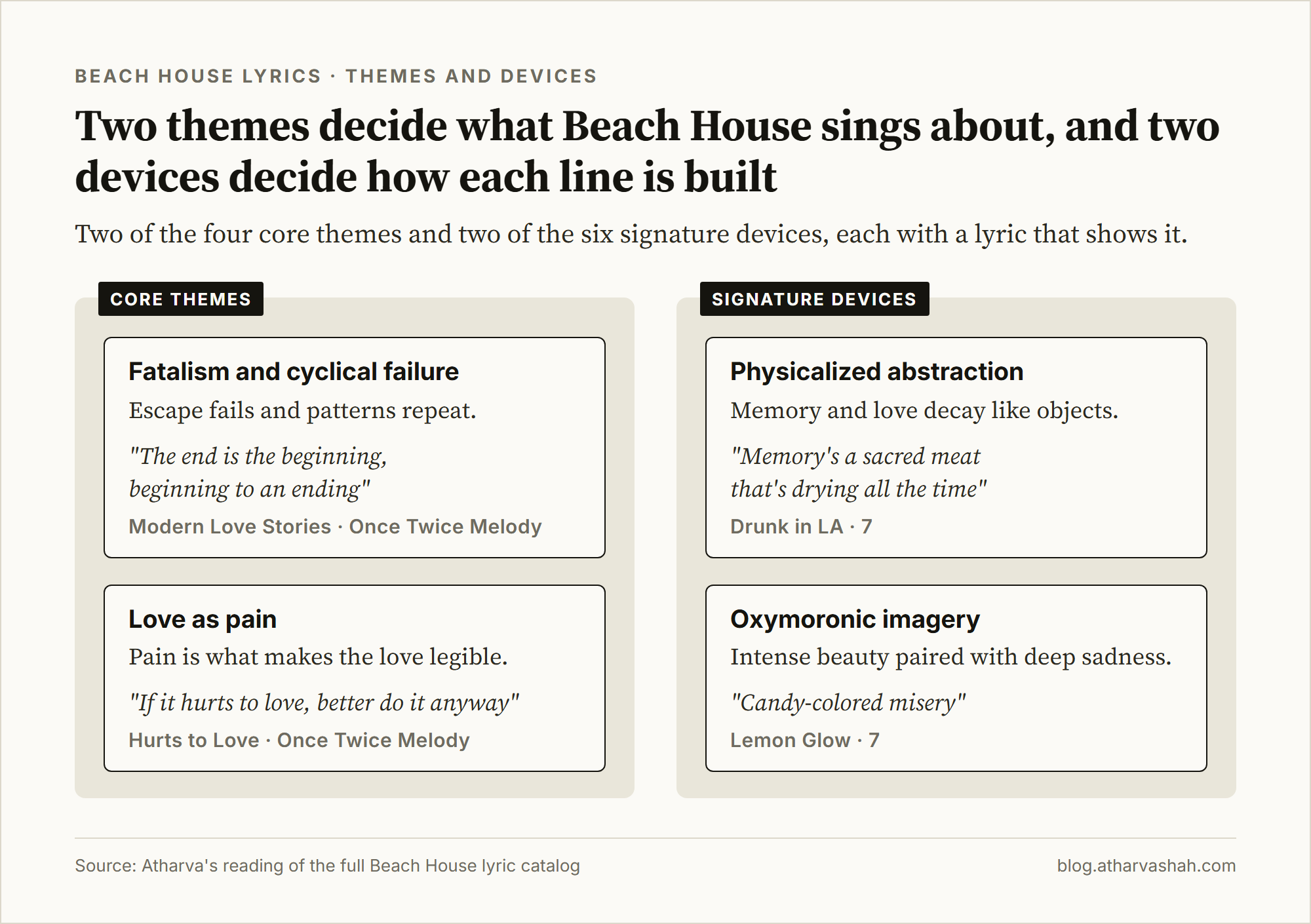
"The end is the beginning, beginning to an ending" (Modern Love Stories, OTM). The cleanest statement in the catalog of a career-long idea: temporal boundaries dissolve entirely.
"Memory's a sacred meat that's drying all the time" (Drunk in LA, 7). No line here does more work with a single image.
"If it hurts to love, better do it anyway" (Hurts to Love, OTM).
"Just like a spark, and then it vanishes" (Sparks, DC). Beauty defined by its own extinction.
"The heart is a stone and this is a stone that we throw" (10 Mile Stereo, TD). Emotion as both burden and weapon.
"It's all heart and lungs, it's not that much fun" (Heart and Lungs, BH).
"If you built yourself a myth, you'd know just what to give" (Myth, B). Identity as a construction with binding consequences.
"The world becomes and swallows me" (On the Sea, B).
"I am just a traveller, there's no light in this room" (The Traveller, TYS). Displacement as a permanent condition.
"She makes movies where she cries on cue" (Common Girl, TYS).
"The universe is riding off with you" (Days of Candy, DC). Cosmic forces acting directly on one life.
"Candy-colored misery" (Lemon Glow, 7).
"It's like a tomb, but it's something to hold" (Black Car, 7). Constraint as its own comfort.
"I met you somewhere, in a hell beneath the stairs" (Real Love, TD).
"Jack of all trades, master of none" (Master of None, BH). Folk wisdom turned into a diagnosis.
"I will haunt you the rest of your life" (Heart and Lungs, BH).
"So sick of swimming, I'm in over my head" (New Romance, OTM). Exhaustion from the effort of staying afloat.
"What everybody knows, not everybody shows" (ESP, OTM).
"Out on the sea, we'd be forgiven" (On the Sea, B). Distance treated as absolution.
"White page turns gold to her lies" (Auburn and Ivory, BH).
Motifs & Themes Across Beach House Albums
Beach House builds its universe from a limited palette of symbols and repeats them with architectural precision across the whole discography.
Color and Light. The most pervasive motif. I counted it in thirty-five songs across all seven albums. Colors define emotional states more than they decorate: pink, gold, platinum, lemon yellow. The band pairs intense color with profound sadness on purpose, producing "candy-colored misery" or a white page that turns gold through lies.
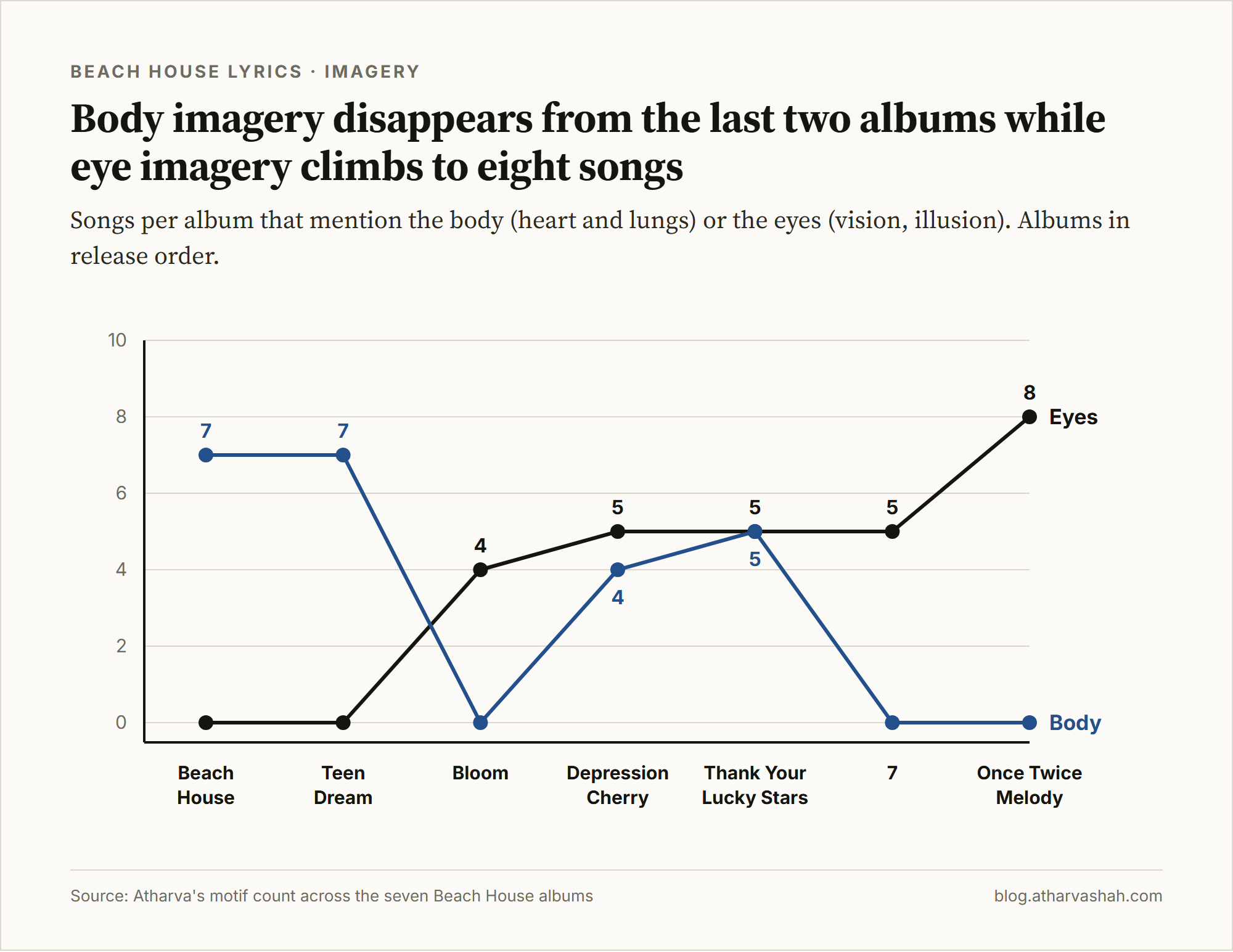
Eyes and Vision. Twenty-seven songs. Eyes represent both deception and terrifying self-recognition here. They mislead, masquerade, fade to black, the site where truth and performance collide.
Body and Anatomy. Concentrated in the early records, twenty-three songs. Hearts, lungs, and bones serve as both vulnerable vessel and material burden. Hearts break, turn to stone, and labor endlessly, without reward.
Water and Sea. Seventeen songs. Water threatens immersion and offers absolution in the same breath. Characters drown, sink, and swim exhausted, but they also dream of being forgiven "out on the sea."
Celestial and Cosmic. Concentrated in the two most recent records, 7 and Once Twice Melody. Stars, planets, Saturn, Orion, Mars, all of it frames personal struggle as predetermined and universal. The stars break hearts. The universe rides off with people. Fate turns astronomical here, out past the individual.
References & Cultural Context
Beach House anchors these soundscapes in real geography. Tokyo shows up in winter darkness. Los Angeles hosts drunkenness and the slow decay of memory. The Eiffel Tower and the Seine bring Parisian grandeur into the French-language fragments on the later records. Each place marks an emotional state.

Geographic Specificity:
Tokyo appears in winter darkness. Norway becomes a destination and a condition. LA hosts drunkenness and memory decay. The Eiffel Tower and Seine provide Parisian grandeur. Hopewell Road offers unexpected suburban specificity. These aren’t travelogue details but emotional coordinates, real places where abstract feelings become localized and therefore more devastating.
Literary and Cinematic Allusions:
F. Scott Fitzgerald’s Tender is the Night appears in “Space Song,” connecting Beach House’s project to Jazz Age dissolution and emotional recklessness. Luis Buñuel’s Belle de Jour surfaces in the title track of Once Twice Melody, invoking the film’s themes of fantasy, repression, and double lives. These references aren’t ornamental. They’re structural, placing Beach House in conversation with artists who also examined the gap between appearance and inner reality.
Mythological and Historical Figures:
Cleopatra’s portrait appears as a symbol of doomed romantic grandeur. Elvis becomes an impossible object of search, representing both cultural aspiration and personal futility. Saturn turns overhead, suggesting astrological determinism. The beast and the devil appear as forces that comply with requests but at terrible cost.
Gemstones and Materials:
Lapis lazuli provides deep blue beauty. Jewels and gems recur throughout, suggesting that beauty itself might be mineral, hard, cold, something formed under pressure rather than given freely.
The Descent Across the Seven Emotional Arcs
Charting sentiment across the discography turns up something unexpected. Beach House doesn't grow more optimistic or resolved over time. Their pessimism grows more consistent instead. The volatile extremes of Teen Dream give way to the smoothed-out acceptance of Once Twice Melody.
I scored each song from negative one, purely negative, to positive one, purely positive, then averaged the scores per album. The debut comes out as their most consistently negative record. Its songs cover failure, decay, and the exhausting labor of existence, the rawest version of these themes before any of the later sonic polish.
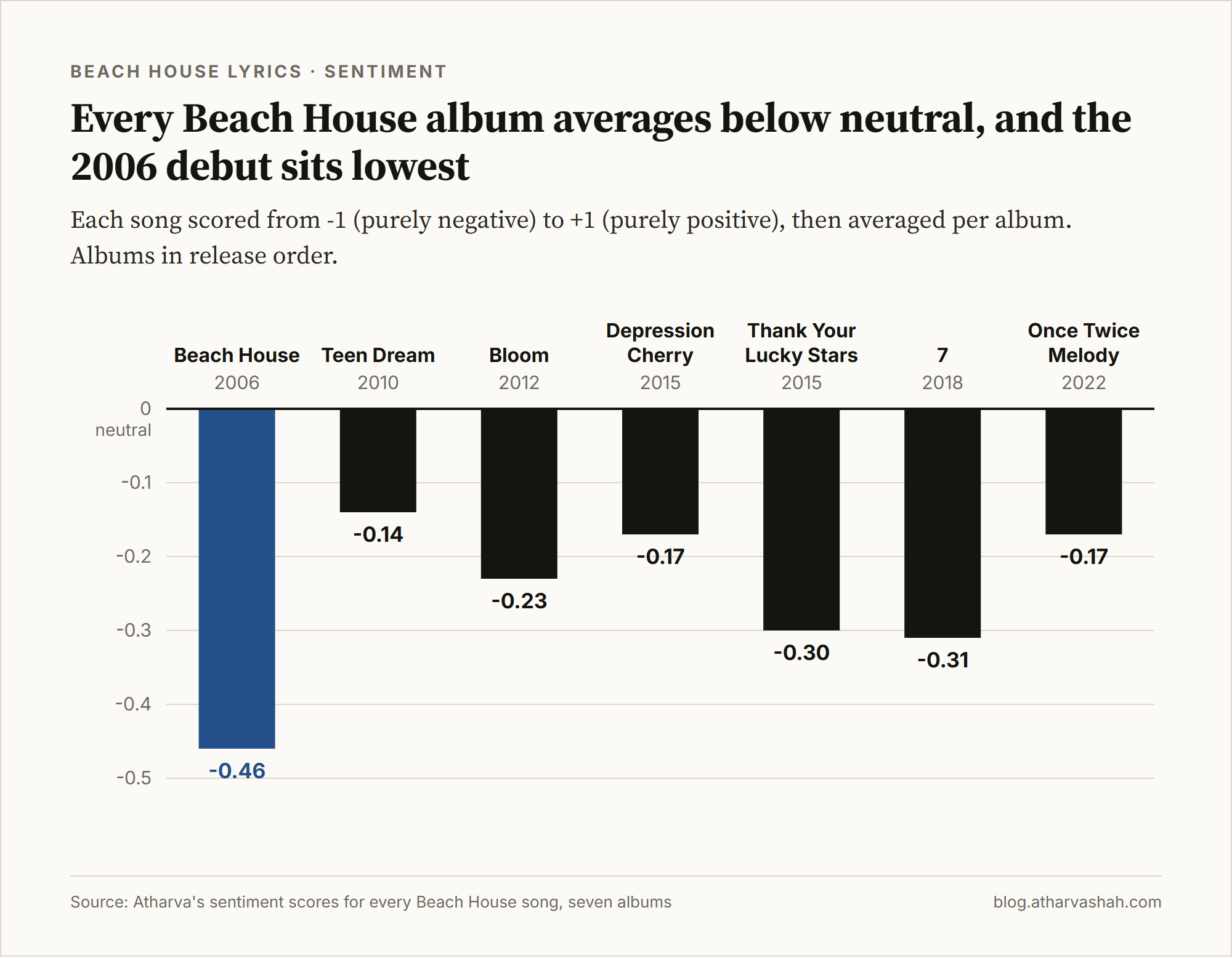
Teen Dream comes out least negative on average, but that reflects volatility, not optimism. The album swings wildly between real hope for connection and the immediate recognition of deception. It's their most emotionally unstable record, searching for something monumental and finding betrayal instead.
The middle stretch, Bloom, Depression Cherry, and Thank Your Lucky Stars, holds a steady negativity. These three records refine the same core themes from new angles: identity construction, ephemeral beauty, exhausted performance. The pessimism doesn't let up.
7 returns to darker territory, focused on constraint, coldness, and the decay of memory itself. Its treatment of recollection as "sacred meat that's drying" captures an unsentimental approach to nostalgia.
Once Twice Melody lands on something like equilibrium, not happiness but acceptance. The album's cosmic scale and its explicit embrace of cyclicality smooth out the emotional extremes. Suffering doesn't shrink on this record so much as turn structural instead of accidental, which makes it read as less volatile.
The arc runs from reactive pessimism to philosophical pessimism. The debut carries a visceral failure. The final album carries a cosmic acceptance across the same catalog of pain. The band spends seven albums learning to hold the same painful questions at a larger and larger scale.
The Signature Devices
Six specific techniques give Beach House's lyricism its texture, on top of the four themes.
Physicalized Abstraction. Memory, dread, and love all get treated as tangible, decaying objects. Memory becomes meat. The heart becomes stone. The device makes emotional states feel material, subject to the same entropy as anything physical.
Oxymoronic Imagery. Intense beauty paired with profound sadness: candy-colored suffering, platinum visions of decay, golden lies. These phrases make pain aesthetically compelling and suggest beauty and hurt might be inseparable.
Fatalistic Proverbs. Folk wisdom and cultural idioms deployed to name emotional failure in one line. "Jack of all trades, master of none" becomes autobiography. Common sayings get weaponized as self-diagnosis.
Allegorical Characters. Specific archetypes carry the emotional weight: the Majorette who performs with nothing left, the Traveller without light, the Common Girl whose tears are scripted.
High-Contrast Place-Naming. Ethereal emotion gets anchored to specific, often dark or holy locations: meeting in hell beneath the stairs, winters in Tokyo, calvaries and pantheons. Naming the place heightens the drama.
Self-Referential Cyclicality. The lyrics discuss their own temporal structure directly. "The end is the beginning" states the album's own repeating shape, plainly, rather than dressing it up as metaphor.

The Gift of Constraint
This catalog examines one emotional territory with rising sophistication and the same fixed assumptions, record after record. The constrained universe is the point of the work. The emotional palette holds only variations on fate, illusion, and inevitable decay, and that restriction buys a strange, real clarity.
The lyrical project keeps asking what happens if escape isn't possible, if patterns repeat regardless of effort, if beauty requires pain and memory itself is subject to entropy. Beach House refuses the easy answers. They treat fatalism as documented experience, not philosophy, and that makes room for a grief that reads more honest than hope.
The line from the debut album Beach House to Once Twice Melody runs toward acceptance rather than resolution. The band learns to hold the same painful questions at a larger scope. The subject moves from personal failure to cosmic fate. The insight stays fixed: we are constrained, we are fated, and beauty exists because of it.
Paid Subscribers Get the Complete Data Set
Want to explore the full analysis? Paid subscribers get access to:
Complete lyric annotations with line-by-line sentiment scores
Network graphs showing thematic connections between songs
The full reference database of every person, place, and product mentioned
Interactive visualizations you can explore yourself
Comparative analysis with other artists in "The Algorithm Listens" series
The methodology breakdown: how these insights were generated
This analysis is based on complete lyrical data spanning Beach House's complete discography. For paid subscribers, the next essay works song by song. It explores the micro-structures that create these macro-patterns. Join us to go deeper into the architecture of beautiful doom.
Related reading: Lorde Lyrics Analyzed: Data From Every Album and How Spotify's Recommendation Algorithm Works.

“Beautiful doom” is the right framing. Would love to see this applied to other constrained discographies.
Here's the TL;DR version of this:
• All Beach House lyrics were analyzed across sixteen years.
• Sentiment analysis shows repeated emotional collapse loops.
• Escape themes consistently resolve into inevitability.
• Dream pop functions as fate, not comfort.
• Data confirms what listeners intuitively feel.