



Something strange happens when you get close to something you actually want.
You stop wanting everything else.
Your brain has locked onto a target it believes is real. Every dopamine hit you would normally chase, the latte, the sneakers, the weekend trip, now feels like friction. The goal is finally close enough to touch.
The Distance Problem
When a goal sits far off, your mind does not fully believe in it yet. It cannot feel the goal, so it settles for small, guaranteed wins instead of real progress.
You buy the fancy coffee because owning a café chain feels absurd. You upgrade your phone because building a company that could afford any phone feels impossible. You scroll travel photos because months of actual freedom still feel like fiction.
This pattern shows up in real data too. Ran Kivetz, Oleg Urminsky, and Yuhuang Zheng tested it for a 2006 paper in the Journal of Marketing Research. Café customers with a 10-stamp loyalty card bought coffee more often as they neared their free cup. Customers handed a 12-stamp card with 2 bonus stamps finished faster than customers who started a plain 10-stamp card from zero.
The reward's distance set the pace. Customer willpower had nothing to do with it. Researchers call this the goal-gradient effect. It runs the same way whether the reward is a free coffee or a company you are trying to build.
The Avocado Toast Inversion
In 2017, the Australian property developer Tim Gurner told Australia's 60 Minutes that millennials could not afford homes. He blamed smashed avocado toast and four-dollar coffees. The clip went viral, and it named the wrong variable. What actually changes someone's spending is proximity to the goal, not discipline.
A person earning $50,000 a year buys small luxuries on a loop. A Rolls-Royce sits so far outside that budget it might as well be parked on the moon. A founder two deals from closing a funding round eats ramen and takes the bus. For that founder, the Rolls-Royce has turned into a finish line, and every dollar spent is a dollar not compounding toward a goal close enough to see.
What Proximity Does to People

The same person behaves like two different people, depending only on how far the goal sits.
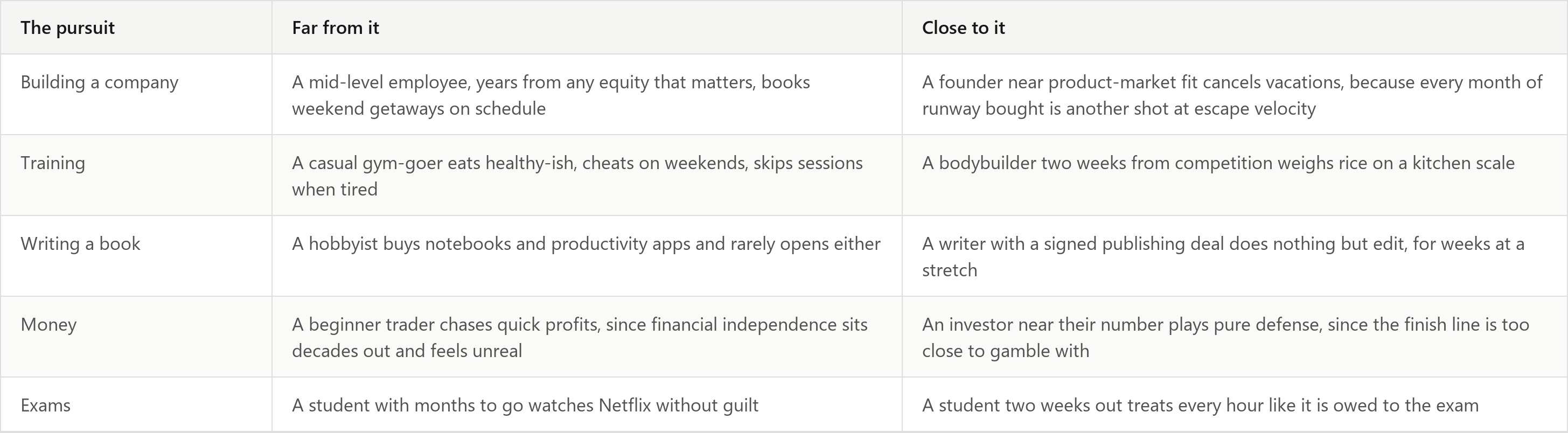
Nobody in the right column has more discipline than the person to their left. They have a shorter distance to travel.
Proximity Explains What Willpower Gets Credit For
People credit willpower for the shift in the right column. The real driver is proximity. Once a goal feels close enough to touch, everything unrelated to it starts to look like a cost. It stops looking like a reward.
The farther your dream feels, the louder your life gets. The closer it comes, the quieter you become. And the quieter you become, the faster you move.
Check what you are still buying instead of checking your discipline. If a latte or a phone upgrade still feels necessary, some part of you doubts the goal is real.
The bodybuilder weighing rice grains two weeks from a show is not applying more discipline than the same person eight weeks out. The show got closer, so the plate got smaller.
Related reading: Investing for Beginners: A Simple Starter Guide and Inflation Explained: The Types That Actually Matter.



The proximity insight explains so much behavior. Deadlines convert dreams into action.
Here's the TL;DR version of this:
• Humans optimize for what feels attainable.
• Distant goals invite symbolic progress.
• Proximity rewrites priorities automatically.
• Discipline is replaced by inevitability.
• Behavior reveals belief faster than intention.