



Before I invest a rupee, I get the basics straight. I cannot romanticize "making money grow" before the foundation sits in place. A house needs a foundation before a roof, and my finances work the same way.
Return Rates Depending on Investment Choice
Every investment carries its own expected return, and the risk moves with it. Here is what I am looking at:
A savings account pays about 2.5%. It works barely better than a mattress.
Liquid debt funds pay around 7%, with easier access than a fixed deposit.
Gold pays about 9% and works as a standard inflation hedge.
Index funds pay about 15%, riding the broader economy's growth.
Real estate pays 12% to 20%, but it swings hard with the local market.
Small-cap funds pay 18% to 25%, with matching downside risk.
Government bonds pay 6% to 8%. They stay safe and modest.
These numbers move every year. The Nifty 50 tracks 50 large Indian companies. Its ten-year CAGR (compound annual growth rate) sat at about 13.7% in February 2026, above its own long-run average of 12% to 14%, per NSE index data. The S&P 500's long-run CAGR runs closer to 10.2% a year since 1928, with dividends reinvested, per S&P Dow Jones Indices. Stretches of higher inflation and rate hikes still chop up any single five-year window. Neither number tells you what next year holds.
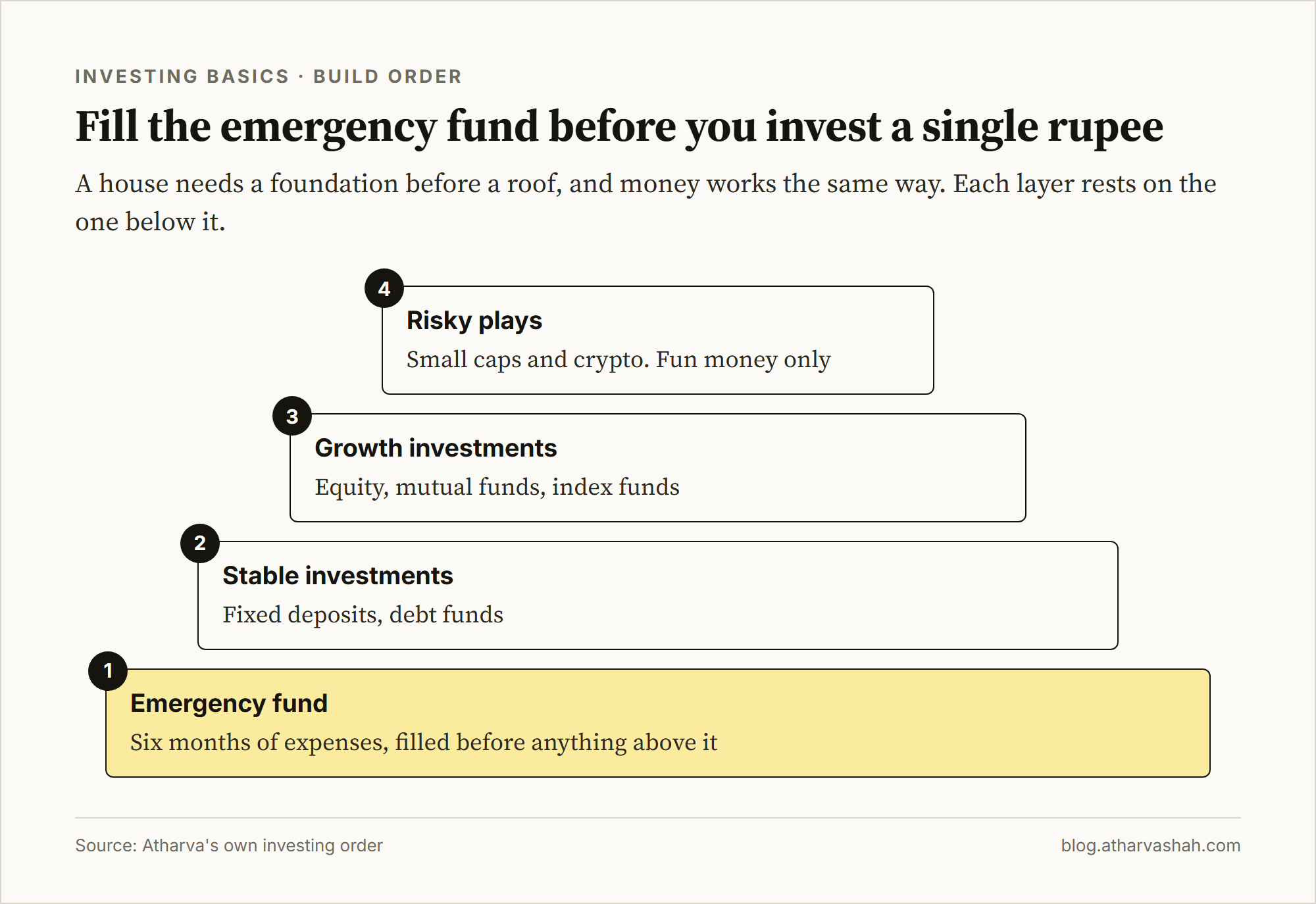
Emergency Fund
This is non-negotiable. My car could break down, I could face a medical bill, or I could lose my job. I need a cushion ready before any of that happens.
The rule is simple: six months of expenses. I spend ₹30,000 a month, so I keep ₹180,000 saved.
I split that cushion two ways. 25% sits in my savings account for instant access. 75% sits in a liquid debt fund, which pays slightly more and stays just as reachable.
I do not touch investments until this fund is full. I mean that seriously.
Choosing Mutual Funds
A fund with a shiny brochure is not enough on its own.
Always choose Direct Plans over Regular Plans. A regular plan bundles in a distributor commission, and that gap alone runs about 0.5 to 1 percentage point a year in fees, which works out to roughly 1% lower CAGR over decades on the same underlying fund, per Kotak Mutual Fund's own breakdown.
Hold for the long term, three to five years at minimum. This is not a quick-money scheme. Let compounding do the work.
Check the fund's Alpha and Beta before you commit. Both are covered in the metrics section below.
Zerodha's founder explains why his broker sells only direct plans.


Building a Good Investment Basket
Say I have ₹100,000 to invest every month. Here is how I spread it:
20% Gold. Solid foundation.
20% Foreign Stocks. Exposure to the US markets or others (Japan, South Korea, Singapore).
30% Large Cap Funds. Stability with decent growth.
20% Mid Cap Funds. Balanced risk and return.
10% in riskier plays, small caps, Bitcoin, meme coins, whatever. Fun, but I never bet the farm on it.
I minimize the overlap. I do not invest in ten funds that all target the same sectors. Real diversification needs different sectors, and it needs to go global too. When the domestic market falls, international exposure protects me.
The Numbers I Check Before I Hold a Fund
CAGR: annual growth over time. ₹10,000 growing to ₹20,000 in five years works out to a 14.87% CAGR.
XIRR: the same idea, built for SIPs (Systematic Investment Plans) and other uneven cash flows.
Sharpe Ratio: return per unit of risk taken. A ratio above 1 means the return outweighs the risk.
P/E Ratio: how expensive a stock is against its earnings. A ₹500 stock with ₹50 EPS carries a P/E of 10.
Alpha: return above the benchmark. A fund returning 15% against an expected 12% has an Alpha of 3.
Beta: how much the fund swings against the market. A Beta under 1 means it moves less than the market, both up and down.
No single metric tells the full story. I read all six together before I commit money.

Market Collapses and How to Survive
Market collapses happen on a schedule nobody can read in advance. Nassim Taleb's The Black Swan argues that it is the event nobody modeled, not the risk everyone already worried about, that breaks a portfolio. The 2008 financial crisis and the 2020 pandemic crash both proved his point.

So how do I survive one?
Goal-Driven Investing: I define the goal first, retirement, a house, a specific number. On a 20-year horizon, a short-term crash does not worry me.
Diversification: I spread across asset classes, geographies, and sectors so one crash cannot wipe out the whole basket.
The Emergency Fund: it exists so I never have to sell an investment at a loss just to cover a bill.
SIPs: a Systematic Investment Plan buys more units automatically when prices fall, which averages my cost down over time.
No Panic Selling: I stick to the plan I set while calm, not the one fear writes for me in the moment.
During the 2020 crash, the S&P 500 fell 33.9% in 33 days. It regained its pre-crash high by mid-August that year, about five months later, in what was at the time the fastest bear-market recovery in 50 years. The investors who held on, or bought more, caught that recovery.
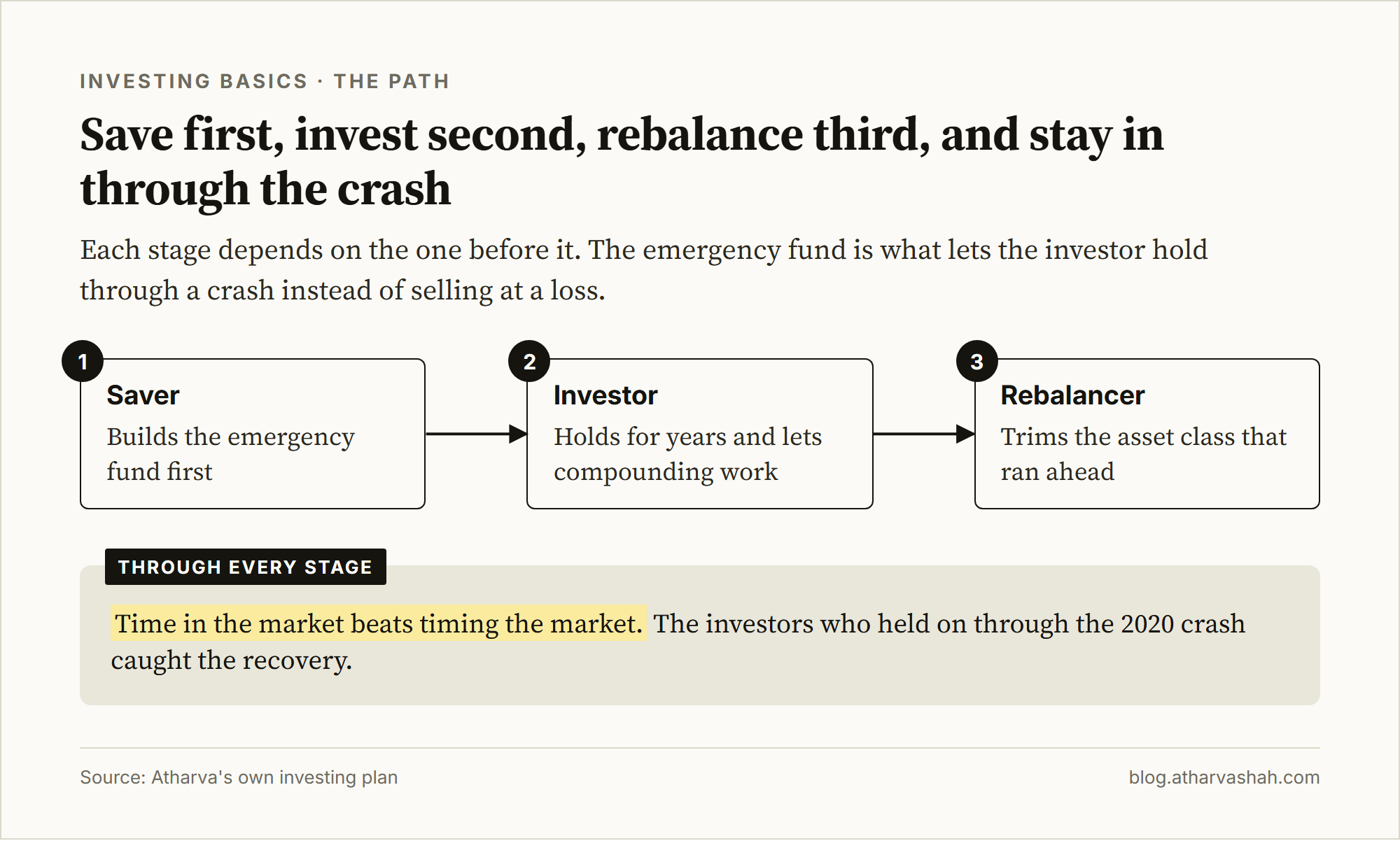
Rebalancing, Debt, and Investing in Myself
Rebalance Regularly: when one asset class runs ahead of the others, I trim it back to the original mix.
Understand Debt: a home loan builds an asset over time. Credit card debt just drains one.
Invest in Myself: the skills I build compound the same way money does, and a market crash cannot touch them.
A return-rate table, an emergency fund, and a diversified basket do the real work. Leave them alone through a 30% monthly drop, hold for a decade, and they compound without needing genius.
The One Book Worth Rereading
The Intelligent Investor by Benjamin Graham is the one I go back to. Graham's core idea is margin of safety. Buy an asset for meaningfully less than it is actually worth, and you still come out ahead even when your own estimate turns out wrong. That single idea is why I would rather buy an index fund at a fair price than chase a hot stock at any price.
Warren Buffett studied under Benjamin Graham and explains the idea here.
Three more books reward a slower read. Common Stocks and Uncommon Profits by Philip Fisher, A Random Walk Down Wall Street by Burton Malkiel, and The Black Swan by Nassim Taleb.
Related reading: Goal Proximity: How Distance Shapes Decisions and How to Calculate Your FIRE Number (With Example).



This removes the mystique without dumbing it down. The order of operations is the real lesson.
Here's the TL;DR version of this:
• Investing fails without a foundation.
• Emergency funds precede market exposure.
• Diversification reduces catastrophic risk.
• Metrics matter more than hype.
• Time compounds faster than tactics.