

You Don't Rise to Your Goals. You Fall to Your Systems.
Why motivation fails and infrastructure wins. A new framework for getting things done.

You’ve been here before.
New year, new quarter, new Monday. You set the goal. You feel the fire. You tell yourself this time will be different.
And then life happens.
The alarm goes off and you’re tired. The meeting runs long. The inbox explodes. The motivation that felt so certain two weeks ago has evaporated.
You don’t fail because you didn’t care.
You fail because when pressure came, you had nothing to fall back on.
Here’s the truth most people learn too late:
You don’t rise to the level of your goals.
You fall to the level of your systems.
Goals are seductive. They feel like progress. They give you something to chase, something to post about, something that looks like a plan.
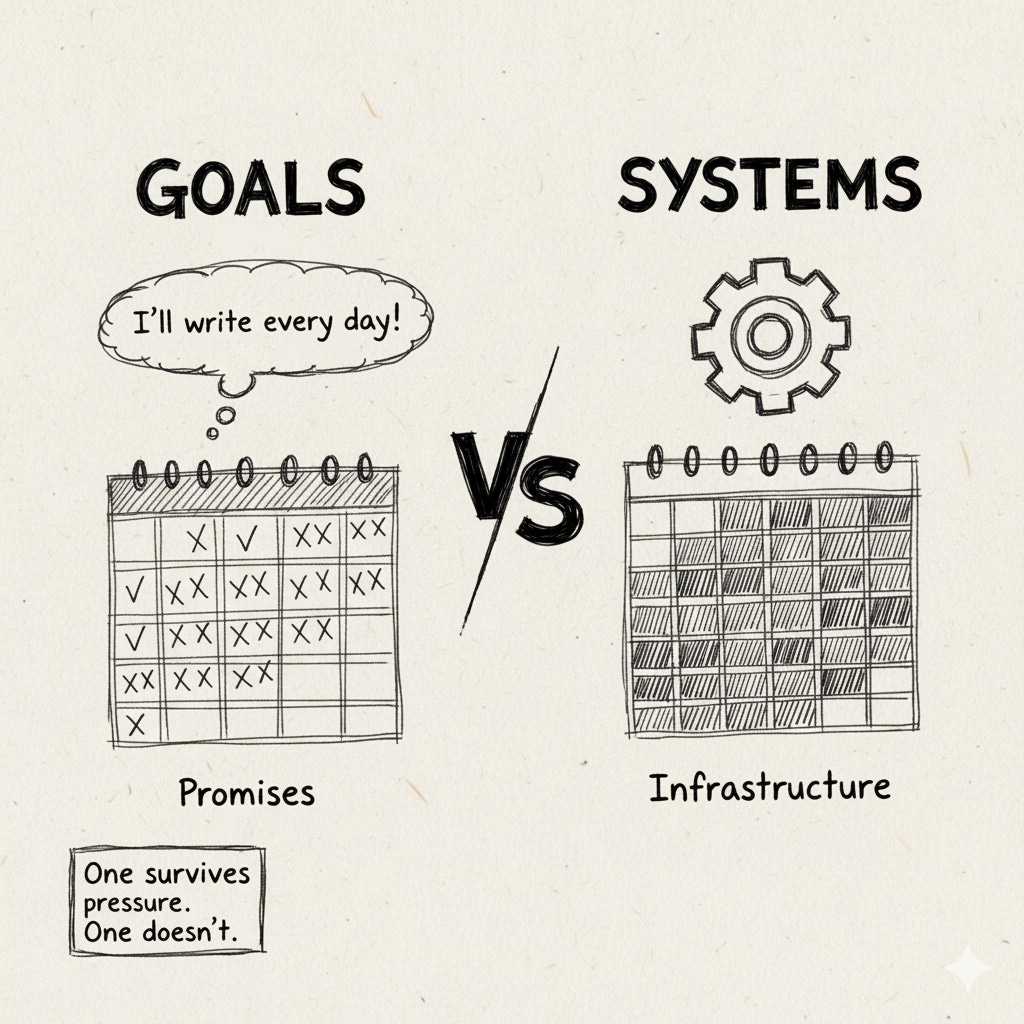
But goals are promises. Systems are infrastructure.
And when the initial excitement fades — and it always does — infrastructure is all that’s left.
Think about every goal you’ve abandoned.
“I’m going to write every day.”
“I’m going to get in shape.”
“I’m going to launch that side project.”
What failed wasn’t your ambition.
It was the absence of a system that could survive your worst Tuesday.
The people who actually ship aren’t more motivated than you.
They’re not more disciplined.
They don’t have more hours in the day.
They just built a floor they can’t fall through.

The writer who publishes every week doesn’t rely on inspiration. They have a scheduled writing block, a distraction-free setup, and a template that removes friction.
The founder who moves fast while everyone else burns out doesn’t run on hustle. They have a customer outreach cadence, a weekly reflection ritual, and automated feedback loops.
The person who never misses the gym doesn’t love exercise more. They pack their gym bag the night before, go at the same time, and have a playlist that eliminates decision fatigue.
Goals tell you where to go.
Systems tell you how to stay there.
A goal is: “Run a marathon.”
A system is: Three runs per week, tracked in Notion, shoes by the door, playlist queued.
A goal is: “Read more books.”
A system is: Ten pages at breakfast, phone on Do Not Disturb, Kindle on the nightstand.
A goal is: “Build a profitable startup.”
A system is: Daily user outreach, weekly revenue review, Friday retrospectives, automated lead gen.
See the difference?
One sounds like a wish.
The other sounds like a machine.
The brutal reality is this:
When stress arrives, you don’t become your best self.
You become your default self.
And your default self is whatever you’ve automated.
If you’ve automated doom-scrolling when you’re anxious, that’s what you’ll do.
If you’ve automated opening your writing doc at 8am, that’s what you’ll do.
Your system is your floor.

When motivation disappears, when willpower is depleted, when everything feels hard — you don’t rise to some imagined version of yourself.
You fall back to what’s automatic.
So how do you build systems that actually hold you?
1. Design your environment, don’t fight it.
Willpower is finite. Your environment is permanent.
Put the book on your pillow. Delete the apps. Make the friction disappear for good behavior and multiply for bad behavior.
2. Automate decisions.
Every decision is a tax on your attention.
Decide once: same workout time, same writing hour, same customer call schedule. Then stop deciding.
3. Track reality, not fantasy.
Hope isn’t a strategy.
Track what you actually do, not what you wish you did. Measure output, not intentions.
4. Build identity-based systems.
Stop trying to “achieve the goal.”
Start acting like the kind of person who does the thing.
Writers write. Builders build. Fit people move.
The identity comes first. The results follow.
Here’s what no one tells you:
The gap between where you are and where you want to be isn’t closed by motivation. It’s closed by infrastructure.
The reason you’re not consistent isn’t because you don’t care enough.
It’s because the path of least resistance doesn’t lead where you want to go.
Fix the path.
Build the system.
Make the right thing automatic.
Next time you set a goal, ask yourself:
What system would make this inevitable?
Not “how badly do I want this?”
Not “how motivated am I?”
But: What structure, what environment, what automation would make this the default outcome?
Because ambition is a spark. Systems are the oxygen.
And the ones who win aren’t the ones who dream biggest.
They’re the ones who design an environment where they can’t lose.
You don’t rise to your goals.
You fall to your systems.
Build a floor worth landing on.
The idea of systems as a floor lands hard. Most failures are infrastructure failures.
Here's the TL;DR version of this:
• Goals do not determine outcomes.
• Systems do.
• Under stress, people revert to defaults.
• Environment design beats motivation.
• Automation removes decision fatigue.
• A strong system creates a high floor.