



In Bong Joon-ho's Mickey 17, your body is a crashed Docker container. Your consciousness gets flashed onto a freshly printed vessel like firmware onto a new device the moment you die. A Docker container is a packaged software process that engineers shut down and restart at will.
The film reads like a plausible engineering spec for how a collapsing society might ration human life. It treats people as deployable infrastructure, not citizens. The scariest part is how little imagination it takes to get from where you are right now to Mickey's world.
The Economics of Expendability
The story starts with debt, not drama or cosmic stakes. Mickey Barnes signs up as an Expendable in 2054, after his anti-meat fast-food venture, called Macarons Are Not a Sin, collapses and leaves him owing a loan shark he cannot repay. Bong Joon-ho adapted the film from Edward Ashton's 2022 novel Mickey7, and the debt-driven premise survives the jump to the screen almost untouched.
Earth in the story has already hit resource limits and shed most of its social safety net. In that vacuum, a new job category exists: the Expendable.
Think of it as the gig economy pushed to its logical endpoint. You do not trade your time or your labor. You trade your body.
You sign a contract. You get printed. You die. You get reprinted. You do it again.
Bong Joon-ho explains why dying had to feel like Mickey's daily job.
Expendables serve as biological telemetry probes, walking into lethal environments so the protected population does not have to. They sample unknown pathogens before anyone important sets foot on the ground. They are human test cases running in production, and the production environment will kill them.
A canary release pushes a small slice of traffic through an untested path to see what breaks before the rollout reaches everyone. The Expendable program runs the same play, except the canary is a person.
Mind as Software, Body as Hardware
The central breakthrough in Mickey 17 is mind-body decoupling. Bong Joon-ho calls the two halves Cortex and Vessel. The mind is a Docker image, a digitized brain state carrying memories, personality, and cognitive rules. The body is a container, a 3D-printed, replaceable biological runtime.
Death becomes a terminated instance. You redeploy the same image onto fresh hardware and keep going. The body turns stateless and disposable, and identity lives entirely in the saved state. Your continuity rides on the fidelity of your memory dump. If the backup is clean, you wake up as yourself. If it is not, you wake up as something else wearing your face.
A stable model runs across many deployments while the environment underneath it changes. The person stays consistent across copies only as long as the state stays intact. Lose the state, and you lose the person, not the body.

The Engineering Problem Nobody Talks About
This entire setup collapses unless someone solves two hard engineering problems. The film glosses over both, which is exactly where it gets interesting if you think about it seriously.
Genetic fidelity. Every reprint needs one-to-one DNA replication. Drift across iterations degrades the vessel, and it changes the brain substrate hosting the mind. A slightly different brain running the same cognitive image introduces subtle errors.
Over enough reprints, Mickey N+1 is not the same person as Mickey N. The software did not change. The hardware drifted. This is the biological equivalent of running the same application on increasingly divergent chipsets and expecting identical behavior.
Memory injection. The brain dump needs perfect continuity, with zero lost time between the death of Mickey N and the boot of Mickey N+1. Any gap creates discontinuity. Any corruption creates a different person who believes they are the original. If the memory stream is unprotected and someone intercepts and edits it, you are not just killing a person. You are rewriting who they wake up as.
That is identity hijacking at the firmware level, and you cannot patch it after the fact. The person who would notice the tampering is the person who was tampered with.

The Race Condition That Breaks Everything
Here is where the architecture falls apart completely, and where the film finds its real tension.
What happens when two bodies print from the same brain image at the same time? You get a race condition.
Two processes sharing a resource, both assuming exclusive access, neither aware the other exists until they collide, is a familiar failure mode in distributed systems. In Mickey 17, the shared resource is an identity. Two Mickey instances boot from the same snapshot, each carrying a full and legitimate claim to being the real continuation.
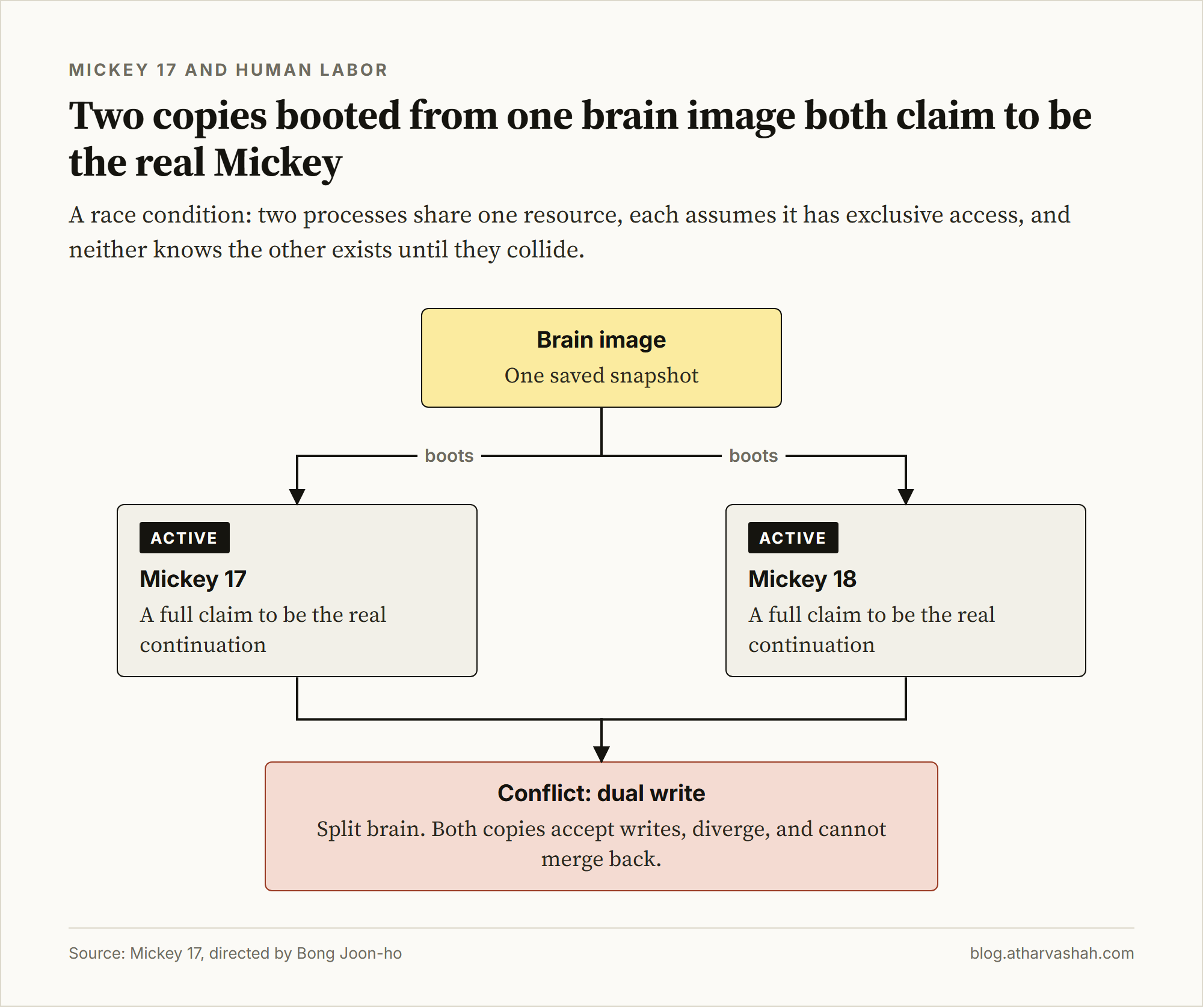
Which one has authority? Which one counts? The system was designed around single-instance governance, one Mickey at a time, and the moment that assumption breaks, the design collapses with it.
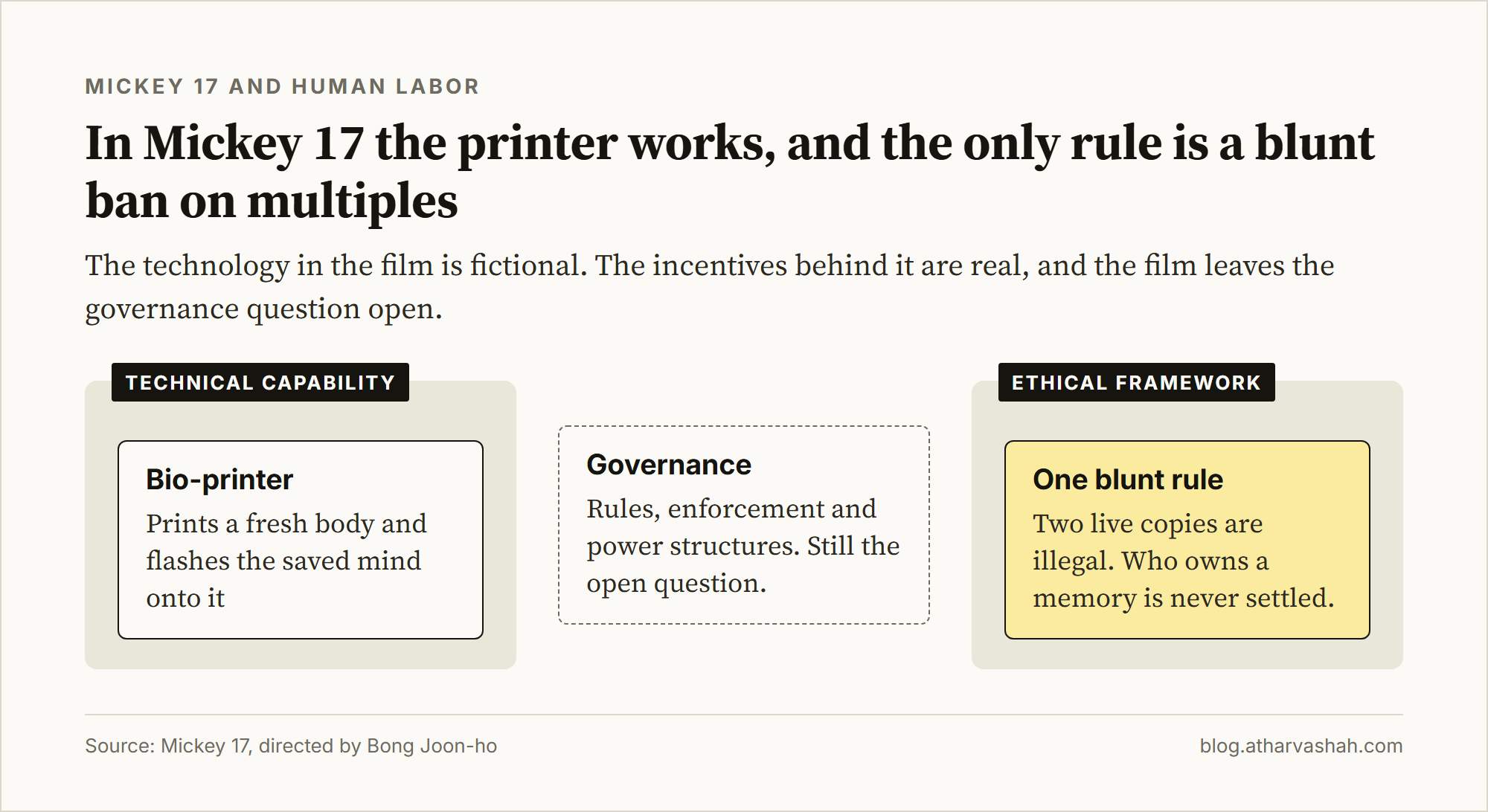
The film's universe treats a broken assumption like that as a capital offense. A "multiple," two active copies of the same person, is illegal, and the expedition leader, Kenneth Marshall, has already sworn to eliminate any multiple on sight. That rule exists because the writers understood a single-instance system needs an enforcement layer, not an honor system.
A workable model would still need hierarchy. A Prime, the original person behind the first genetic sequence and brain scan, would act as the master node. Reprints would run as child pods, failing over through an explicit protocol if the Prime dies.
Skip that protocol and you get identity collision instead. That is split-brain behavior in database terms: two nodes accept writes at the same time, diverge, and cannot be merged back without losing data. In Mickey's case, the data you lose is a human being.
The Horror of Normalization
The most disturbing part of Mickey 17 is how fast everyone accepts the technology.
Nobody in the film stays horrified by the Expendable program for long. The ethics get raised, then buried under operational urgency. There is a mission. Resources are scarce. Someone has to die so the colony survives, and because the system works, people stop questioning it.
The warning has nothing to do with 3D-printed bodies. You already live in a world that normalizes disposability: gig workers with no benefits, contract soldiers fighting privatized wars. The distance between "acceptable cost of doing business" and "Expendable" is shorter than you think. Mickey 17 just removes the pretense by making the disposability literal.

The film forces questions that do not have clean answers. If a mind can be copied indefinitely, individual sovereignty dissolves, and you stop being a person and become a template. If death is reversible, murder turns into an operational inconvenience rather than an irreversible act, and accountability evaporates with it. If humans become disposable, the only question left is who gets to set the disposal policy, and that question is always answered by whoever holds power, not by whoever holds a moral argument.
A society running this system needs governance around duplication and memory ownership. Without those guardrails, human life becomes a resource you allocate and terminate based on need.

What This Film Actually Gets Right
The trajectory Mickey 17 warns about is already visible if you know where to look. Efficiency pressure and economic desperation are already pulling in the same direction as the technology that would make disposable people a system rather than an accident. The technology in the film is fictional, but the incentive structure behind it is real.
The open question is governance. Brain-computer interfaces and 3D-printed organs are already active research fields, which means pieces of mind-body decoupling exist today, not just in Bong Joon-ho's script. The technology alone will not decide whether people stay people or become containers you spin down when the cost-benefit calculation changes. Rules, enforcement, and power structures will decide that.
The film does not answer the governance question, and it does not have to. It shows what happens when nobody asks the question early enough.
State persistence, identity integrity, consensus across copies, and resource management for on-demand replication are the problems Mickey faces throughout the film. Infrastructure engineers solve versions of these same problems every day, just with workloads instead of human lives running on the servers. When the system you design runs on people, every architecture decision becomes an ethical one.
Mickey 17 and Mickey 18, the two copies alive at once, do not resolve their identity collision through a protocol. They resolve it by trying to kill each other first, then hiding from Kenneth Marshall long enough to negotiate who takes which shift and which death. That is what happens when a system reaches production with no plan for the case its own design allows: the people running through it improvise the failover themselves, in real time, with everything on the line.
Related reading: The Games That Broke My Brain (And Why I Keep Coming Back) and Haruki Murakami: How to Read His Surreal Fiction.
