



You read a sentence that feels like a conversation. Then a cat starts talking. A well becomes a portal. You realize you crossed into something you cannot name, and you cannot tell when the crossing happened.
Murakami writes prose so plain it lowers your guard, and reality slips sideways right after. His readers stay because the impossible feels inevitable on the page.
Jay Rubin translated Norwegian Wood and The Wind-Up Bird Chronicle into English.
Best Reading Order That I'd Recommend
Everyone tells you to read Murakami. Nobody tells you where to start.
His books are not difficult. They demand the right entry point. Pick wrong and you will think he is overrated. Pick right and you will understand why people obsess.
What You're Actually Reading
Murakami writes about loneliness the way jazz sounds at 2 AM. His tone is intimate, melancholic, and strangely comforting.
His characters drift through life searching for something they cannot articulate. They cook themselves elaborate meals and eat alone. Old records spin late into the night. Somewhere in that quiet, they wonder if anyone else feels this untethered. You do, and that is why the books work.
He never explains the strange parts. Talking cats, parallel dimensions, and prophecies arrive the way loneliness arrives in real life, with no warning and no explanation.
His fiction is emotional realism with the physics turned off.
The Five Ingredients in Every Murakami Novel
Five elements repeat across almost everything he has published: magical realism that blends the mundane with the fantastical, prose plain enough to read like conversation, themes of isolation and memory, a Japanese setting run through with jazz and American fiction, and an atmosphere that stays melancholic even when nothing overtly sad happens. The table below breaks down how each ingredient shows up on the page and the twist Murakami adds to it.

The Entry Points
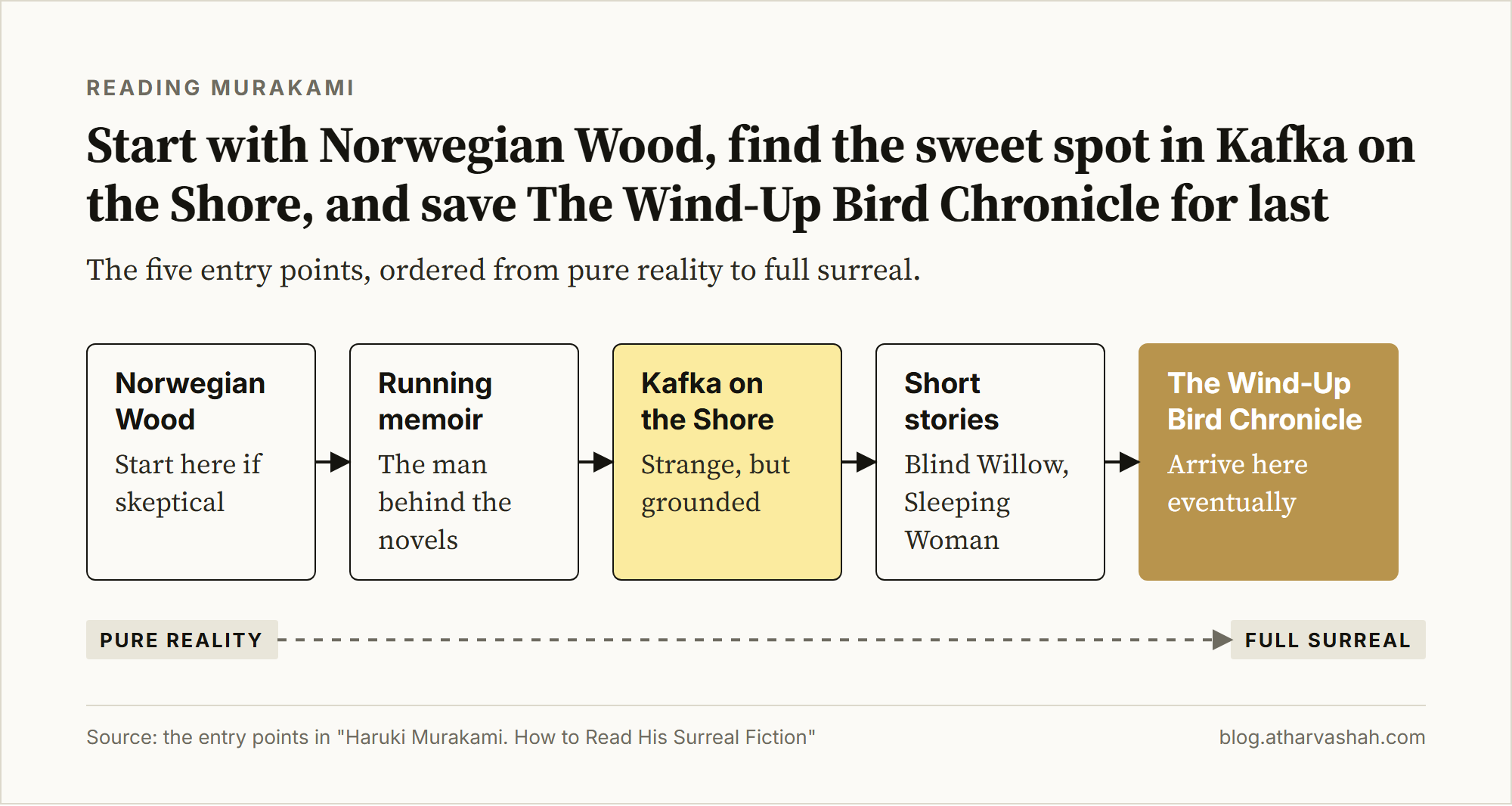
Five books work as a door into his world. Pick the one that matches what you want right now.
Norwegian Wood

Start here if you want the emotion without the weirdness. The setting is 1960s Japan, and the subjects are first love, grief, and growing up. No parallel universes and no talking animals appear anywhere in it.
When Norwegian Wood came out in Japan in 1987, it sold more than four million copies and lifted Murakami to a level of pop-culture fame he found unbearable enough to leave the country for several years. Read it if you doubt he can write a straight literary novel. He can, and this is the proof.
What I Talk About When I Talk About Running

This memoir follows Murakami through years of marathons, and its emotional center is one race: the Lake Saroma 100-kilometer ultramarathon in Hokkaido, which he ran in June 1996 in eleven hours and forty-two minutes. Somewhere past the sixty-kilometer mark he hits a wall, then breaks through it, and one line from that race outlived the book: "Pain is inevitable. Suffering is optional."
Read this one to understand the man behind the novels. It is the most practical Murakami book, and the most revealing one.
If you are ready for the weird parts: Kafka on the Shore

Two storylines run side by side. One follows a teenager running from a dark prophecy. The other follows an old man who can talk to cats. They should not connect, and they do anyway.
The New York Times named it one of the ten best books of 2005, and it won the World Fantasy Award the year after. The book earns both honors: strange enough to stay memorable, grounded enough to be devastating.
If you want the full experience in small doses: Blind Willow, Sleeping Woman

This collection rarely gets recommended, but it holds twenty-four stories written across twenty-five years, from 1980 to 2005, with the same atmosphere and less commitment. Think of it as a tasting menu of Murakami's whole career. Some stories are bizarre. Others are quietly heartbreaking. Every one of them lingers longer than its page count earns.
If you want to go deep: The Wind-Up Bird Chronicle

A man looks for his missing cat. That search pulls him through memory, war crimes, dreams, and wells that lead to other dimensions.
The novel sprawls and it confuses, and both of those are why it haunts you for years afterward. This is Murakami with no restraint left. Don't start here, but make sure you arrive here eventually.
The Real Pattern
Once you read enough Murakami, you start seeing the formula.

An ordinary person meets an inexplicable event, and the inward change disguises itself as an outward one. Jazz plays while spaghetti gets cooked, and the longing never resolves.
Knowing the formula does not ruin it, because the formula is not the point. The feeling is the point. Murakami put words to a specific kind of loneliness: the flatness of going through the motions of an ordinary life while suspecting that reality has come slightly unglued. His characters do not fix that feeling. They cook a good meal and put a record on at midnight, and they let the loneliness sit there instead of pretending it away.
Start Somewhere
Pick your entry point and commit to one book.
If it does not land, try another. His work is remarkably consistent, and individual books resonate differently with different readers.
The right Murakami book feels like someone reaching through the page and saying, "Oh, you feel that too?"
Bring a jazz record. You will need it.
Related reading: Materialists Movie Review: 25 Honest Thoughts and One Empty Car on the Ferris Wheel.

The jazz-at-2-AM metaphor nails it. Murakami saw digital loneliness before it had a name.
Here's the TL;DR version of this:
• Murakami writes loneliness as a lived condition.
• His characters embody modern emotional isolation.
• Technology intensified themes he predicted early.
• Entry points vary based on tolerance for surrealism.
• His appeal comes from emotional accuracy, not plot.