



I near my two-year milestone at AccuKnox, an early Cloud Native Security SaaS company. The two years were intense, humbling, and relentlessly educational. This is no polished tale of easy victories.
It is a record of growth through hard problems in a high-stakes field. New technology in that field arrives faster than convention does. I write this for anyone who thinks about cloud-native security, or about startup life, or about what a two-year run actually looks like underneath the resume line.
🎊 Shoutout to Syed Hadi for pushing me to write this post. He kept handing me ideas and strategies that pointed toward growth.
Joining AccuKnox in May 2023
I entered the specialized world of cloud-native security in May 2023. That domain became my professional focus for the next two years. The cloud security market shifted hard in the same period. Organizations adopted containerized architectures fast. Kubernetes became the default orchestration platform. Security teams rushed to fit old security models to these distributed environments.
The timing was critical. The previous year brought several high-profile attacks on cloud-native infrastructure. The CNCF's 2022 Security Survey reported that 96% of organizations hit at least one serious security incident in Kubernetes. Supply chain attacks grew in number and in sophistication. The software ecosystem still carried the damage from Log4Shell and the SolarWinds breach.
Gartner had just named Cloud-Native Application Protection Platforms, or CNAPPs, an emerging category in its security hype cycle. The category promised one platform in place of many separate security tools. That platform secures an application through its whole lifecycle. This was the domain where AccuKnox staked its claim.
My route to AccuKnox joined three interests: technology, security, and communication. I came from technical writing, and I read about cloud computing all the time. The work I wanted was to turn a complex security concept into content that people understand and act on. The startup promised a steep learning curve and several roles at once, which is what I wanted.
The cloud-native security field needed technical knowledge and communication skill together. I soon learned the size of that demand. An explanation of runtime security, network policy enforcement, or vulnerability management needs depth and clarity at once. That process never stays finished, either. A control that looks solid today can fail against next month's attack pattern. Communicating that moving target became central to my role.
My first day of orientation included one conversation with our CEO, Nat Natraj, that I still remember. AccuKnox builds security tools, but the pitch he gave me was really about a philosophy. Security, at AccuKnox, runs on zero-trust principles and moves at the same speed as the cloud infrastructure it protects.
That introduction opened an intense period of growth, technical learning, and rising responsibility. Two years later I moved from an intern on basic content tasks to a technical specialist. The specialist role covers documentation, website infrastructure, marketplace integrations, and content strategy across the company.
The learning curve stayed steep and the problems kept coming. The work secures the cloud-native ecosystem, which carries much of the modern digital economy. That made the effort worth it. This is the story of those two years.
What AccuKnox Builds, and Who Built It
My path at AccuKnox makes sense only with the company in view. Start with its origins, its technical foundation, and its position in the market.
Four Founders, One Zero-Trust Bet
AccuKnox emerged in 2019 from a collaboration between industry veterans with complementary expertise. Nat Natraj brought extensive experience in enterprise security and go-to-market strategy, having previously founded Apcera, which Ericsson later acquired. Asif Ali and Rahul Jadhav contributed deep technical expertise in cloud-native technologies and security architecture. The team was completed by Phil Porras, a renowned researcher in network security from SRI International.
The founding vision was ambitious and timely. Build a security platform for the specific problems of cloud-native environments. Apply zero-trust principles at every layer of the application stack. One insight drove that vision. Traditional security tools fit poorly with the short-lived, distributed nature of modern cloud applications.
The company's technical approach was influenced by its collaboration with SRI International, known for its landmark work in cybersecurity research. This partnership gave AccuKnox access to advanced security concepts that would later become core differentiators in its product offering.
AccuKnox CEO Nat Natraj tells the founding story, including the SRI connection, in this interview.
Early employees told me the name carries the mission. "Accu" stands for accuracy and precision in security controls. "Knox" points at Fort Knox, and at the security posture the platform aims to reach.
eBPF and the Zero-Trust Model
AccuKnox built its platform on the zero-trust security model. That model assumes a breach. It verifies every access request as though the request comes from an uncontrolled network. The model fits cloud-native environments, where perimeter-based security stopped working.
The platform architecture shows careful engineering. The system uses eBPF, or extended Berkeley Packet Filter. eBPF runs security controls at the Linux kernel level with no change to the kernel itself. That gives deep visibility into system calls, network traffic, and file access. The platform then detects and blocks a security violation in real time.
The official eBPF documentary explains how the technology came out of Plumgrid in 2014.
The platform's capabilities span several critical dimensions of cloud-native security:
Runtime Security: Using behavioral analysis and policy enforcement to detect and block anomalous activities in containers and microservices during execution.
Network Security: Implementing fine-grained microsegmentation through Kubernetes Network Policies and extending these controls to non-Kubernetes workloads.
Vulnerability Management: Scanning containers, infrastructure-as-code templates, and application dependencies for vulnerabilities throughout the development lifecycle.
Compliance Automation: Continuously validating environments against industry standards like CIS Benchmarks, NIST, and PCI-DSS.
AI/ML Model Protection: Securing machine learning pipelines against poisoning attacks and unauthorized access, an emerging capability few competitors had built yet.
The unified approach set AccuKnox apart. Competitors answered a single security problem with a point solution. AccuKnox joined these capabilities into one platform with consistent security across environments. Those environments run from public clouds, such as AWS, GCP and Azure, to private data centers, edge installations, and 5G infrastructure.
AccuKnox co-founder and CTO Rahul Jadhav walks through the zero-trust approach in this session.
A Crowded Market and a $10.6 Million Series A
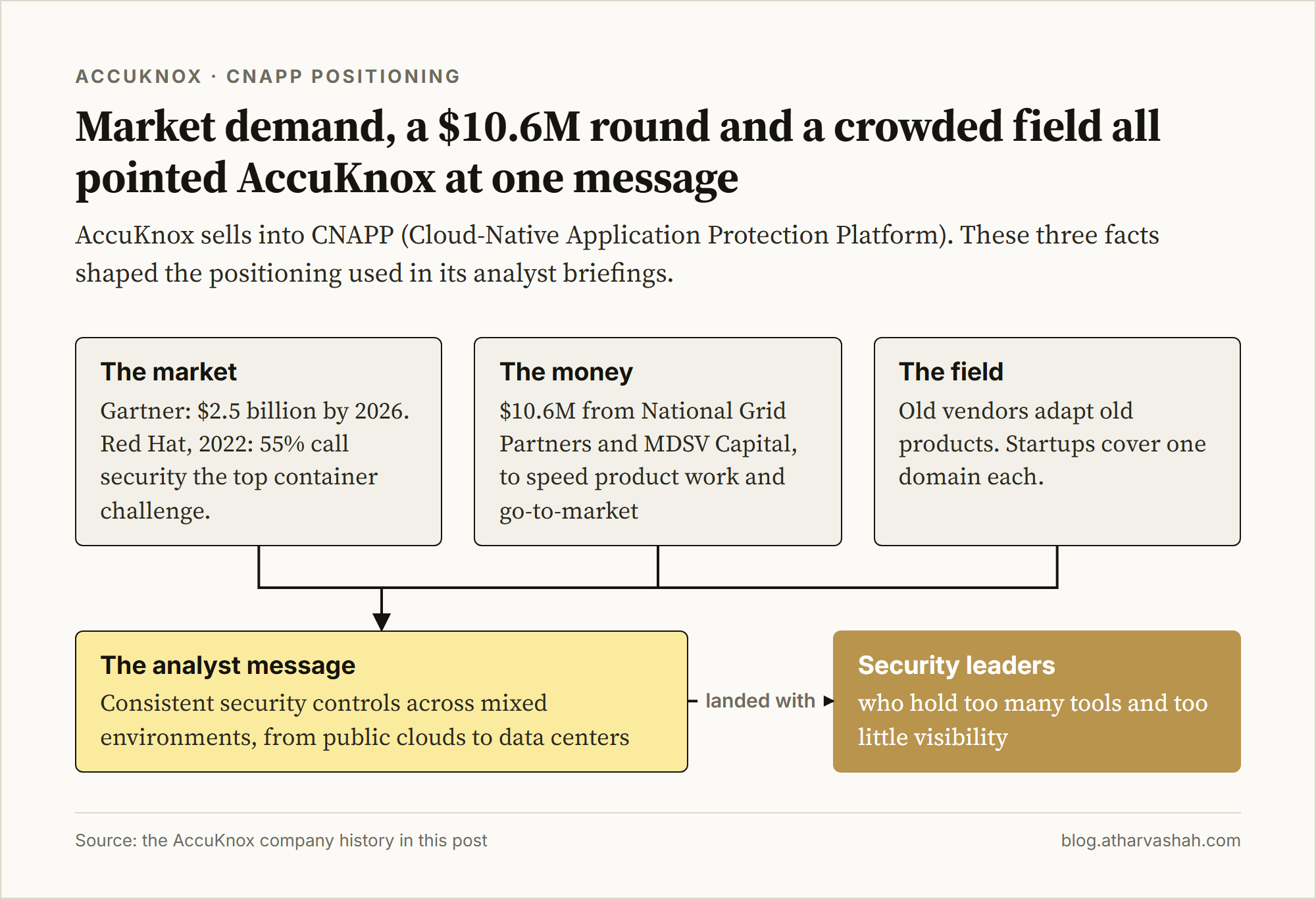
AccuKnox sits in the fast-growing CNAPP market. Gartner predicted that market reaches $2.5 billion by 2026. The company raised $10.6 million from National Grid Partners and MDSV Capital. That was a real achievement in a selective investment climate.
This investment enabled AccuKnox to accelerate product development and expand its go-to-market efforts. The timing proved advantageous, as organizations were increasingly recognizing the security challenges of cloud-native architectures. A 2022 Red Hat survey found that 55% of organizations called security their top challenge in container adoption. That created a clear market need for the AccuKnox platform.
The competition came from two directions. Established security vendors adapted old products to cloud-native environments. Cloud-native startups covered one security domain each. AccuKnox separated itself with a complete approach, research-backed technology, and AI/ML model protection.
I later helped prepare analyst briefings. Our positioning stressed one point, which is consistent security controls across mixed environments. That answers a real pain point for enterprises with complex multi-cloud infrastructure. The message landed with security leaders who hold too many tools and too little visibility.
As the company grew, it established strategic partnerships with cloud providers and security ecosystem players. These partnerships extended AccuKnox's reach and enhanced its credibility in the market. The platform reached the major cloud marketplaces: AWS, GCP, Azure, Oracle, Alibaba Cloud, and VMware. A global customer base can buy it there.
This company context proved invaluable in my content and messaging work. The technical depth of the platform demands precision in communication. The competition demands a clear statement of what makes us different. Inside that environment I gained technical knowledge and a strategic view of the cloud-native security market.
Learning the Stack From Zero
My time at AccuKnox began with a simple mandate. Research emerging threats, study cloud-native technologies, and contribute to the company's digital presence. The job description hid the range of skills the work needs. It also hid the steep learning curve inside a fast-scaling startup.
The First Weeks: KubeCon Pages and a Steep Curve
My first week landed in the run-up to KubeCon EU 2023. My first task was a set of landing pages for the security professionals at that conference. The assignment showed me the real nature of technical marketing in a specialized domain. It needs technical accuracy and strong messaging together. That balance came back every quarter after it.
The learning curve was steep. Within days I worked inside the taxonomy of cloud-native security. I separated CWPP, or Cloud Workload Protection Platform, from CSPM, or Cloud Security Posture Management. Both differ again from CNAPP. I read technical documentation, research papers, and analyst reports to build the base.
My background in technical writing and software engineering, with an understanding of cloud technologies, proved valuable, but insufficient. I needed to rapidly develop domain expertise in Kubernetes architecture, container security, and zero-trust principles. This required close work with engineering teams, who patiently explained complex concepts and reviewed my early content attempts.
One senior engineer took an interest in my development. He set up weekly sessions on the architectural diagrams and the technical base of the platform. "If you're going to write about our eBPF-based security controls," he told me, "you need to understand how eBPF works at the kernel level." Those informal sessions took my learning far past self-study.
The pace was relentless. Each day brought new technical concepts and new communication problems. I spent one whole weekend on Kubernetes admission controllers for a technical blog post about their security use. Weeks earlier that topic looked impossible to me.
Writing Blog Posts That Pass Engineering Review
As my understanding deepened, my responsibilities expanded. By my second month I wrote blog posts, white papers, and e-books. The topics ran from supply chain security to zero-trust in Kubernetes.
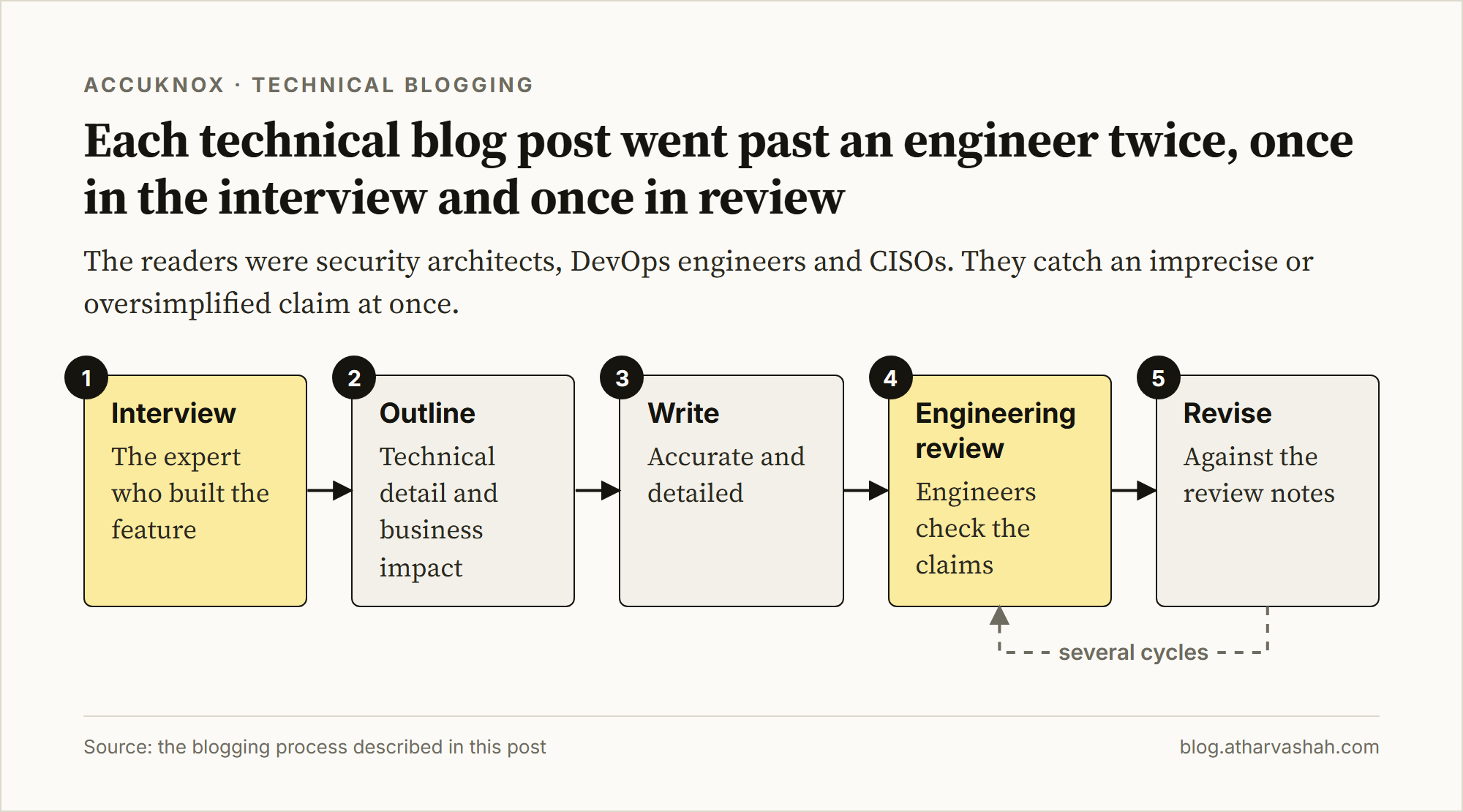
The technical blogging process took a set pattern. I researched the threat or capability first, then interviewed the subject matter expert who actually built it. I drafted a full outline with the technical detail and the business impact mapped out. I wrote the piece, sent it for engineering review, and revised against their notes. Design added the supporting visuals last.
One blog post could take days across several review cycles. The cycles protected technical accuracy and messaging alignment. The standard was high. Our audience held security architects, DevOps engineers, and CISOs. They catch an imprecise or oversimplified claim at once.
One particularly challenging project was an e-book on implementing zero trust in cloud-native environments. The topic required complex security frameworks, cloud architecture principles, and practical implementation guidance in one document. The final draft spanned 35 pages and needed input from seven different technical experts across the organization. The process taught me project management, technical consensus-building, and how to turn expert knowledge into content a reader can act on.
Through this period I held to detail and to deadlines. In a startup with constrained resources, people notice both. Delivery of high-quality technical content on schedule built my reputation as a reliable contributor.
Learning WordPress, SEO, and Analytics on the Job
Past content creation, I took on the company's digital presence. That work expanded my technical skills in unexpected directions. The website needed full development on a hub-and-spoke content model, which organizes a growing portfolio of resources.
The work introduced me to WordPress development, SEO principles, and web analytics. These skills sit next to content work, and they decide the impact of every digital asset. I learned to cut page load times, add tracking, and structure content for search engines and for human readers.
The challenge extended beyond technical implementation to strategic planning. I designed an information architecture for a product line that kept changing. The architecture also had to hold one clear narrative for visitors. That needed close work with product management on upcoming features and positioning shifts.
My role in building this digital foundation exposed me to the technical infrastructure supporting our marketing operations. I became proficient in Google Analytics, Tag Manager, and Search Console. Those three tools later measured the whole content strategy.
At the end of my first six months, the role changed. The internship became a full-time technical specialist job. My work moved from basic content tasks to the company's digital presence and technical communication strategy. The change reflected my growing capability and the company's lean operating model, where impact defines a role rather than a traditional boundary.
The period closed with one key achievement. We published our first complete white paper, "Cloud-Native Security Maturity Models." Hundreds of security professionals downloaded it within weeks. That success validated the approach and opened the next set of responsibilities.
Rebuilding the Help Documentation From Scratch
After those first six months, I took on my largest contribution to the company. I rebuilt our technical documentation from the ground up, and the project marked my move from content creator to strategic technical communicator.
Reimagining Help Documentation
The situation I inherited was hard. Our technical documentation sat scattered across GitHub READMEs, PDF guides, and an incomplete documentation site. None of it read as one product. The product grew fast with new features and integrations, so the documentation gap grew with it.
I audited the existing material and read the support tickets for common user problems. Then I wrote a complete plan to rebuild the documentation. The proposal aimed at one authoritative source organized by user task. It called for a modern, searchable interface built for self-service. It also called for a process that would keep the documentation accurate as the product kept changing.
Leadership backed the plan. They treat good documentation as a driver of product adoption and customer success rather than a support cost.
The scope was large. It covered over 200 new documentation pages, from first installation to advanced security policy configuration. Each section needed deep technical knowledge and a grasp of user workflows. I worked with product managers to map pages to user personas, from security administrators to DevOps engineers to compliance analysts. Every audience finds its own guidance.
One addition was a Quick Start section with simple setup instructions per environment. Stripe and HashiCorp inspired it, because both push a user to a first success fast. The analytics confirmed the approach. A user who finished the Quick Start guide moved on to advanced feature configuration far more often.
The MkDocs Implementation
I chose MkDocs after weighing several documentation platforms. It let engineers write documentation in Markdown through our existing Git workflow. It supported flexible theming for brand consistency, and it came with search and code highlighting built in. It could also version separate documentation branches per product release, which mattered as we shipped faster.


The implementation process was technically demanding. I established a documentation repository with clear contribution guidelines, templates, and examples. This let engineers contribute directly to documentation through familiar Git workflows, a critical factor for keeping technical accuracy.
The card-based menu I designed was a large usability improvement. Hierarchical menus made a user hunt. The card-based approach gave visual pathways for common tasks. Heat map analysis of the old documentation interactions informed the design.
The technical aspects of the implementation extended beyond content creation. I configured continuous integration pipelines for the documentation. A merge to the main branch builds and deploys the update automatically, so documentation stays current with minimal manual work.
One particularly hard part was proper versioning to support multiple releases of our software. I built a system that kept separate documentation branches for major releases while sharing common content across versions. This balanced maintenance effort against the need for version-specific guidance.

What Changed After the Documentation Launched
Within months of the launch, the numbers moved in Google Analytics. Average time on a documentation page rose 180%. Support tickets for basic configuration questions fell 37%. As security teams evaluated AccuKnox, the completeness of the documentation gave them a reason to trust our technical claims.
The project taught me a few things about technical communication in a specialized domain. I learned that effective documentation needs a real grasp of user workflows. Generic instructions weren't enough. Users needed guidance specific to their own environments and use cases, which led to separate guides for AWS, GCP, Azure, and on-premises deployments.
Visual communication carried a complex technical concept well. With our design team I built architectural diagrams, workflow charts, and decision trees. They explained ideas that text alone handles badly, and user surveys rated those visuals highly.
Documentation also never stays "complete." The platform changes, so the documentation needs constant refinement. I set up a review cycle inside sprint planning, so every new feature gets documented before release.
The project raised my visibility inside the company. GitHub metrics show me as the top contributor to the help documentation repository. More important, I became the person who turns a complex technical concept into clear guidance.

Building an Editorial Calendar and Writing 48 Blog Posts
Content creation stayed a core responsibility, with more strategic weight and technical depth each quarter. Past basic blog posts, I built a complete content strategy that positioned AccuKnox as a thought leader in cloud-native security.
Developing the Editorial Calendar
I built a strategic editorial calendar around market trends and product development cycles. It replaced an ad-hoc process with a structured framework that held a steady publication cadence and kept topics relevant.
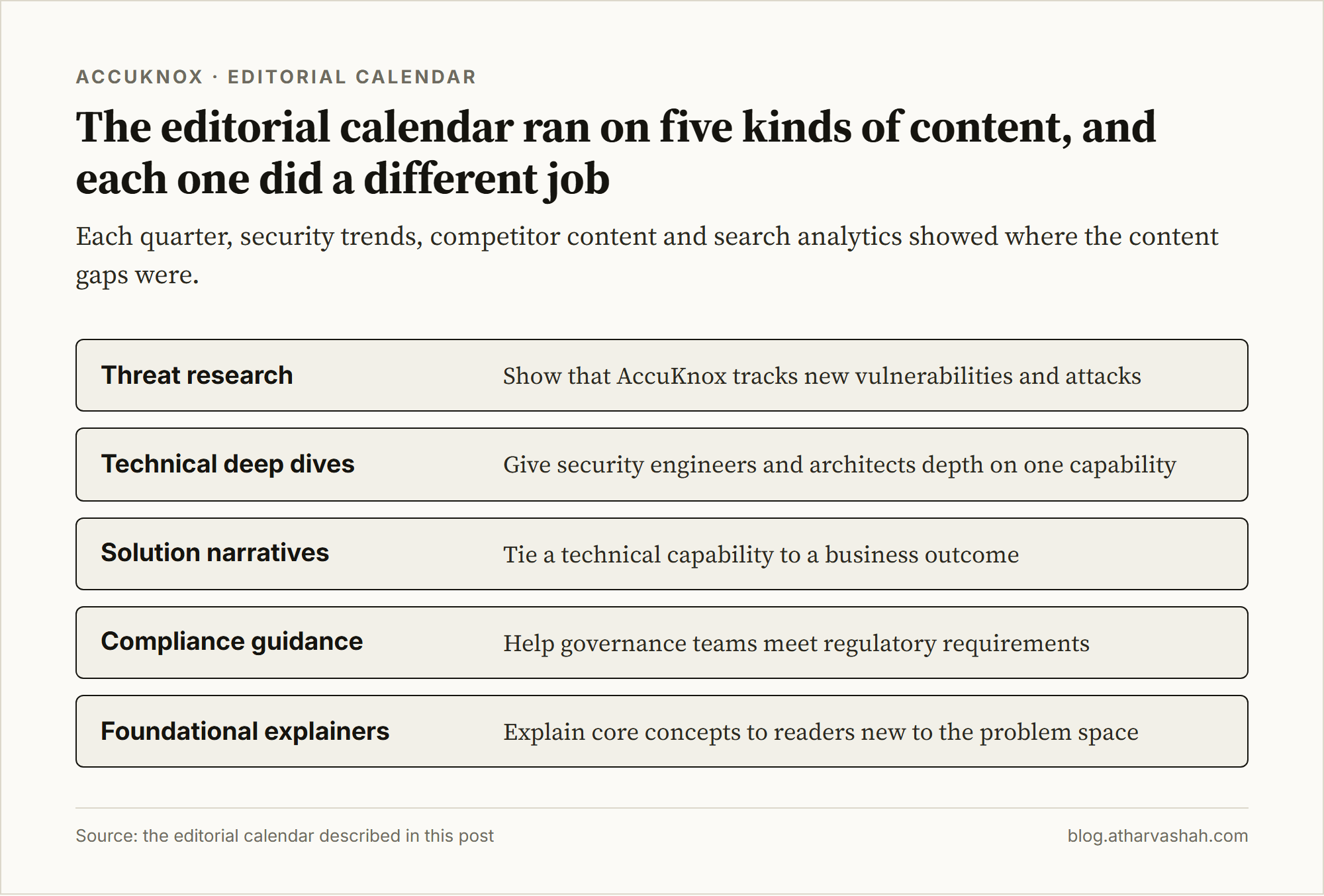
I organized the calendar around five kinds of content. Threat research showed we tracked new vulnerabilities and attack vectors as they appeared. Technical deep dives gave security engineers and architects real depth on a capability. Solution narratives tied a technical capability to a business outcome. Compliance guidance served governance professionals working through regulatory requirements. Foundational pieces explained a core concept for readers still new to the problem space.
Each quarter I analyzed security trends, competitor content, and search analytics to find content gaps. That kept our content on real market needs rather than on internal priorities.
The implementation needed real cross-functional coordination. I set up a content review board with product management, engineering, and marketing, to check topic selection and technical accuracy together. That governance balanced technical precision against marketing effectiveness, so our content would land with sophisticated security audiences.
The Blogging Process, Refined Over Two Years
Technical blogging became the base of our content strategy. Each post shows our technical expertise and our grasp of customer problems. Over two years I wrote 48 substantial blogs, on topics from container escape vulnerabilities to compliance automation in Kubernetes.
The process settled into a routine. I picked a topic that balanced technical relevance, search demand, and strategic fit with our solutions. I researched it deeply, through academic papers, security advisories, and product documentation. I interviewed the internal expert who knew the topic cold, then built a proof-of-concept environment where one was needed, to check my own claims before I published them. Only then did I write the narrative that connected the technical concept to the business stakes, and optimize the piece for search.
Our technical blogs held an average time-on-page above four minutes.

My approach to technical blogging leaned on practical value. Rather than purely theoretical content, I built in implementation guidance, code examples, and architectural patterns. That practicality landed with an audience of practitioners facing real security problems.
eBooks, Whitepapers, and Datasheets
Beyond blog content, I built complete assets that covered complex security topics in depth. These high-value resources needed real technical knowledge and strategic judgment.
I completed 10 eBooks, each a substantial resource on one significant security domain. The "Complete Guide to Kubernetes Security" spanned 40 pages, from cluster configuration to runtime protection. Each eBook took weeks of research, technical validation, and rewriting. The "Zero Trust for Cloud-Native Applications" eBook is the clearest case of how far one project can drift from its brief. We planned it as a short product document, and it grew into a complete implementation guide. It generated hundreds of qualified leads in its first quarter.
I completed six or more whitepapers, each exploring one specialized topic with academic rigor. The "Zero Trust Implementation in Multi-Cloud Environments" whitepaper carried technical architecture diagrams, implementation sequences, and risk mitigation strategies. Prospects cited the "Runtime Security Enforcement Mechanisms" whitepaper often during technical evaluation, which is the clearest signal I have that these documents actually moved a deal.


I also built multiple datasheets, concise documents on one product capability, integration point, or performance characteristic each. The challenge there was balancing technical completeness against clarity, giving a technical evaluator enough detail without burying them in it.
The process for each major asset followed the same rough shape: outline against technical research and competitor content, multiple interviews with the internal expert, a first draft written for accuracy, review cycles with engineering and product, design work on visuals, and a final revision pass before publication. Several customers later named a specific whitepaper as what pushed them to evaluate AccuKnox.
The work on these assets deepened my own technical expertise across runtime threat detection, network policy enforcement, and compliance automation. That knowledge served me past content creation, in product strategy discussions and in customer conversations.
70 Landing Pages and the SEO Work Behind Them
AccuKnox's digital presence became a large part of my job, and it expanded my technical skills past content. Over two years I built and maintained over 70 landing pages. I ran technical SEO and built the infrastructure for digital engagement.
Landing Page Strategy and Implementation
The landing pages needed a structure that guided a visitor from a high-level solution overview down to a specific technical capability. Platform pages gave a complete overview of the AccuKnox CNAPP approach. Solution pages targeted one challenge, such as Kubernetes security, compliance automation, or supply chain protection. Feature pages went deep on one capability, like runtime protection or vulnerability management. Integration pages documented how we connected with a specific cloud provider, security tool, or development environment.
Each page type followed a consistent structure built for both comprehension and conversion, with clear value propositions, technical specifications, implementation detail, and a real call to action.
Working with WordPress, I built custom page templates that balanced design against performance. That required HTML and CSS work, responsive design, and an understanding of what actually slows a page down.
Some of the most successful pages were:
The CNAPP Platform Page (accuknox.com/platform/cnapp): a full explanation of our platform approach, with interactive elements that show how the different security capabilities fit together.
The Kubernetes Security Page (accuknox.com/solutions): a technical overview of Kubernetes-specific security challenges, with embedded architecture diagrams and implementation guidance.
The Compliance & Governance Section (accuknox.com/platform): a detailed walkthrough of our automated compliance capabilities, including supported frameworks.
A visitor who read these detailed pages asked for a product demonstration or a technical discussion far more often than one who skimmed a shorter page.

User Experience Considerations
Building effective landing pages needed a real grasp of our users' technical backgrounds and information needs. Security professionals and technical decision-makers had specific expectations for both content depth and user experience.
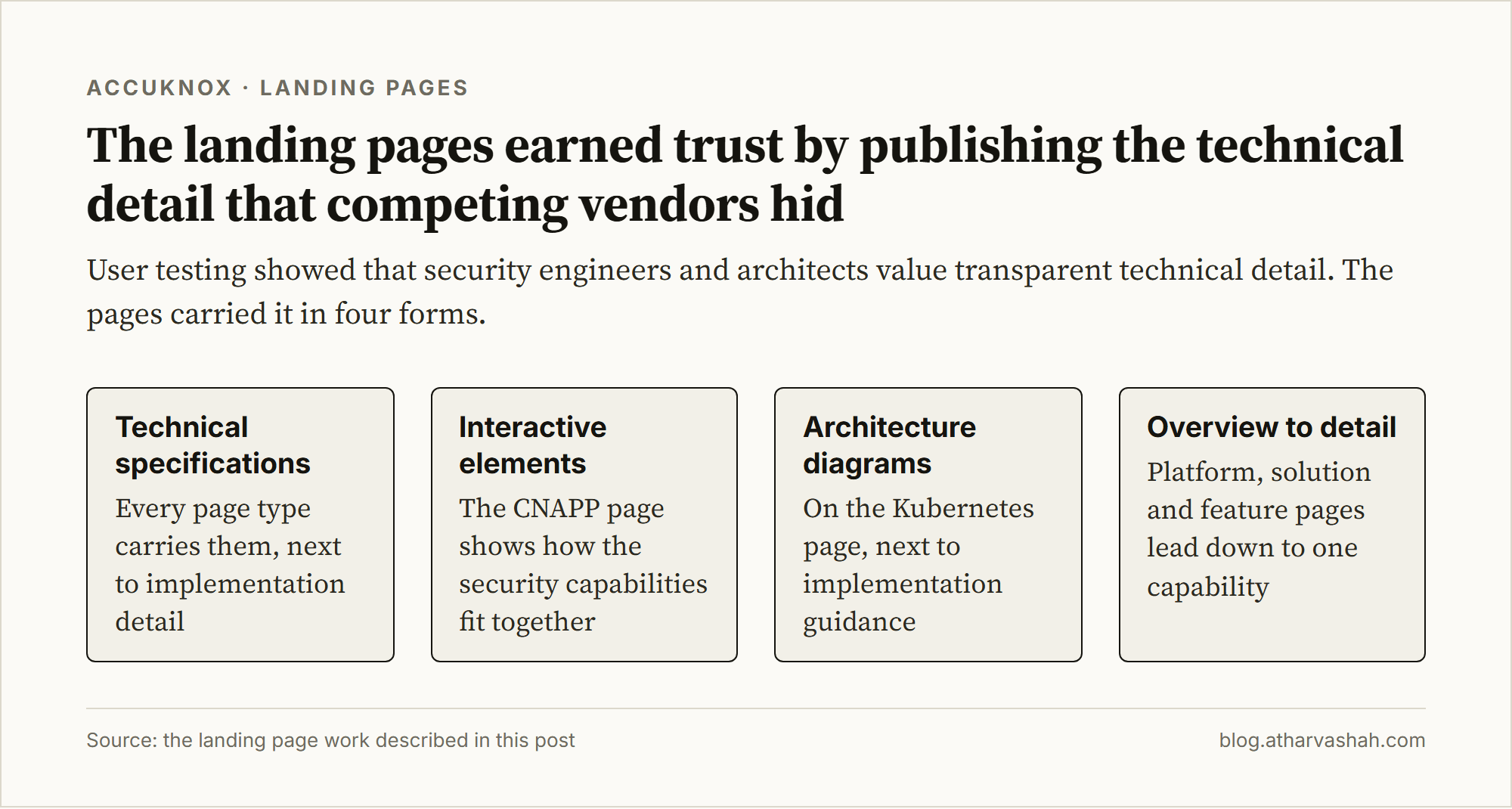
User testing showed that technical audiences value transparent technical detail. So our pages carry specific information on implementation approaches, technical limits, and performance. Competing vendors hide that detail. Publishing it built credibility with security engineers and architects.
One page worked better than the rest. Our Solution Comparison page compares AccuKnox against alternative approaches to cloud-native security. It drops the marketing claims and shows capability comparisons with technical evidence. Technical evaluators responded to that.
Performance Optimization and Technical Infrastructure
Analytics revealed that page load times were dragging down user engagement, so performance work became a real focus. I moved images to WebP with responsive loading to cut bandwidth without losing quality. I minified CSS and JavaScript to shrink file sizes and parsing time. I set pages to load progressively, so the above-the-fold content arrived first and everything else waited. I tuned browser and server caching for the return visitor, and I put a CDN in front of the whole site to cut latency for visitors outside our home region.

These changes gave measurable results. Average page load time fell by 42%. The mobile performance score rose from 68 to 91 on Google's PageSpeed Insights.
I also took on server management and uptime monitoring. With the engineering team I set up backup procedures and failover policies, which added server configuration, monitoring, and disaster recovery planning to my skills. A content role rarely carries those skills, but in a startup, responsibilities cross the usual lines.
The infrastructure work extended to analytics. I deployed full tracking across our digital properties, configured event tracking for the interactions that mattered, and built dashboards on top of it. That infrastructure supports a data-driven call on content priorities and user experience.
After two years, AccuKnox's digital presence changed from a basic website into a complete technical resource, tuned for both user experience and business outcomes.
Marketplace Listings, Analytics, and Webinar Production
Past content and website work, my role took on specialized technical marketing. It covers marketplace management across cloud providers, analytics for decision making, and technical support for events and webinars.
Marketplace Management Across Cloud Providers
As AccuKnox expanded its go-to-market strategy, cloud marketplaces became critical distribution channels. I managed our presence across AWS, GCP, Azure, Oracle, Alibaba Cloud, and VMware. The work is technical and operational, and it sits well outside traditional marketing.
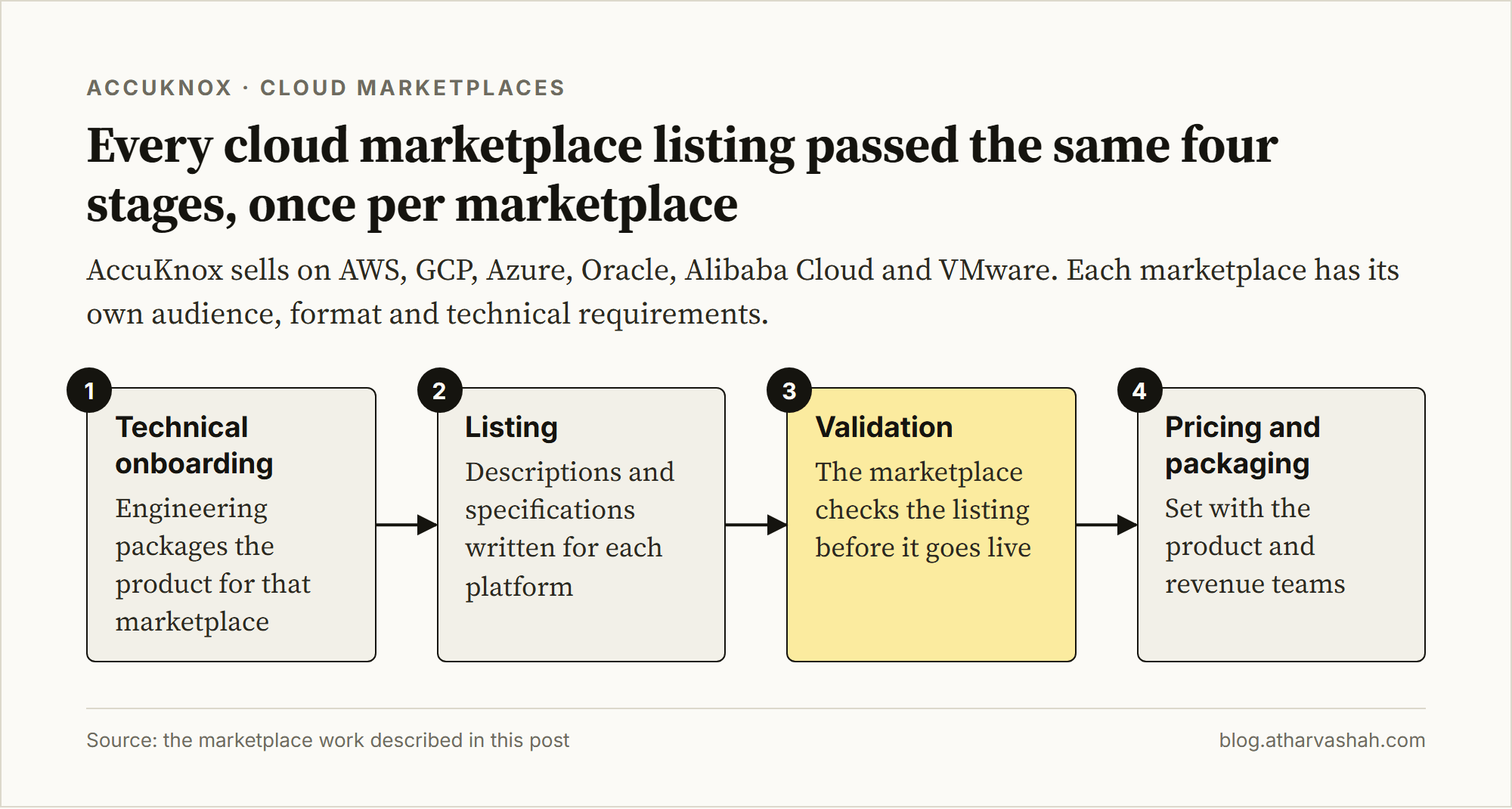
Each marketplace needed its own technical onboarding, which meant working closely with engineering to package the solution for that environment, configure deployment templates, and meet marketplace-specific requirements. I wrote marketplace-specific product descriptions and technical specifications for each platform's own audience and format. Before a listing could go live, the marketplace validated it technically, and I coordinated that process and addressed the feedback. I also worked with product and revenue teams on pricing and packaging for each marketplace, weighing consumption models, marketplace fees, and how competitors priced the same capability.
On the AWS Marketplace I helped configure AMI, or Amazon Machine Image, deployments plus CloudFormation templates, for a one-click deployment of the platform. On GCP I worked with engineering on container configurations and deployment scripts. The hardest part was keeping product functionality consistent across environments that each had their own constraints.
Beyond basic listings, I built lead management for marketplace inquiries, connecting marketplace consoles to our CRM so a marketplace lead got a timely follow-up and proper revenue attribution.
Analytics Implementation and Decision Making
I built a complete analytics infrastructure across our digital properties, well past basic traffic measurement. I tracked our website, help documentation, event pages, and other digital assets through Google Analytics, Tag Manager, and custom event tracking. I built dashboards in Looker Studio that showed key metrics, user journeys, and conversion patterns. The main dashboard became a central resource for marketing planning.
I configured conversion tracking to map a user's path from first content interaction to a product evaluation request, so we could see both the successful paths and where people dropped off. I added multi-touch attribution to understand which content and channels actually drove a conversion, and I tracked scroll depth, time-on-page, and other signals of real engagement.

The technical build needed JavaScript tracking code, API integrations, and data visualization work. I wrote custom tracking scripts for specialized interactions and configured event sequences to capture a meaningful user journey.
The data changed content strategy directly. Technical blog posts on Kubernetes security beat every other topic on traffic and conversion, so we expanded that domain. A visitor who read technical documentation before a demo request converted 3.8x more often than one who skipped it. A visitor who read a technical deep dive started a trial 2.7x more often than one who read an overview page. Those two numbers moved our resources toward technical validation content and away from high-level marketing material.
Heat map analysis of landing pages showed where user attention actually went, which informed design changes. Funnel analysis found where a form was losing people, and we fixed the interface around it.
Event Support and Webinar Infrastructure
Technical events and webinars became important channels for showing off AccuKnox's capabilities and reaching the security community. I gave technical support for these activities, past basic marketing functions.
For major industry events like KubeCon and the RSA Conference, I built scripted product demonstrations that could still flex for a spontaneous audience question. I wrote event-specific materials that mixed marketing messaging with real technical depth. I configured demo environments and interactive displays for the booth, inside the physical limits of an event floor.
For webinars, my job expanded into technical production. I set up and tested our webinar platform, mainly Restream, for reliable delivery across YouTube, LinkedIn, and Facebook at once. I built presentation materials that carried real technical content, not just promotion. I ran polls, Q&A, and live demonstration segments to keep the audience engaged. I configured recording and post-processing, and set up distribution so a webinar kept generating value long after it aired.

The technical side of webinar production was harder than it looked. I learned to troubleshoot audio and video problems, manage streaming configuration, and keep delivery consistent across very different viewer setups. That took real understanding of video encoding, streaming protocols, and audience connectivity.

The Marketing Stack We Grew Into
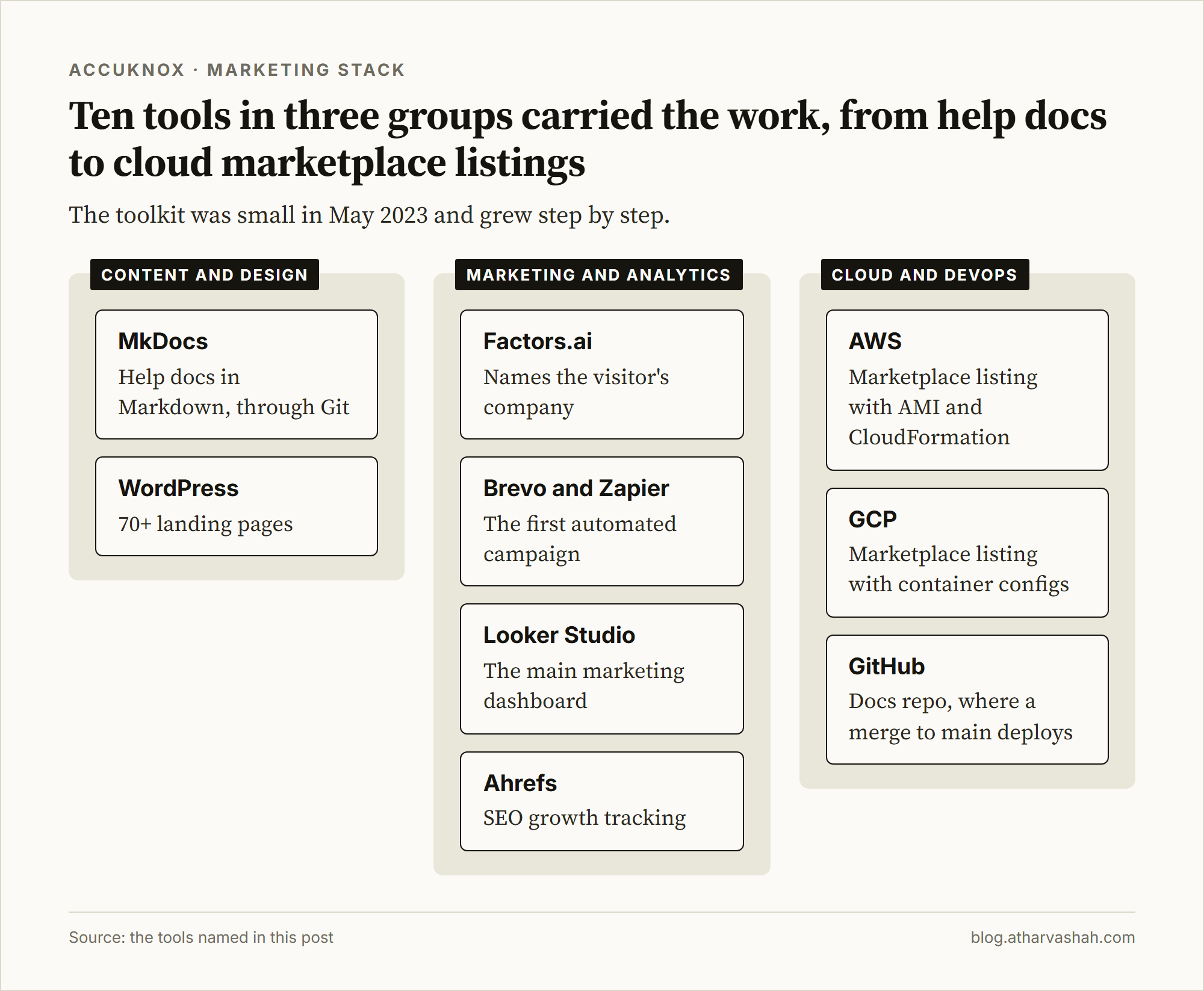
Technology Stack Evolution
My two years at AccuKnox ran on a marketing technology stack that kept growing. Our toolkit was small when I joined. We expanded it step by step for efficiency and impact.
The move from basic content management to marketing automation was a steep curve. I remember our first integrated campaign on Brevo and Zapier, where manual coordination across several team members became one automated workflow. The change went past efficiency. It changed how we planned a campaign.
Factors.ai changed our website visitor intelligence. Before it, basic analytics gave us generic insight. Factors.ai names the visitor's company and segments the audience precisely. That changed how we personalized content and ranked lead follow-up. The capability mattered most in Q3 2023, when cloud security budgets tightened across the industry and we had to convert more of the traffic we already had.
Interactive product demos on Arcade and Storylane were a second turning point. We noticed buyers increasingly wanted to try a product before they talked to sales, so we leaned into it. These platforms needed technical configuration, and they also needed a rethink of how we told the product story. The demos raised qualified lead conversion by 27% in the first quarter.
Cloud Platform and Security Tool Expertise
My technical skills went past marketing tools into the cloud platforms and security technologies of this industry. That double expertise turns a complex technical concept into a strong marketing story.
GCP Marketplace, AWS Marketplace, and Azure Marketplace all needed the technical base of cloud environments. I learned the marketplace mechanics and the architecture questions that drive a customer decision. That knowledge mattered in our multi-cloud expansion in late 2023, when I had to state our different approach on each platform.
The security domain was a steeper curve. YAML policy configuration for Zero Trust took me from marketing terms to practical work. I spent one weekend inside the CNCF's Security Technical Advisory Group documentation, and our content became more accurate for it.
My hands-on time with security testing tools like KubeGoat and Kubescape proved valuable during the Log4j vulnerability crisis. When that critical vulnerability surfaced, our team needed to move fast and explain the implications for Kubernetes environments. That prior hands-on time let me publish accurate diagrams and explanations within 24 hours, which made AccuKnox a thought leader during the crisis.
The emerging field of AI security presented another frontier. As large language models gained ground through 2023, I spent real time on the security challenges they present. That work paid back when we launched ModelKnox, our AI security product. I could state the technical risk of LLM poisoning and explain our mitigations with credibility.
Automation and Efficiency Improvements
Automation became a central theme in my technical skills, driven by both personal interest and plain necessity. As our marketing initiatives grew, manual processes stopped scaling.
Python became my primary automation tool, from data transformation to asset generation. One project addressed our Excel sheet management problem. With multiple people contributing to campaign tracking spreadsheets, data inconsistency had become a real issue. I built a system that standardized inputs, calculated key metrics, and generated executive summaries with no manual work. It saved approximately 12 hours a week and improved data integrity across reporting.
Web performance automation was another useful project. Site speed affects both user experience and SEO, so I set up automated performance monitoring with Lighthouse CI. The system flagged performance drops immediately and alerted the development team when a threshold was crossed. Core web vitals improved 32% over six months.


The real payoff went past efficiency. Cutting the mundane work freed up time for strategic thinking and actual creative work. Our CEO framed it simply: automation freed up capacity for the work that actually mattered.
How AccuKnox Runs: Flat, Remote, and Documentation-First
A Flat Structure and the Third-Month Documentation Pitch
AccuKnox's leadership balances strategic vision with tactical execution better than anywhere I had worked before. Our CEO, Nat Natraj, is unusually accessible for someone at his level. Ideas move on merit rather than on organizational rank.
In my third month I presented a radical redesign of our documentation system. I expected a quick no. Instead I got real engagement, questions that pushed the idea further, and then approval. That is the version of meritocracy that actually defines AccuKnox.
The leadership team runs open board meetings and shares financial updates, both rare in the startup world. The cybersecurity funding climate shifted hard in late 2023. Leadership shared what that meant openly and brought the whole team into the strategic pivots that followed. That built real collective ownership, and it held through the hard quarters.
Cross-functional work thrives here because people can push back without a career cost. Engineering, product, and marketing act as partners rather than as silos, which mattered during our CNAPP platform launch, where the technical build and the market message had to line up exactly.
The team's diversity covers thinking styles and professional backgrounds as much as demographics. Our weekly syncs carry former CISO practitioners, academic researchers, and commercial software veterans. That mix is rare in an early-stage company, and it helps us anticipate a market need early instead of late.
Learning Opportunities and Skills Development
AccuKnox backs professional development with real investment, not lip service. The partnership with KodeKloud shows the approach. It gives unlimited technical training, which most companies reserve for engineering. That took me from basic container knowledge to advanced Kubernetes security, and our marketing material got more accurate for it. Security practitioners, who mostly ignore vendor publications, started reading our technical content anyway.
Beyond formal training, our "Network and Learn" sessions create regular knowledge transfer. These weekly gatherings alternate between an outside expert and an internal deep dive, which keeps a steady cadence of learning going.
Learning here goes past technical domains into communication and leadership. Our CEO's push for clear writing has changed how the whole organization writes. He shares annotated examples of both strong and weak communication, which teaches more than generic advice ever does. That habit shaped my own writing, especially in how I break down a complex technical concept.
Async First, Meetings Only When Necessary
AccuKnox is fully remote by design, not by compromise. It built its practices around geographic distribution from the start.
Asynchronous documentation is the primary information channel here. Synchronous meetings are reserved for real collaboration, not status updates. That has built a documentation-centric culture where writing something down beats saying it out loud. Detailed pull request templates and full project briefs are the norm, not the exception.
The team is deliberate about which collaboration tools it adopts, weighing integration with existing workflows and not just features. That discipline has kept us from the tool sprawl that fragments communication in a lot of remote teams. Our stack of GitHub, Slack, and Notion stays small on purpose, with a clear job for each one.
The social side of remote work gets structured attention rather than being left to chance. Regular virtual coffee pairings build cross-functional connections, and quarterly off-sites build deeper team bonds.
Performance management here leans on outcomes over activity. Clear objectives give direction, and individual autonomy in execution builds ownership. The documentation project showed the pattern directly. I got a clear goal on user experience and full autonomy on how to reach it.
Work here is visible by default, which builds a kind of accountability through transparency rather than through oversight. Key decisions get documented in shared spaces instead of staying in private conversations, and that has sped up execution while cutting down on misalignment.
What Two Years Taught Me About This Job
Technical fluency is the real foundation of cloud-native marketing. You have to understand and explain Kubernetes admission controllers, container runtime security, and multi-cloud architecture, not just describe them. You learn what a technology does, how it works, and how it fits an enterprise environment. The "Zero Trust for Kubernetes" whitepaper proved the value of that depth. Technical accuracy built credibility with security practitioners who ignore vendor content otherwise.
Systems thinking separates the effective professional from the rest of the field. Cloud-native environments connect everything, so you have to learn the interactions between technologies, not just the technologies themselves. That let me write about real architectural problems instead of isolated product features. The resulting content landed with architects and security leaders who deal with integration problems every day, and engagement ran 31% higher than on feature-focused pieces.
Empathetic communication rounds out the set. The skill goes past simplifying a technical concept, into understanding the knowledge, concerns, and objectives of a specific reader. Our role-based content paths for the CNAPP offering show the approach. Security leaders, platform engineers, and compliance professionals each get a separate narrative, all covering the same technical ground from a different angle.
The tension between technical depth and communication clarity is the defining challenge of this job. Audience calibration is the real answer, precise adjustment to what a specific audience already knows rather than generic simplification. Our CNAPP messaging splits into distinct technical tiers, an executive overview, an architectural explanation, and an implementation detail, each one technically accurate but pitched at a different depth.
A good analogy does more work here than most people expect. I built a "security checkpoints" analogy for Kubernetes admission controllers, and security leaders without Kubernetes background understood it immediately while it stayed technically correct.
Progressive disclosure solves the same problem structurally. A layered content architecture lets a reader choose their own depth, so nobody has to pick between accessibility and completeness. Our documentation's tiered structure works this way, with conceptual overviews linking down to progressively deeper technical explanations.
Visual communication is the last lever. The architectural diagrams for our cloud workload protection use visual hierarchy and selective detail so a complex security architecture reads clearly even for a non-technical reader.
Two years in, the job keeps changing faster than I can fully document it. New threats show up, the product roadmap shifts, and the writing has to keep pace with both. Invest equally in technical understanding and in communication, because neither one alone gets you very far in this field.
Related reading: The Future of Leadership Is Fluid and Meritocratic and DevRel Uni Cohort 7: Takeaways From 5 Sessions.


This explains why most B2B content misses engineers. The process is the real takeaway.
Here's the TL;DR version of this:
• Technical content fails without technical fluency.
• Learning the stack precedes explaining it.
• Output scales through systems, not effort.
• Engineering trust beats marketing polish.
• Method matters more than volume.