



At CES in January 2025, Nvidia CEO Jensen Huang told a reporter that practical quantum computing was still at least fifteen years away. Quantum computing stocks lost more than $8 billion in value within a day, according to Tom's Hardware. Five months later, at GTC Paris, Huang reversed himself. He said quantum computing had reached an inflection point, and Nvidia followed up by launching NVQLink, a standard that connects seventeen quantum hardware builders and nine U.S. national labs to Nvidia GPUs.
Huang never said quantum computers would train the next Llama model from Meta. He described quantum processors as accelerators that sit beside GPUs. That distinction carries the whole argument of this piece: training belongs on GPUs, and quantum hardware cannot take that job over. The reason is architectural, not a gap that better hardware closes later.
Matrix Multiplication Doesn't Need Superposition
Training a large model reduces to matrix multiplication, enormous grids of numbers multiplied against each other, over and over. Meta's own paper, "The Llama 3 Herd of Models," puts the training run for its 405B model at 3.8 x 10^25 floating-point operations. That run used 30.84 million GPU-hours on Nvidia H100 chips.
Run serially on a single GPU, that is roughly 3,520 years. Spread across the 16,000-GPU cluster Meta actually used, the same math finished in about 80 days. That is parallel computing working exactly as intended.
A qubit holds superposition, both zero and one, until you measure it, so it is tempting to think a quantum computer could run that same math all at once. Training does not want a probability. Every gradient update needs one deterministic number, and a qubit's superposition collapses into a single random outcome the moment you read it out. That collapse happens on every step backpropagation takes.
A GPU Is Still a Zero-or-One Machine
The jump from CPU to GPU was smooth because both are transistor-based, and both store information the same way: a zero or a one, carried on an electrical signal. Deterministic, and compatible with everything built before it.
A quantum processor stores a qubit's state probabilistically, zero and one at once, until measurement forces one answer. Training an LLM on a QPU (quantum processing unit) would mean encoding deterministic tokens into those probabilistic states.
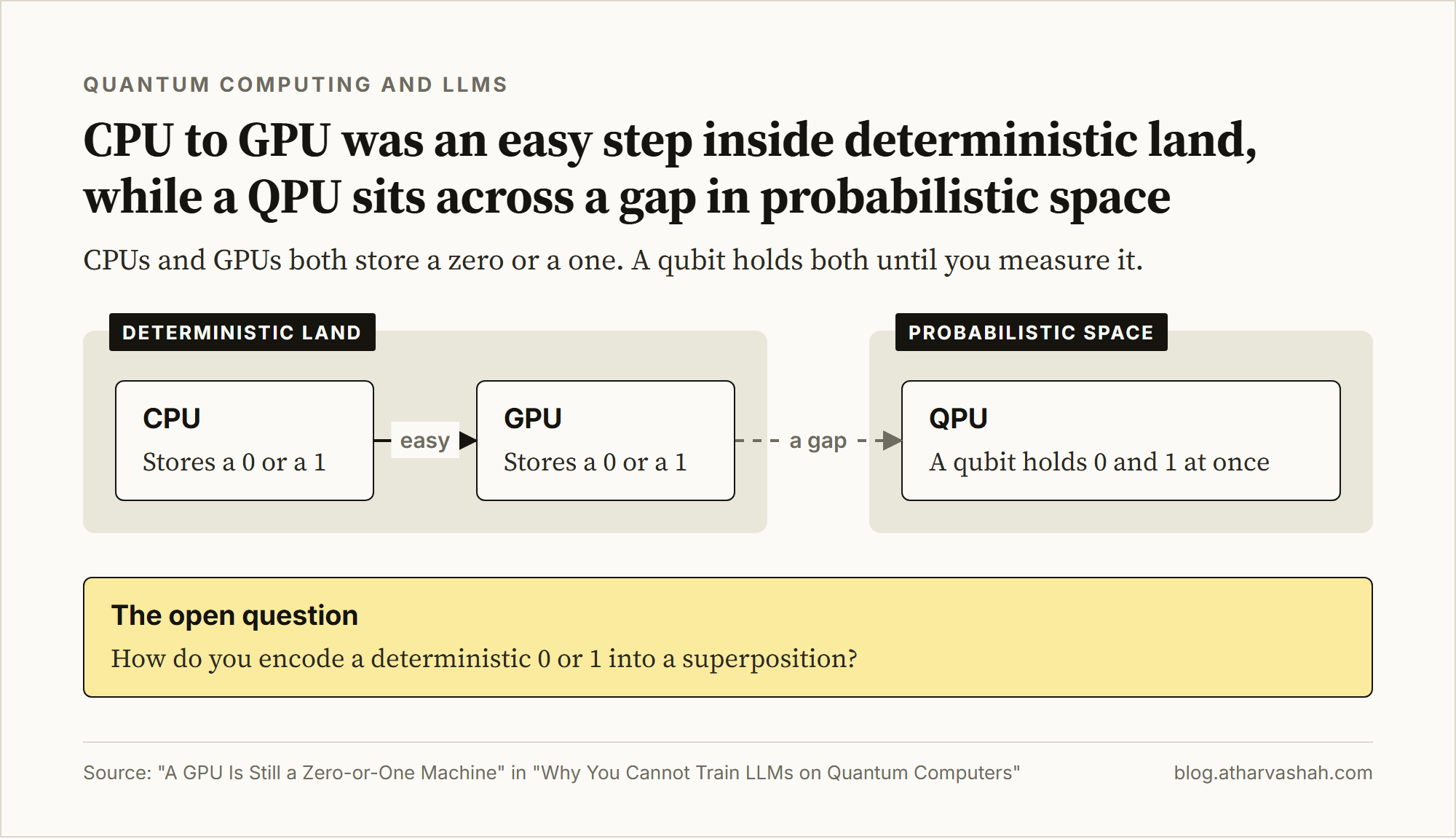
If you force a quantum computer to think deterministically, you have asked it to give up superposition, the one property that makes it quantum in the first place.
Where Quantum Computing Already Has a Job
GPUs replaced CPUs for parallel, computation-heavy work, but nobody retired the CPU. It still runs a browser, a spreadsheet, an email client, because those jobs never needed GPU-scale parallelism. That same kind of role now describes quantum hardware: a specialist for a narrow set of problems, not a general replacement for the hardware training already uses well.
Nvidia's Own History Explains What Quantum Computing Still Needs
Before Nvidia became the AI industry's default chip supplier, it built its business on gaming, a market other chipmakers had considered too small to chase seriously. Gaming gave Nvidia the volume to fund a decade of GPU research, years before AI training was a line item on anyone's budget. Nvidia crossed $5 trillion in market value in October 2025 and $5.5 trillion in May 2026, making it the most valuable public company in the world.
No comparable market exists yet for quantum computing. NVQLink is one attempt to build one. It wires seventeen quantum builders, IonQ and IBM among them, directly into Nvidia's GPU ecosystem as accelerators rather than rivals.


IonQ and IBM chase the same goal, an error-free qubit, with different hardware. IonQ traps ions in a vacuum chamber, lets any qubit connect directly to any other, and reported 99.99% gate fidelity (how often a qubit operation runs without error) on its EQC prototype in October 2025. IBM builds qubits as superconducting circuits on a chip, which scales more easily, and its systems now reach beyond a thousand physical qubits.
Neither approach solves the determinism problem above. IonQ bets on accuracy before scale, and IBM bets the other way, but both still need to solve determinism before either bet matters for training.
Qubit Counts Miss the Real Bottleneck
The race to add qubits has run for years, but qubit count is not the real constraint. In classical computing, Moore's Law said transistor counts on a chip double roughly every two years. For quantum hardware, that pace is too slow: most frontier labs run in the hundreds of qubits today, and doubling every two years puts them under 10,000 qubits by 2034.
The real problem is error, not count. A qubit's probabilistic state is easy to disturb, and it resists the kind of correction classical computing takes for granted. That resistance to a stable state, more than the raw qubit tally, is why a machine at IBM's current qubit scale still cannot host the deterministic math LLM training needs.
Huang tied his June 2025 inflection-point remark to the growth of error-corrected logical qubits.
Where Quantum Hardware Actually Belongs
Quantum computing may end up serving industries with no GPU equivalent at all, the way drug discovery and materials science need answers no classical computer can approximate. Or LLMs stay on GPUs the way spreadsheets stay on CPUs, a settled tool for a settled job, while quantum hardware waits on error correction to catch up to its promise.
Huang's own reversal, from fifteen years away in January to a GPU-quantum standard shipping five months later, shows the industry has already moved on to that question. Related reading: How AI Video Generation Actually Works and Cyborg Ethics: Engineering the Soul of a Machine.



The Ferrari-in-traffic analogy works perfectly. Problem selection matters more than raw capability.
Here's the TL;DR version of this:
• GPUs already solved deterministic parallel computation efficiently.
• Quantum systems operate probabilistically by design.
• Forcing quantum into LLM training wastes its strengths.
• Hardware shifts only matter when paired with the right problems.
• Quantum needs a native use case, not a benchmark race.