

Why the Next Decade Will Rewrite Human Civilization
AI, clean energy, and bioengineering hit exponential curves simultaneously. Cheers to the new age.

Something happened.
Not gradually. Not predictably.
Three separate technological revolutions hit their exponential curves at the same time.
This doesn’t happen.
The printing press didn’t arrive alongside steam power and antibiotics.
The industrial revolution didn’t coincide with nuclear energy and the internet.
But right now?
Right now we got all three at once.
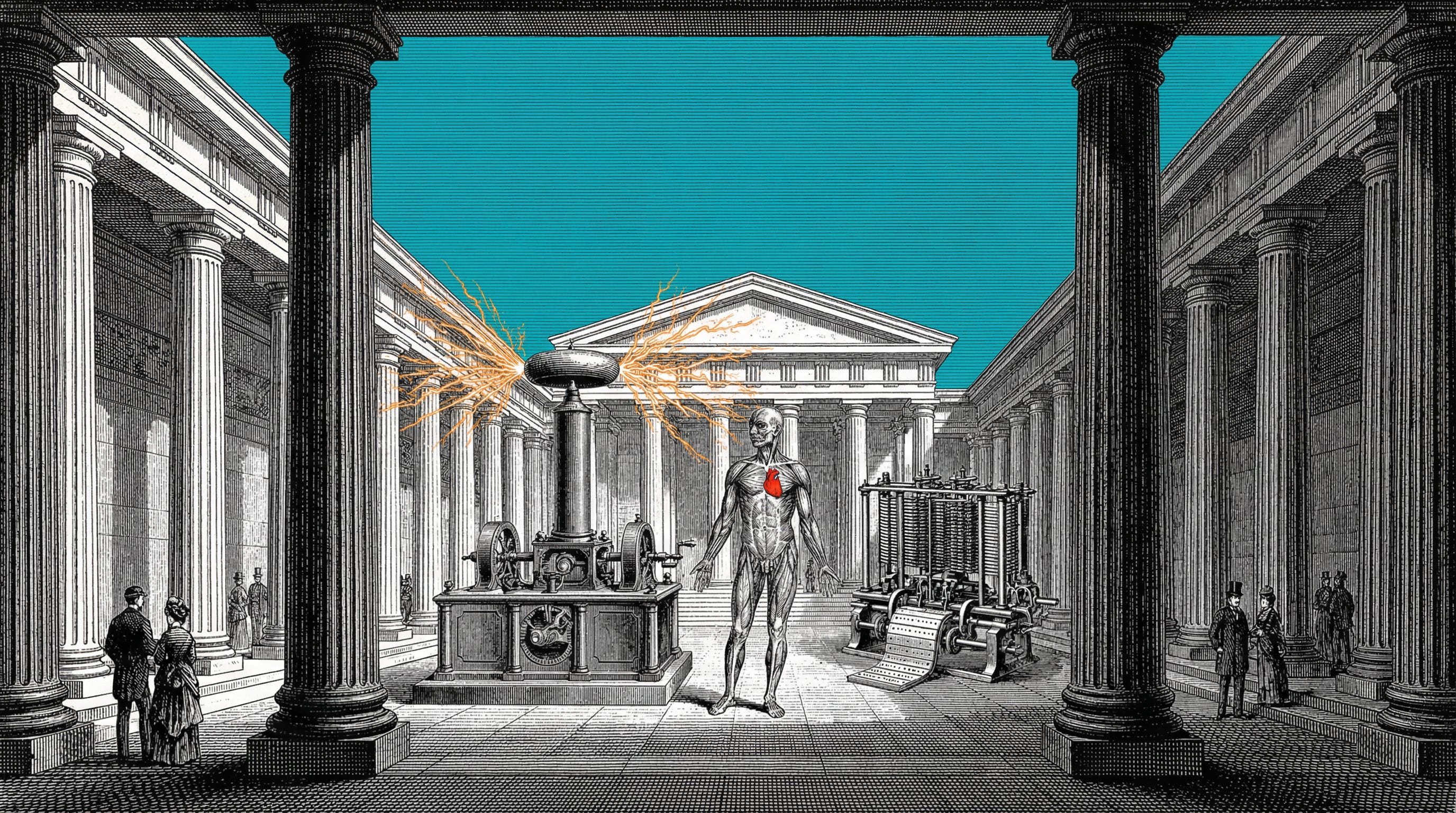
The Three Engines
1. AI: The Bronze Age Moment
November 2022.
ChatGPT 3.5 launches.
You might remember it as “that chatbot thing.”
History will remember it as the starting gun.
Not because ChatGPT was perfect.
Because it was obvious.
For the first time, non-technical people saw what had been building.
The moment when AI stopped being a research problem and became a civilizational fact.
Think about it this way:
Mechanical engines augmented human muscle.
AI augments human cognition.
We just entered the Iron Age for thinking.
This isn’t a product category.
It’s a step-change in human capability.
Irreversible. Fundamental. Already here.
2. Clean Energy: When Physics Beats Economics
Here’s the thing about oil:
You have to find it.
Extract it.
Ship it.
Every barrel costs roughly the same as the last one.
Commodities don’t get cheaper.
But solar panels aren’t commodities.
They’re technology. Manufactured technology.
And manufactured technology follows a simple rule:
Every doubling of production → 20% cost drop.
This has held for decades.
Solar got cheaper. Then cheaper still.
Now it’s the cheapest energy in human history.
And it’s still getting cheaper.
Batteries? Same curve.
Solid-state batteries? Already here, continuing the trend.
We’re not running out of sun. We’re not running out of manufacturing learning curves.
For the first time in history, energy is becoming abundant.
Not because we found more stuff to burn.
Because we learned to manufacture abundance.

3. Bioengineering: The $3 Billion Problem That Costs $100
2003: First human genome sequenced.
Cost: $3 billion. Time: 15 years.
Today: $100. Soon: $50.
That’s not a cost reduction.
That’s a phase transition.
CRISPR emerged about 15 years ago.
You can now edit the genome of any living thing.
Cheaply. Easily. Precisely.
Cultivated meat isn’t science fiction—it’s grown from a cell in a vat, actual meat, no animal required.
We’re not just observing biology anymore.
We’re designing it.
Same exponential curve as solar.
Same manufactured abundance as AI.
The Problem
These three technologies are the foundation for an entirely new civilization.
Not an upgraded version of the current one.
A different one.
But we’re still running on:
Financial Capitalism (designed for scarcity, not abundance)
Representative Democracy (designed for slow-moving agrarian societies)
Nation-States (designed before we could coordinate 10 billion people digitally)
The technology moved. The institutions didn’t.
What Breaks First
The current economic system works great if you’re in the top 10%.
Incredible if you’re in the top 1%.
It doesn’t work for the other 80%.
And when energy becomes abundant?
When intelligence becomes abundant?
When we can manufacture biological solutions?
Scarcity-based capitalism stops making sense.
Representative democracy was brilliant for 1789.
But we now have the technology for real-time, digital coordination.
Why are we still voting once every four years?
Nation-states made perfect sense when communication took weeks.
But we’re about to coordinate 10 billion people on one planet with finite resources.
Global problems need global coordination.

The Rebuild
This isn’t about fixing the current system.
You can’t patch Bronze Age institutions with Iron Age tools.
You rebuild.
From Financial Capitalism → Sustainable Capitalism
From Representative Democracy → Digital Democracy
From Nation-States → Global Governance
The foundation is already poured.
AI works. Clean energy works. Bioengineering works.
Now comes the hard part: Building the civilization that can actually use them.
The Choice
We’re in the moment.
Not approaching it. Not preparing for it.
In it.
The starting gun fired in November 2022.
Most people are still in the locker room.
But ready or not?
The race has started.
And this time, we’re not just upgrading the engine.
We’re building a new vehicle entirely.
The only question is whether we’ll design it consciously.
Or let it design itself.
The simultaneous curve crossings are the key insight. Scarcity-era systems cannot survive abundance-era tools.
Here's the TL;DR version of this:
• Multiple exponential technologies crossed viability at the same time.
• This has not happened in any previous industrial shift.
• Institutions are still designed for scarcity economics.
• AI, energy, and biology are manufacturing abundance.
• Systems will either be rebuilt intentionally or fail reactively.