

Token Anxiety and the Illusion of Productivity
You're leaving parties early to check on agents. You're lying in bed thinking about what you can spin up. We need to talk.

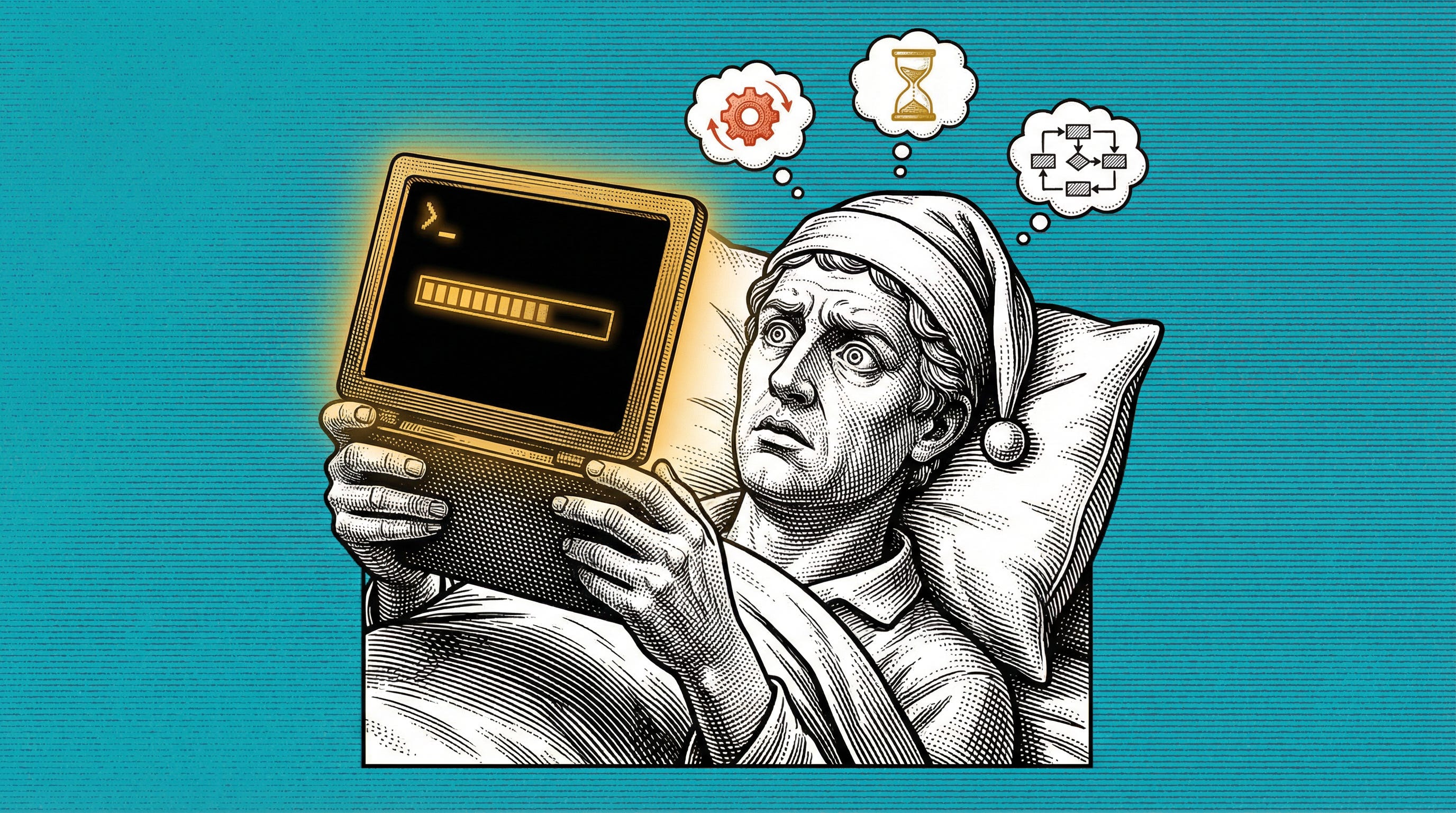
Something is rotting in the developer brain, and nobody wants to name it.
I’m going to name it.
It’s called Token Anxiety. And if you’ve written a single line of code in the last six months, you’ve felt it. That low-frequency hum behind your eyeballs. That itch to check on a running agent while someone’s talking to you at dinner. That creeping suspicion that while you’re doing literally anything else, something could be running, and it isn’t, and that’s somehow your fault.
Let me explain.
The Old Buzz
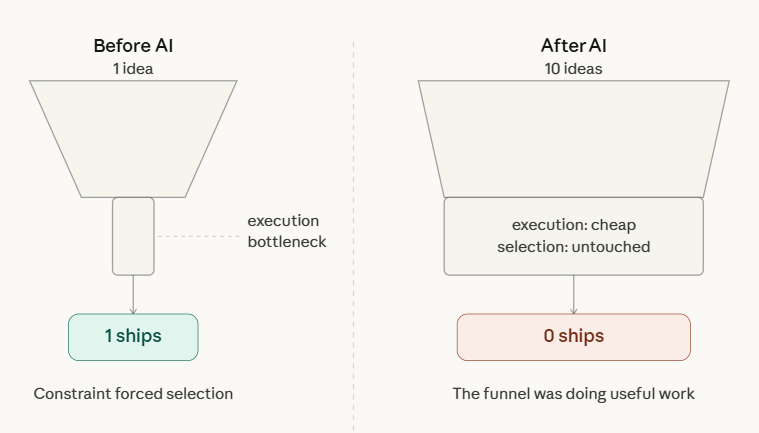
Every programmer who’s been at it long enough knows this feeling: you hit a wall. Some gnarly bug, some architectural knot that your conscious mind can’t untangle. So you step away. Take a shower. Go for a walk. And somewhere between shampoo and conditioner, it hits you. The solution just lands. That white-flash moment where the entire architecture clicks into place like a dislocated shoulder popping back in.
That was the old buzz. It felt like a superpower.
The dark side was subtle. You’d sit at dinner, physically present, mentally spiraling. You could feel the gears turning behind your ears even when you weren’t actively thinking about the problem. Friends are talking, food is getting cold, and you’re halfway inside a function signature you can’t let go of. If you’ve been coding long enough, you know this feeling. It’s intimate. It’s almost romantic, in a sick way.
That buzz used to be intermittent. You had to earn it. A hard enough problem had to show up first.
Now? The buzz is permanent. And it isn’t coming from your brain anymore.
It’s coming from the machines.
The Permanent Vibration
There’s this culture taking shape among developers right now, and it’s genuinely unsettling.
Someone leaves a party at 9:30 on a Saturday. Not tired. Not sick. They want to get back to their agents. Nobody questions it. Half the room is thinking the same thing. The other half is checking agent progress on their phones at the party itself.
Startup founders are publicly declaring they’re giving up alcohol so their brains stay “maximally pristine” to “sling 10,000 lines of code a day.” People openly saying they replaced watching movies with watching Claude output. Lying in bed, not sleeping, thinking about what they can spin up before they lose consciousness. What can I run while I’m out?
Reading a novel feels indulgent.
Watching a movie without a laptop open feels wasteful.
This voice in your head: something could be running right now.
It just doesn’t shut off.
That’s Token Anxiety. And the scariest part? The anxiety is rational. Which is exactly why it sticks.
The Rational Trap
Every week, some new benchmark drops that makes last month’s workflow feel prehistoric. A new model ships overnight. Context windows double. Opus gets faster. Sonnet gets cheaper.
None of this reduces the pressure. It multiplies it.
You can do more now, and someone already is. The window to being first at anything, building anything, shipping anything, feels like it shrinks by the day. Literally by the day.
Tech circles used to feel like this raw, electric field of opportunity. “There’s so much to build. Come try things.” There was excitement. Genuine, infectious, reckless optimism.
Now look at the same circles. The energy has inverted. It’s no longer “come build exciting things.” It’s “I better keep working because if I stop for an hour, it’s all escaping me.” The tone shifted from opportunity to desperation. From “I get to build” to “I must build or I drown.”
That’s a completely different animal. And it’s eating people alive.
The Faustian Bargain of Vibe Coding
I’ll be honest. I’ve been forcing myself into this vibe coding world. Building things with agents, spinning up projects through conversational prompts, really trying to understand what the hype is about.
Here’s what actually happens.
The beginning is seductive. The idea is simple. You can describe it in a few words. The rough scaffold comes up fast. MVP in hours. Feels electric.
Then the fixes start. Each fix requires more prompting. More waiting. More context-loading. The cycle is brutally long. Worse than a Rust compile cycle. And each fix spawns two more things you want to tweak, and those spawn two more. The work grows exponentially.
But here’s the insidious part. Because each new project is so easy to start, you end up with four or five things spinning simultaneously. All of them in the crappiest versions of themselves. All of them demanding your attention. You’re constantly babysitting small steps, typing out explanations in English to fix things that would take 10 keystrokes in actual code.
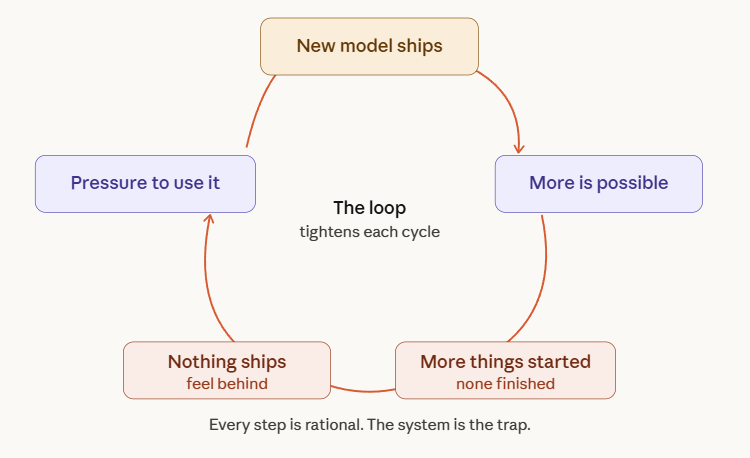
You’re building more than you’ve ever built in your life. And accomplishing less than ever.
10,000 lines of code in a day. Easy. But those 10,000 lines aren’t good. You don’t feel satisfied. You didn’t even build the right thing.
The Selection Problem
This is the part nobody talks about.
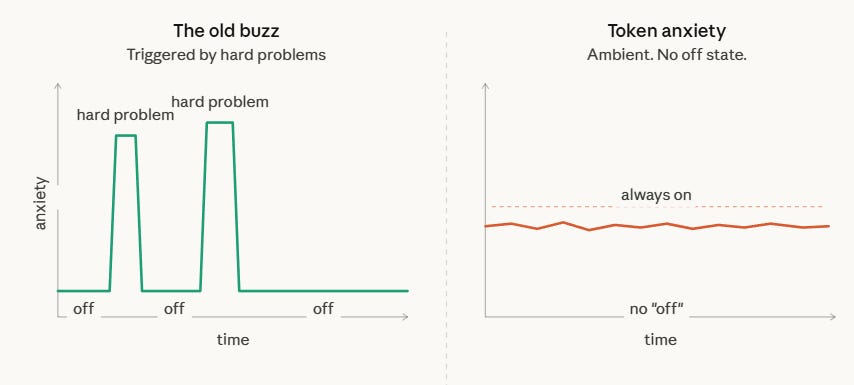
Before AI, you couldn’t try every idea. You had to be selective. You had to pick one problem, commit to it, and push through it. That constraint was a gift. It forced prioritization. It forced you to solve the right problem because you simply couldn’t afford to solve the wrong one.
Now you can have three or four ideas spinning at the same time. All of them half-baked. All of them growing in scope at an exponential rate. The work multiplies, the task juggling spirals out of control, the productivity metrics go through the roof.
And nothing ships.
People are spending $1,000 a day on API tokens. Building constantly. Jumping from project to project. Running agents 24/7.
And they have literally nothing to show for it.
The programming was never the bottleneck. The bottleneck was always choosing what to build. AI removed the wrong constraint. It made execution trivially cheap while doing absolutely nothing about the actual hard problem, which is deciding what matters.
The Split-Brain Problem
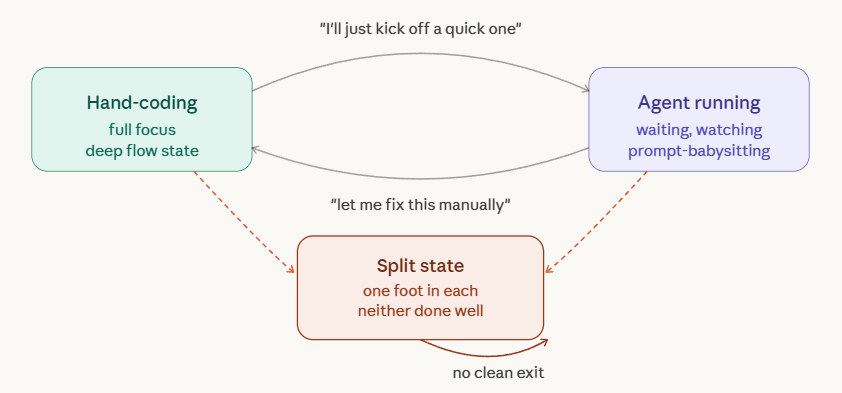
There’s this fracture happening inside every developer who straddles the old and new world. You’re hand-coding something, and halfway through a function, this thought creeps in: “I could vibe code this in 30 seconds.” So you kick off an agent. And now you’re standing in two worlds. One foot on the platform, one foot on the train.
You feel the pull of the agents constantly. “Better kick off a quick one.” “Let me just prompt this side feature real quick.” And that buzzing sensation keeps evolving, growing, compounding. It’s not productive energy. It’s anxious energy. The energy of someone who knows something could be happening and isn’t.
What This Actually Costs
Let me be direct.
I’ve been in that state before, long before AI was in the picture. The non-stop pursuit of building. Staying up through entire nights programming. Feeling anxious at social gatherings because part of my brain wanted to get back to the editor. Feeling like every minute spent not coding was a minute wasted.
It impacted friendships. It turned me into a process instead of a person.
AI agents are resurrecting that exact feeling. Except now it’s amplified, because the machine never sleeps. It’s always ready. There is always another prompt you could send. There is always another project you could spin up. The guilt of rest is infinite because the capacity for work is infinite.
That is not productivity. That is addiction dressed in a hoodie.
The Advice I’d Give Myself
One extra feature in your calendar app is not worth skipping a good evening with your friends.
One more agent run overnight is not worth the fog you’ll carry into tomorrow’s conversation with someone who matters.
The 10,001st line of code today will not be the one that changes your life. But the moment you miss tonight might.
Hard work is a vehicle. It is how you got here. But it is not who you are. The second you confuse the vehicle for the identity, you stop being a person and start being a process. And processes don’t have dinner with friends. Processes don’t read novels. Processes don’t watch movies with their full attention and feel something.
You are not a process.
The machines run without you. Let them. Turn off the terminal. Close the laptop. Leave the agents unsupervised for one single evening.
The code will still be there in the morning. The same bugs, the same half-baked MVPs, the same exponentially growing task lists.
But the people around you won’t always be.
Token anxiety is real. The pressure is real. But the thing you’re racing against isn’t a competitor. It’s a feeling. And feelings don’t ship products.
Ship less. Ship meaningful. Choose better. Live more.