

The $0 Lead Gen Channel Your Competitors Are Sleeping On
Demand capture converts at 3-5x cold outreach because the buyer already did the hard part.


Most marketing teams burn budget trying to manufacture interest. They write blog posts nobody asked for, run ads against cold audiences, and spray cold emails into inboxes where they die unread. The entire model is built on interruption. You are creating demand from zero, hoping that if you shout loud enough, someone in your ICP will eventually turn around.
There is an alternative. And it is brutally more efficient.
Instead of generating demand, you capture it. You find the people who already want what you sell - right now, today, in this thread, in this comment section - and you show up with the exact answer they are looking for. The cost difference is staggering. Demand generation is expensive because you are fighting inertia. Demand capture is cheap because the buyer already did the hard part for you. They raised their hand. They typed their pain into a search bar or a Reddit post. All you have to do is be there.
This is what social listening for lead generation actually looks like when it is done right.
The Economics Nobody Talks About
Think about what a single qualified lead costs you through outbound. You are paying for a sales rep’s time, a sequencing tool, data enrichment, and the opportunity cost of every email that bounces or gets ignored. A conservative estimate puts a single outbound-qualified meeting at $200-500 in fully loaded cost. Most of those meetings go nowhere.
Now compare that to intercepting a Reddit thread where a VP of Engineering is publicly asking “What CNAPP tools actually do runtime visibility well?” That person is already in-market. They have budget context. They have a problem that hurts today, not hypothetically. The cost to engage? Nearly zero. A well-crafted reply that adds genuine value. No ad spend. No sequence. No prayer.
The ROI math is not even close. Demand capture converts at 3-5x the rate of cold outbound because context and timing are already on your side. You are not convincing someone they have a problem. You are solving one they already articulated.
Reading the Room - Three Signals That Matter
Not every social post is worth engaging. The skill is in reading intent. After running this playbook across hundreds of threads, three signal patterns emerge that consistently convert.
The highest-intent signal is competitor frustration. Someone writes “We are moving off [Competitor] because their runtime visibility is lacking - any alternatives for CNAPP?” That person is not browsing. They are buying. They have already made the decision to leave. Your job is to show up with a direct comparison that focuses on the exact capability they just said is missing, and offer a migration path that feels effortless. This is the closest thing to a layup in B2B marketing.
The second signal is technical problem-solving. A post like “How are people securing LLM agents against prompt injection in production?” tells you someone is building right now and hitting a wall. They do not want a pitch. They want an architecture diagram, a code snippet, or a link to something that actually explains the solution. You provide that, and you have positioned your tool as the infrastructure layer beneath their entire stack. The sale comes later. The trust starts here.
The third signal is category research. “What is the actual difference between Agentic Security and traditional CSPM?” - this is someone early in their journey, trying to build a mental model. An educational response that defines the category clearly puts you in the position of the authority who shaped how they think about the space. When they are ready to buy three months from now, your name is the first one in their head.
Scoring Signals So Your Team Stops Wasting Time
Raw signal volume will overwhelm any sales team. You need a scoring layer that filters noise from opportunity. Every lead that surfaces through social listening gets processed through four dimensions before anyone touches it.
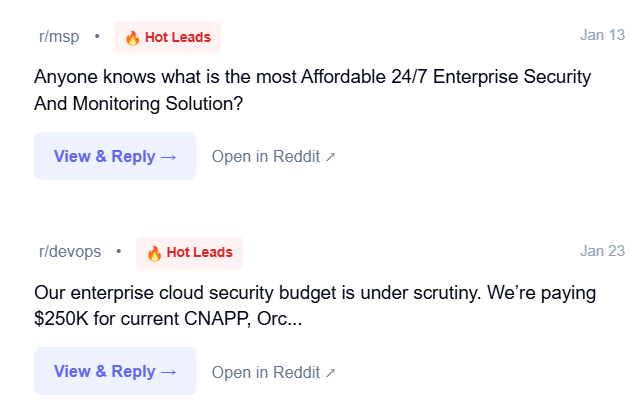
Relevancy score runs from 0 to 100 and measures how closely the keywords and sentiment in a post align with your core product offering. A post mentioning your exact category and a competitor by name scores high. A vague question about “cloud security” scores low. This alone eliminates 70% of the noise.
User authority matters enormously. The system analyzes the poster’s profile - LinkedIn title, Reddit post history, community reputation - to determine whether they are a researcher doing preliminary homework or a decision maker with purchasing power. A CISO asking a question on LinkedIn is a fundamentally different signal than an intern posting on r/cybersecurity.
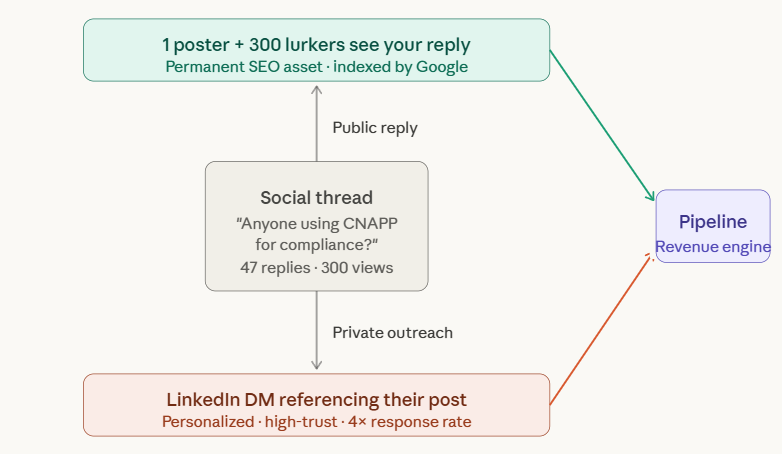
Thread velocity tracks engagement. A post with 47 comments and climbing means hundreds of lurkers are reading it. Your reply in that thread is not a one-to-one conversation. It is a one-to-many broadcast, and every person reading it is self-selected for interest in the topic.
Sentiment analysis differentiates between casual curiosity and genuine pain. “Just wondering about X” is neutral. “We are hemorrhaging money because X does not work” is urgent. The scoring matrix weights urgency heavily because frustrated buyers move fast.
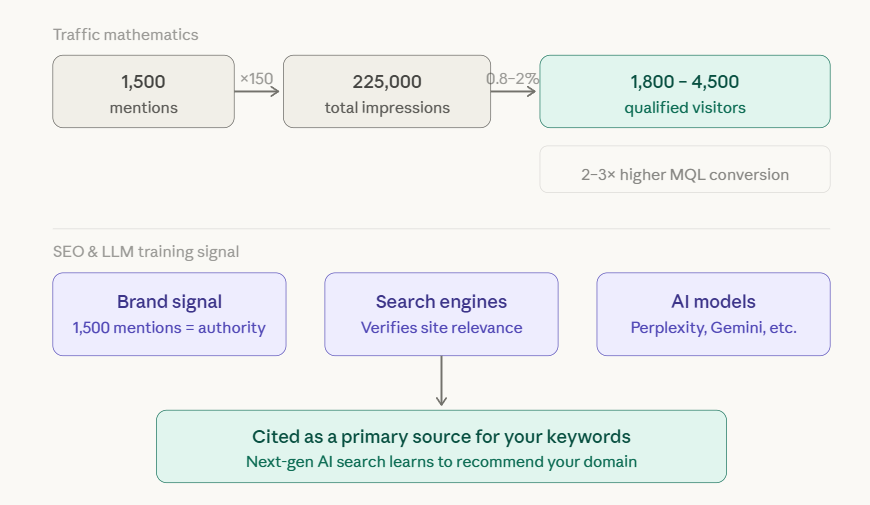
From Anonymous Handle to Pipeline
Here is where most social listening efforts fall apart. They generate engagement but never connect it to revenue. The gap between an anonymous Reddit username and a qualified opportunity in your CRM feels impossibly wide. It is not.
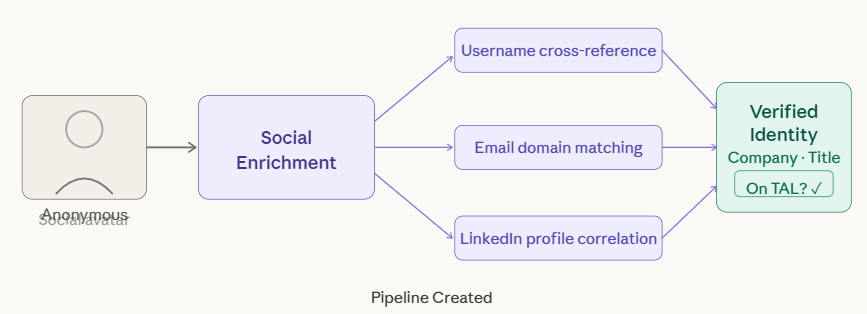
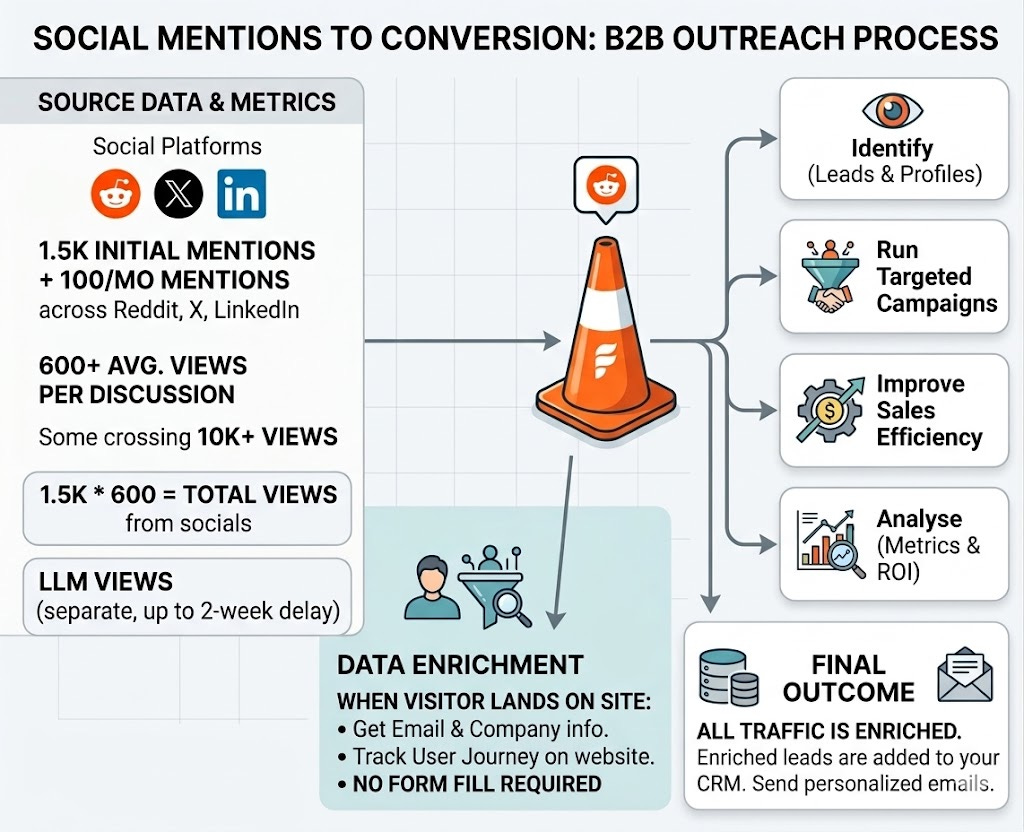
The workflow has four steps. First, discovery - you identify a high-intent post on Reddit, X, or LinkedIn using the signal patterns above. Second, de-anonymization - social enrichment tools map the handle to a real-world identity and company. This is not magic. People reuse usernames, link profiles, and leave digital breadcrumbs everywhere. Third, intent verification - you check whether the company is already on your Target Account List or currently using a competitor. This step prevents you from wasting effort on accounts that will never close. Fourth, multi-channel follow-up that works two angles simultaneously.
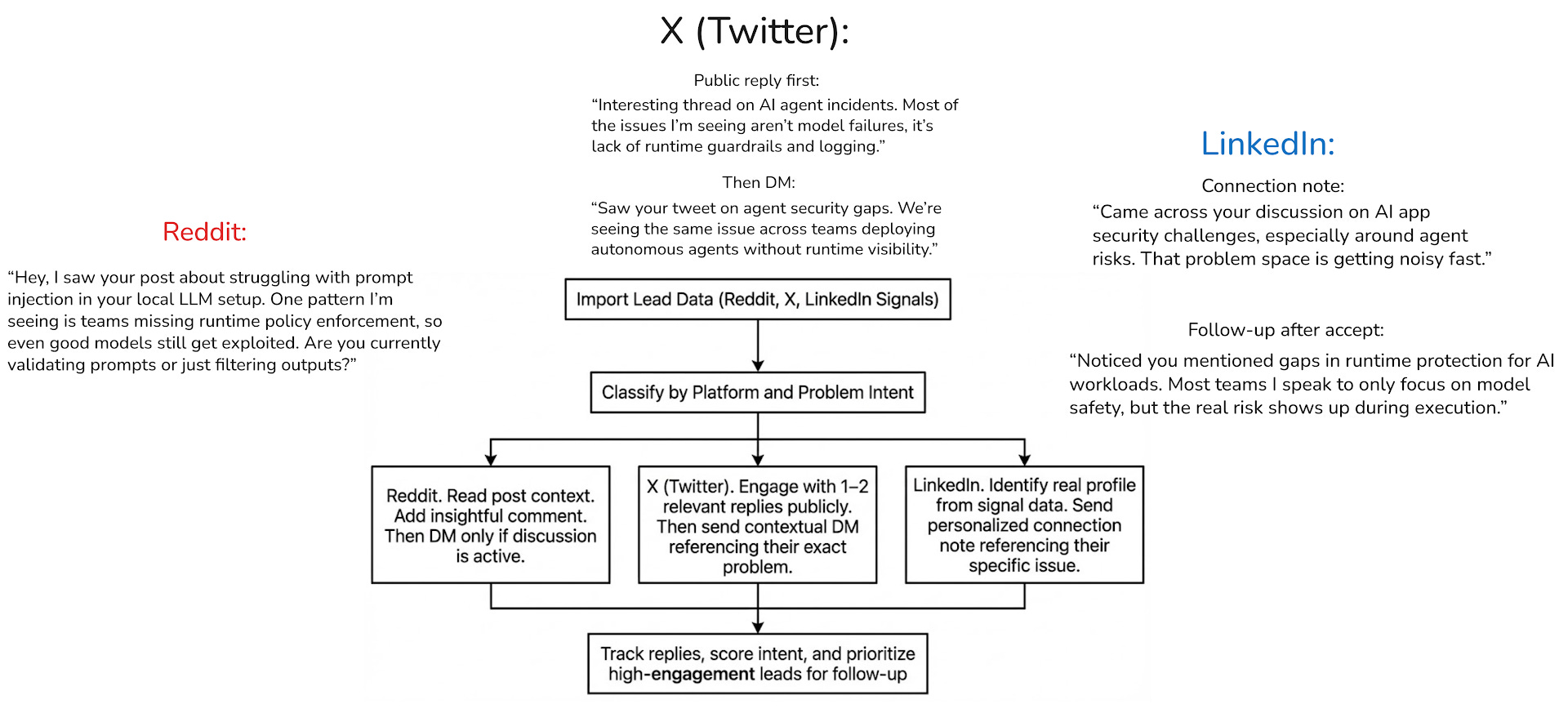
The public angle is your reply in the thread itself. This captures the lurker audience - the 90% of people who read but never post. Your reply is not for the person who asked the question. It is for the three hundred people silently reading the answers. The private angle is a LinkedIn message or email that references the specific technical question they asked publicly. “I saw your post about runtime visibility gaps - we actually solved that exact problem for [similar company]. Happy to share how.” That message gets a response rate that would make your outbound team weep.
Why This Beats Cold Outbound on Every Dimension
The comparison is worth making explicit.
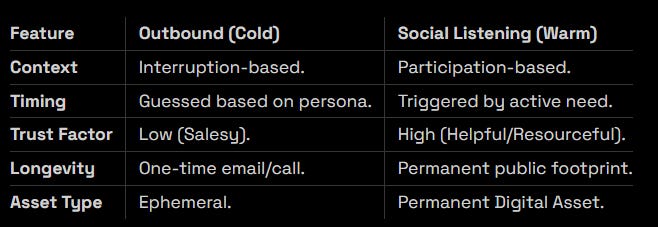
Cold outbound is an interruption. You are guessing that the timing is right based on a persona model that is probably six months stale. The trust factor is low because the recipient knows you want something from them. And the asset is ephemeral - that email gets deleted or ignored, and the work vanishes.
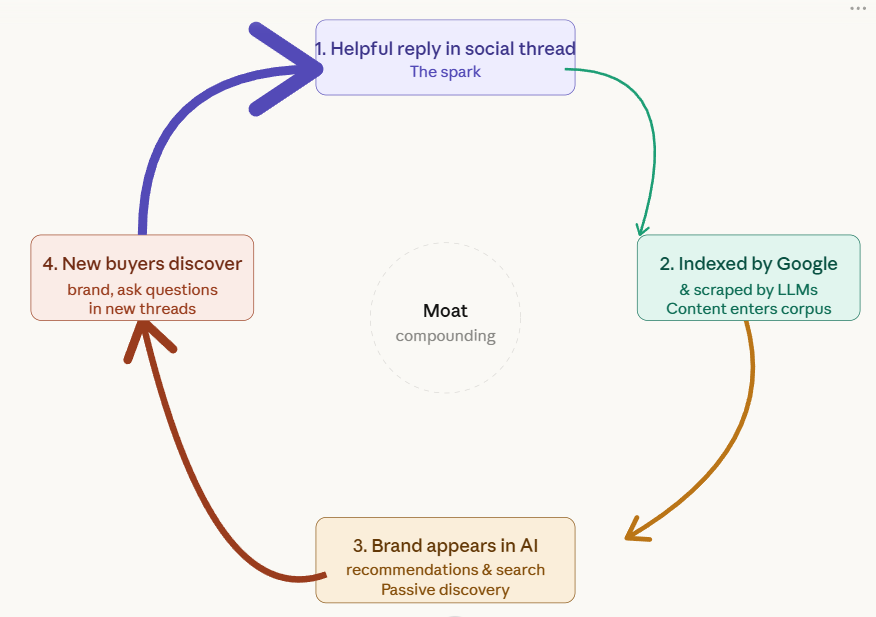
Social listening flips every single one of those dimensions. You are participating, not interrupting. Timing is not guessed - it is triggered by the buyer’s own behavior. Trust is high because you showed up with help, not a pitch. And here is the part most people miss: every reply you write is a permanent digital asset. That Reddit thread gets indexed by Google. It gets scraped by LLM training pipelines. Six months from now, when someone asks ChatGPT or Perplexity “What is the best CNAPP for runtime visibility?”, your brand shows up in the answer because you seeded the conversation that trained the model.
Guardrails That Keep This From Blowing Up
Running this at scale without guardrails is how you get banned from subreddits and roasted on Twitter. Three non-negotiables keep the operation clean.
Every response gets human review before it goes live. AI drafts the initial reply based on your ICP data and product positioning, but a human ensures the tone matches the community, the technical details are accurate, and the response does not read like a press release. The moment your replies start sounding like marketing copy, the strategy stops working.
Volume management matters more than most teams realize. You cannot have one brand account replying to every security thread on Reddit without getting flagged. The solution is a distributed network of technical evangelist profiles - real people with real expertise who genuinely participate in these communities. The engagement has to be authentic or it is worse than not engaging at all.
Safe-list monitoring prevents the most embarrassing failure mode: accidentally pitching your own customers. The system cross-references social handles against your existing customer database to ensure you never engage with someone who is already paying you in a way that disrupts their current support or success workflow.
The Compounding Machine
This is not a campaign. It is a compounding asset.
Every thread you participate in becomes a piece of search engine real estate. Social discussions rank on page one of Google for queries like Alternative to [Competitor]” and “[Product Category] reviews. Over time, you are not just capturing demand - you are shaping the information landscape that creates it.
The market intelligence feedback loop is equally valuable. Every thread is raw, unfiltered customer voice data. What features are competitors lacking? What problems keep coming up that nobody in the market addresses? That information flows directly into your product roadmap, and suddenly your social listening operation is not just a sales channel - it is the best product research tool you have.
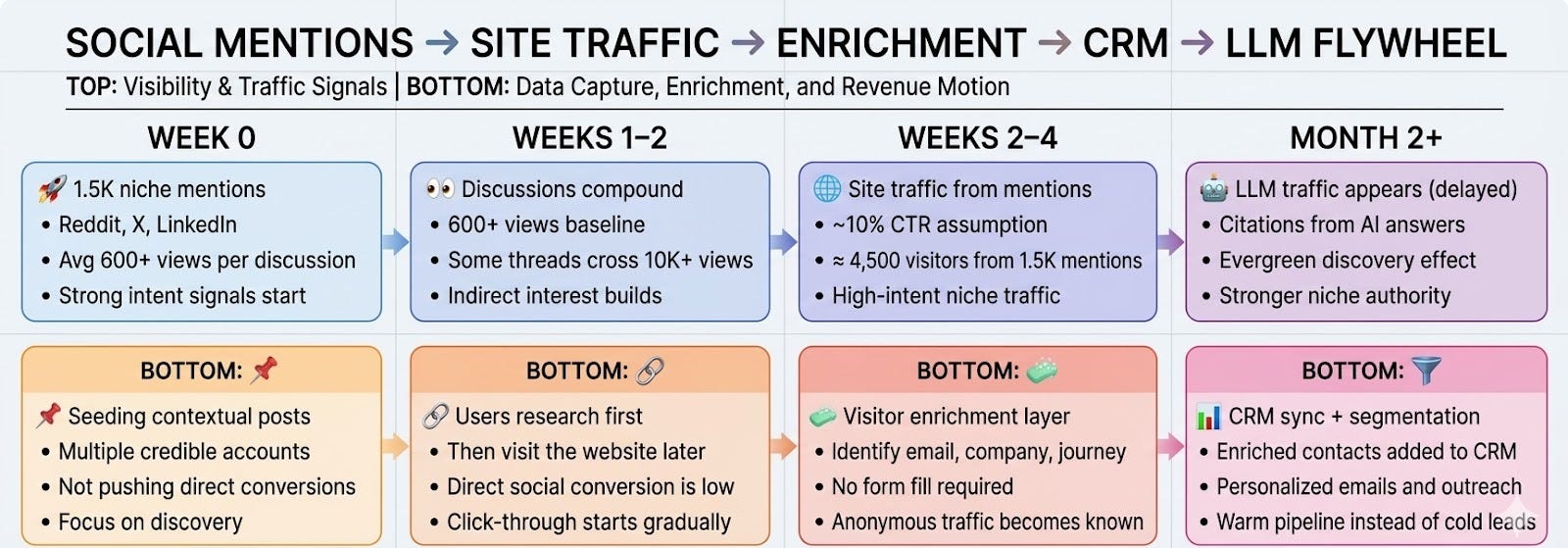
And then there is the LLM optimization layer. Large language models are trained on web data. When you consistently show up in high-quality technical discussions across Reddit, LinkedIn, and X, you are seeding the training data for the next generation of AI models. The end state is that when someone asks an AI assistant to recommend a tool in your category, your brand is the default answer. Not because you paid for it. Because you earned it, one helpful reply at a time.
That is the real unlock. Outbound fills a quarter. Social listening builds a moat.