

Stop Writing Posts. Start Building a Flywheel. (Elite Content Distribution Strategy)
How to fracture a single idea across your entire distribution ecosystem without starting from scratch.

Most content strategies fail for the same reason. They treat every post as an isolated event. You write something, publish it, and start from scratch the next day. There is no system connecting what you learned yesterday to what you create tomorrow.
A flywheel fixes this. Instead of a linear pipeline that leaks at every stage, you build a loop where every piece of content feeds the next one. Research informs creation. Creation generates audience feedback. Feedback becomes new research. The system accelerates the longer you run it.
This essay lays out the architecture--source layer, distribution layer, compounding layer, and feedback loop--so you can build one that runs on your own infrastructure.
The Source Layer
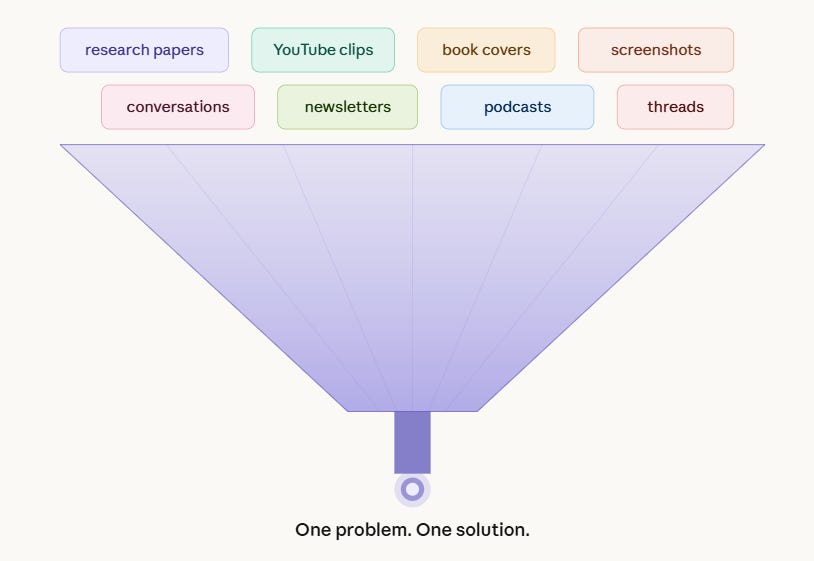
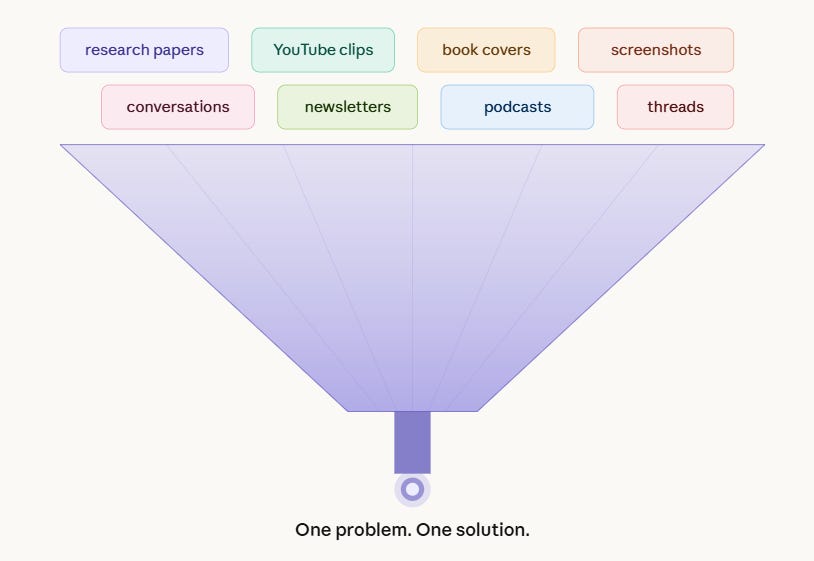
Sources are the fuel. They are not distribution channels. They are the intellectual inputs that happen before any writing begins.
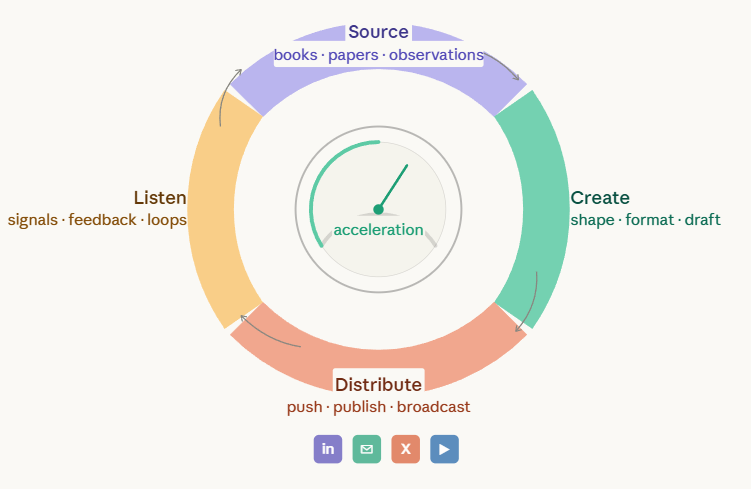
Primary inputs come from research papers, industry reports, product updates, and technical documentation. These are the highest-signal sources because they contain data you can cite and conclusions you can build on. A single cloud security whitepaper can yield three essays, ten social posts, and a newsletter section.
Media inputs include YouTube videos, saved Reels, and Substack essays from practitioners in your space. The key is curation, not consumption. You are not watching content to be entertained. You are extracting specific insights that connect to your audience’s pain points.
Static inputs are books, essays, and long-form threads. These provide the conceptual depth that separates your content from hot takes. A reference to a first-principles argument from a book nobody in your niche has read gives you differentiation that no prompt template can generate.
Internal inputs are the most underrated. Screenshots of interesting data, observations from your own work, snippets from conversations with customers or colleagues. These are the raw materials that make content feel lived-in rather than researched from the outside.
The discipline is simple but non-negotiable. Every source entry should produce a single takeaway--one specific problem or one direct solution--before it moves to the distribution layer. If a source cannot produce a clear takeaway, it does not enter the system.
The Distribution Layer
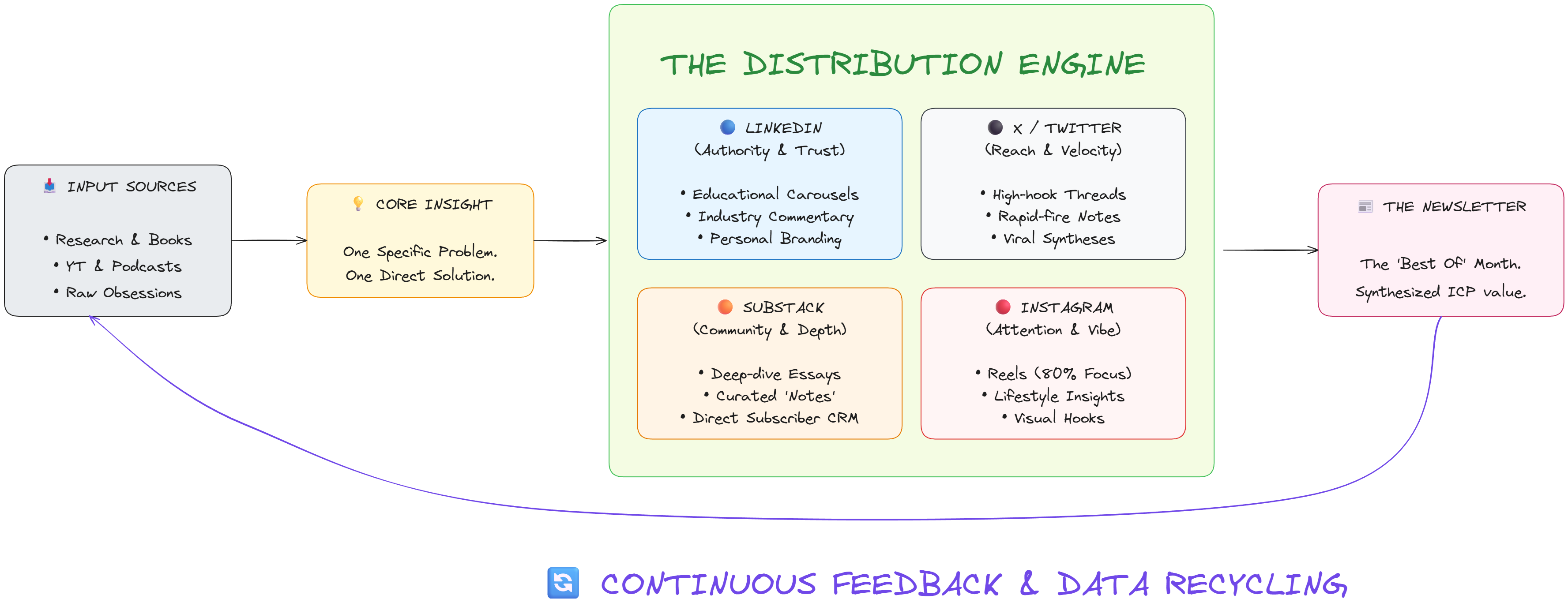
A single core insight fractures across your distribution ecosystem. The same idea appears on four platforms, but in four different shapes.
NOTE: Do not make the strategic prompts suited to your thing but rather you can make them. As for the voice and who you are and all that, I don’t put that in each prompt. Rather import the entire Voice, About, etc from the
Me, Myself and Ifolder so it’s like you are feeding the entire knowledge base about who I am to the prompts.
LinkedIn is for professional reach and credibility. The formats that work here are text-only posts, text with a single supporting image, and educational carousels. LinkedIn rewards specificity. A post about “the three metrics our team tracks after deploying a new security policy” will outperform a generic observation about “the future of cybersecurity” every time. The audience is decision-makers. Speak to their operational reality.
X (Twitter) is for fast distribution and idea iteration. Short posts test hooks. Long-form posts develop arguments. Threads build narrative. X is where you figure out which version of an idea resonates before committing it to a longer format. If a tweet gets 10x your usual engagement, that is a signal to expand it into a Substack essay.
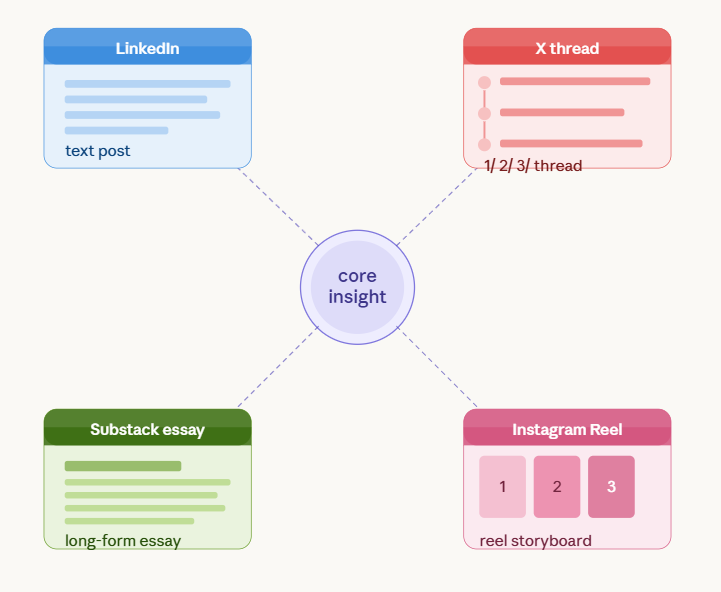
Substack is for depth and audience ownership. Full essays and short Notes are the primary formats. This is the only platform where you own the subscriber relationship. Everything else is rented land. Your Substack archive is a permanent, searchable body of work that compounds in value over time.
Instagram is for visual reach and discovery. Reels should get 80% of your effort here. Carousels and photo-plus-caption posts fill the remaining 20%. Instagram is the widest top-of-funnel channel, but the audience skews toward discovery rather than conversion. Use it to capture attention, then redirect to owned platforms.
Platform Purpose Output Formats Strategic Prompts LinkedIn Professional reach & credibility Text-only post, Text + image, Educational carousel Twitter (X) Fast distribution & iteration Short post, Long-form post, Viral thread Substack Depth & audience ownership Full essay/post, Short ‘Note’ Instagram Visual reach & discovery Reel (80% focus), Carousel, Photo + caption
The 2026 Content Stack - Three Tools to Win > The Knowledge Base Lock Yourself In
The critical insight is decoupling ideas from formats. Start with a source. Find the insight. Then decide which format in the table best serves it. Most creators do this backwards--they decide they need a LinkedIn post and then scramble for an idea. That is a recipe for mediocre output at every stage.
The Compounding Layer
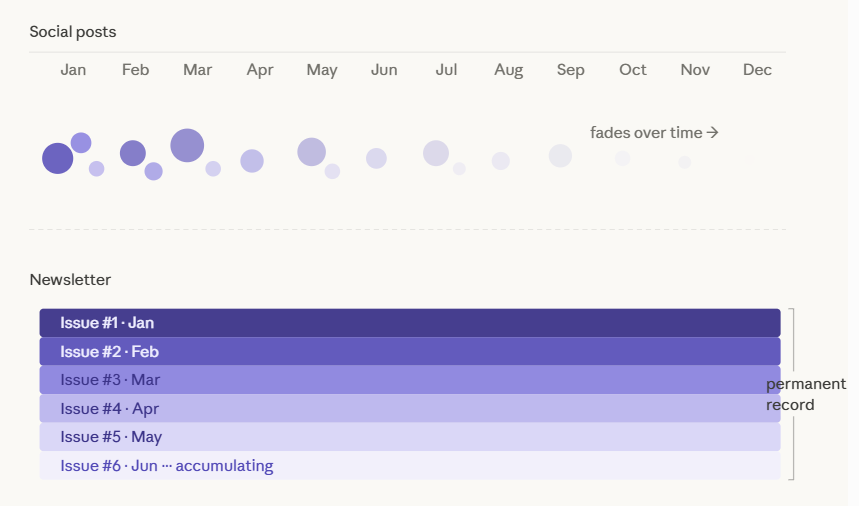
The monthly newsletter is the primary long-term asset. It transforms ephemeral social posts into a permanent, searchable archive of value for your Ideal Customer Profile.
Each issue curates 12 to 15 high-signal items from the month’s research. Not a link dump--a curated feed where each item includes why it matters and how it connects to the audience’s work. One section should be a deep-dive “State of the Union” on a specific topic, like the intersection of AI and cloud security, or the shift in enterprise buying behavior toward PLG. This section is where your expertise compounds. Over six months, you have built a body of analysis that no social post can replicate.
Include the best videos, books, and development updates discovered during the source phase. The newsletter is the permanent record. Social media is the amplification layer. If you lose your X account tomorrow, the newsletter subscribers are still yours.
The Feedback Loop
Signals from your audience are not engagement metrics. They are new source material.
Monitor the comments, DMs, and questions that come in across LinkedIn and X. Look for patterns. If three different people ask some variation of the same question in a week, that is not a coincidence. That is a content gap you created.
Extract the recurring pain points and areas of confusion. These become source entries that trigger the next cycle of the flywheel. The audience is telling you what to write next. Most creators ignore this signal because they are too busy planning content calendars based on what they think the audience wants, rather than what the audience is literally asking for.
Feed those signals back into the source layer. Now you have a complete loop. Research feeds content. Content generates audience signals. Audience signals refine research. The flywheel spins faster with every cycle because the quality of your inputs improves continuously.
Setting Your Content Goals
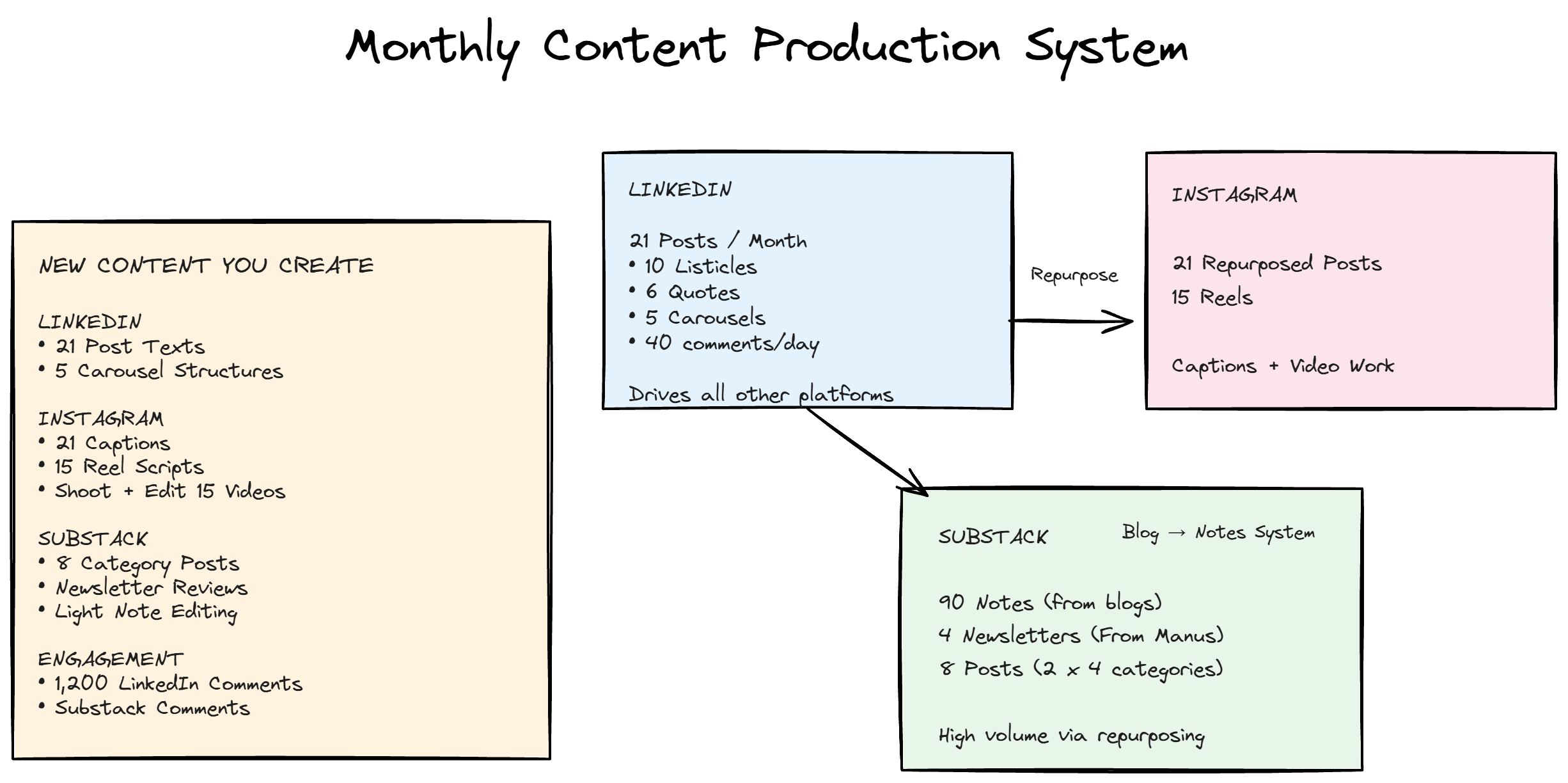
I am attaching an image that shows my content goals. Similarly you should have one for yourself that includes what targets you have or something like that. Basically it is a way to monitor and map your KPIs so that you understand your monthly goal and understand the flow, the data lineage or content lineage. It flows from the first one to the other ones in the expected sort of frequency
monthly content.png
Archive everything. Social media is rented land. Your newsletter and your personal domain are the only places where your content is a permanent asset. If a short post on X gets high engagement, treat it as a signal to expand into a Substack essay or a newsletter deep-dive. The flywheel is not about creating more content. It is about creating a system where every piece of content makes the next one better.