Scale with 10xDevRel Playbooks for Repeatable Growth and Measurable Impact
The practical layer-by-layer playbook that turns messy DevRel work into predictable growth and measurable impact.


If you’re a DevRel leader who has inherited a team that operates on vibes and improvisation, this article is your blueprint for building a repeatable system.
If you’re a solo advocate who does everything and has a framework for nothing, this article gives you the sequence to follow.
If you’re an engineering manager who got handed DevRel with zero playbook, this is your onramp.
If you’re a startup founder who needs developer relations but can’t afford a team yet, this article shows you how to run a one-person DevRel motion using 15 battle-tested frameworks.
Most DevRel teams operate on a combination of instinct, urgency, and whatever the last person in the role figured out before they left. Someone writes a blog post when inspiration strikes. Someone else runs a hackathon because a competitor did one. Launches happen when engineering finishes the feature, not when the go-to-market plan is ready. Metrics get reported quarterly in a slide deck that nobody reads.
This is not a system. It’s a collection of activities that happen to share a Slack channel.
The 10x DevRel Workbench replaces that with something repeatable. 15 playbooks, organized into a framework that builds on itself. Not 15 random checklists. A sequence. Here’s how to use them, and why the order matters.
Layer #1 - The Foundation (Start Here, No Exceptions)
Before you write a single blog post, plan a single event, or build a single community channel, you need two things: metrics that tie to business outcomes, and a feedback loop that tells you what developers actually need.
DevRel Metrics & ROI Playbook
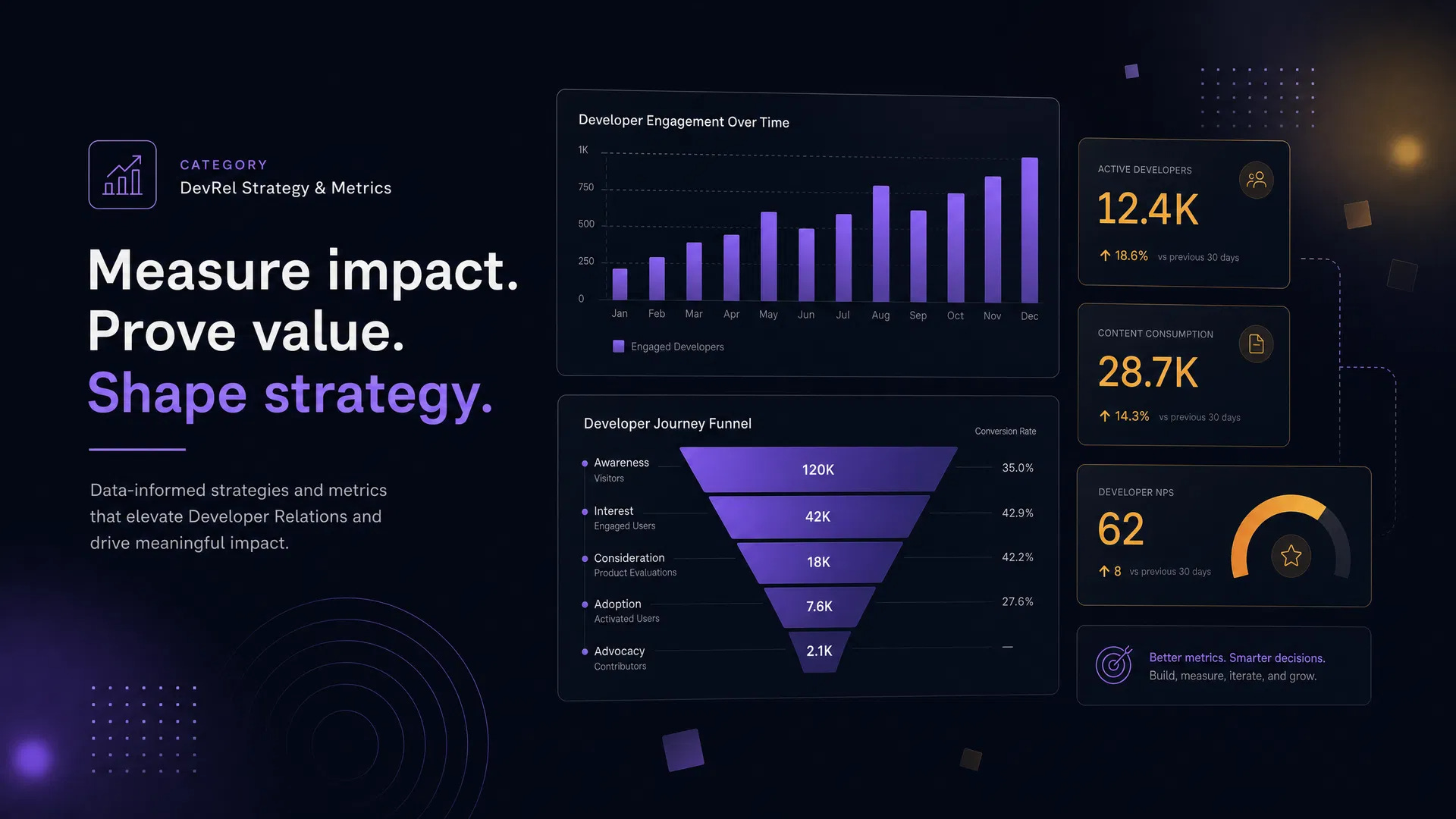
What it gives you: A measurement framework organized around the developer journey (awareness, activation, engagement, retention), not around DevRel activities. Attribution models that are honest about their limitations while being useful enough to justify budget. Presentation frameworks for translating developer metrics into business language that leadership values.
Why it’s foundational: Everything you build in layers 2 and 3 needs to be measurable. If you launch a community program without defining what success looks like, you can’t defend the investment. If you run conferences without tracking pipeline influence, you’re spending budget on faith.
How to use it in the workbench: Open the DevRel Metrics & ROI Playbook. Work through the checklist. Define your metrics before you start the other playbooks. Bookmark it because you’ll reference it quarterly.
Take the prompts to AI: The playbook’s decision frameworks can be fed directly to Claude or GPT with your company context. “Given our product [X], our developer audience [Y], and our business goals [Z], which DevRel metrics should we prioritize?” The playbook gives you the right questions. AI gives you the specific answers for your organization.
Developer Feedback Loop Playbook
What it gives you: A systematic pipeline for collecting developer feedback from every channel (Discord, GitHub, Twitter, support tickets, sales calls), routing it to the right teams (bugs to engineering, feature requests to product, docs gaps to content), and closing the loop so developers know they were heard.
Why it’s foundational: Without feedback flowing, you’re building in the dark. Your content strategy will be based on guesses. Your launches will miss what developers actually want. Your community will feel like it’s shouting into a void.
How to use it in the workbench: Open the Developer Feedback Loop Playbook. Set up the pipeline. Track feedback volume, response time, and resolution rate. Connect these metrics to your quarterly report.
The compounding effect: Once feedback is flowing, every other playbook you execute will be informed by real developer needs. Your content topics come from feedback patterns. Your launch priorities come from feature requests. Your community health comes from closed feedback loops.
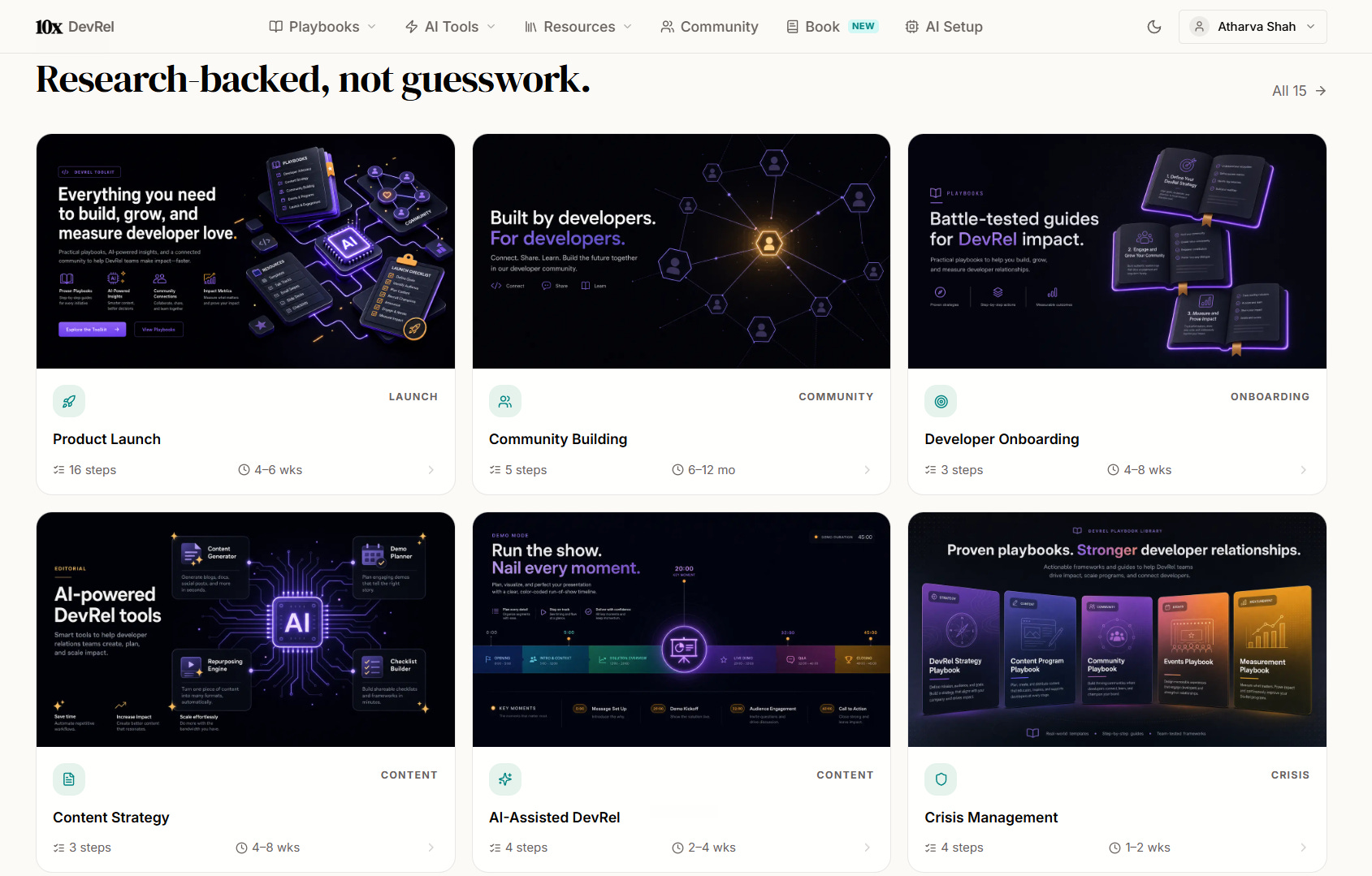
Layer #2 - The Growth Engines (Build These Next)
With metrics defined and feedback flowing, you build the three engines that drive developer adoption. These run continuously. They take time to build but compound once they’re operational.
Content Engine
Developer Content Strategy Playbook: Not about writing blog posts. About building a production system. What to prioritize (your feedback loop tells you). How to structure content for different developer journey stages. How to build an editorial calendar that survives competing priorities.
Technical Writing Playbook: Documentation specifically. The difference between docs developers read and docs developers abandon. Structure, voice, code sample testing, information architecture organized by developer intent rather than product structure.
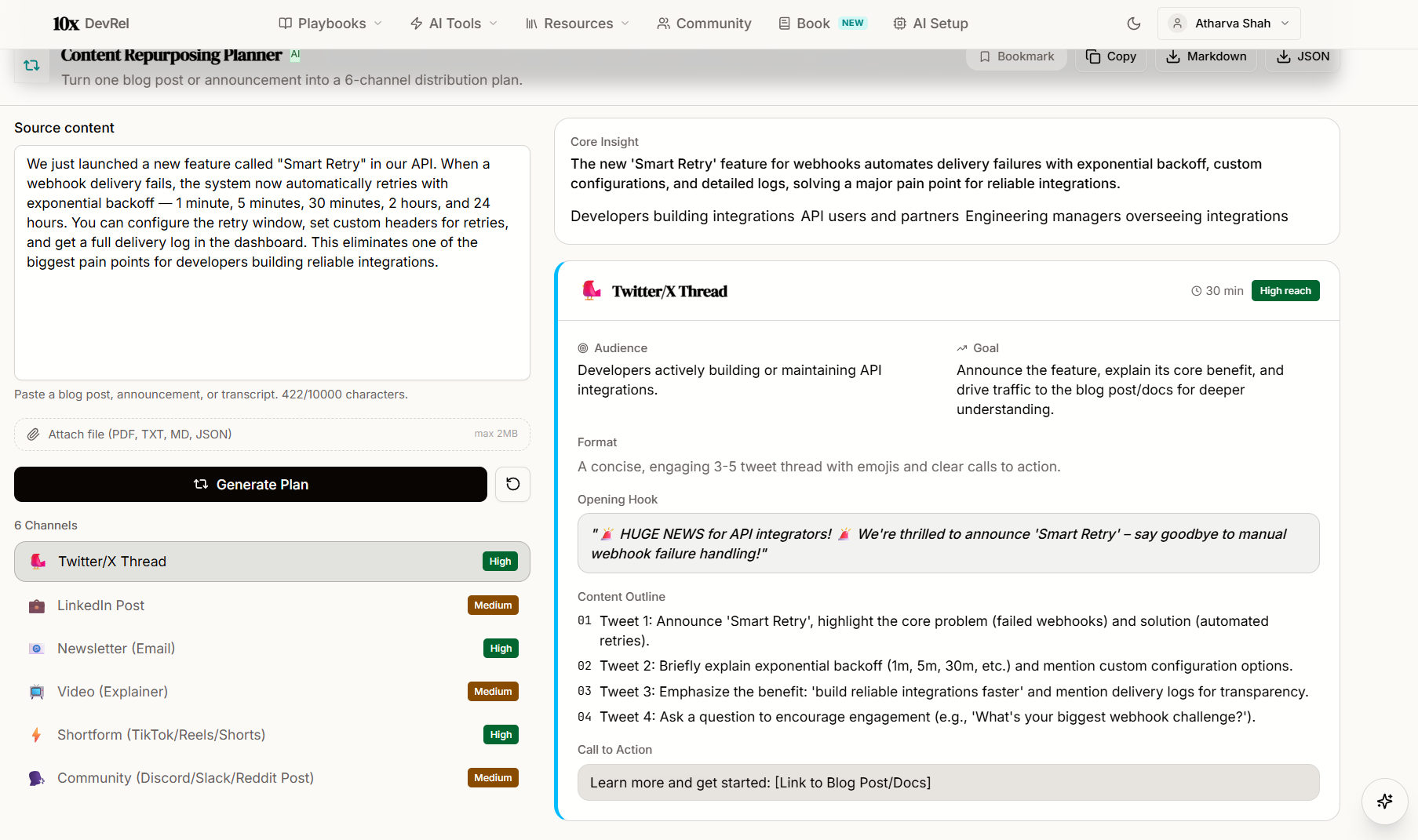
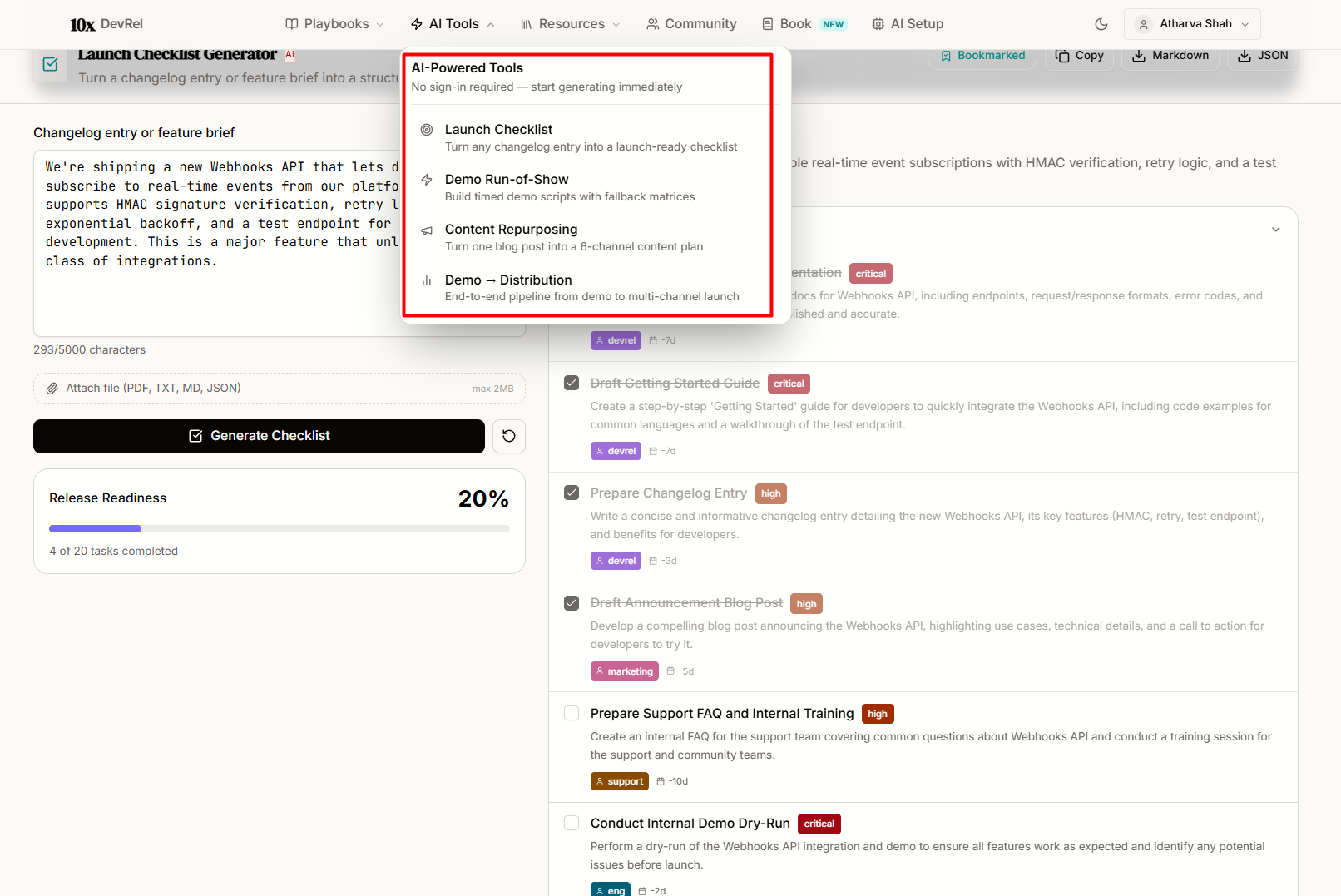
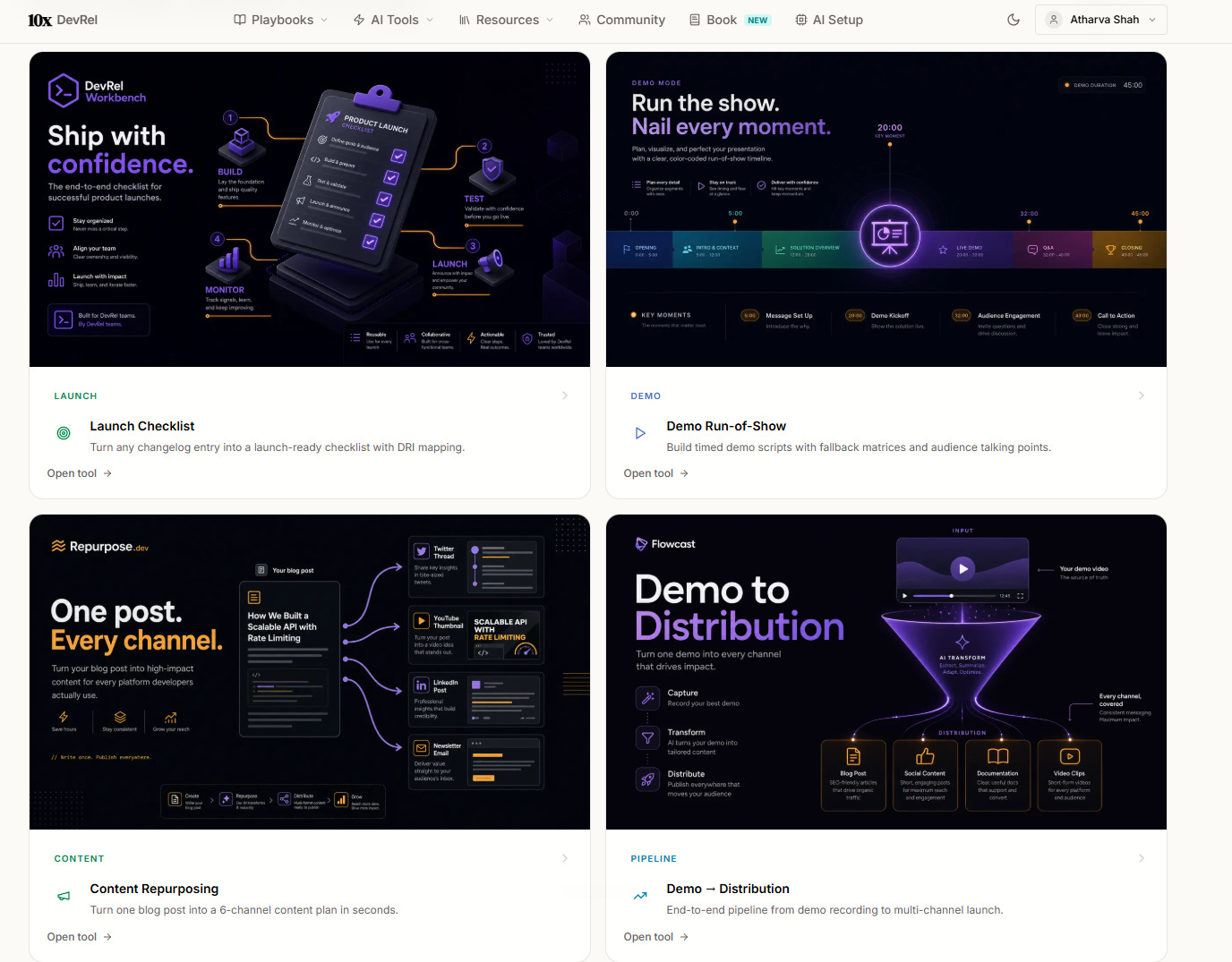
AI-Assisted DevRel Playbook: How to multiply your content output with AI without losing authenticity. This connects directly to the four AI tools in the workbench. The Content Repurposing tool turns one blog post into six channel-specific pieces. The Launch Checklist tool generates go-to-market plans from a changelog entry. The playbook teaches the principles. The tools execute the workflows.
How to use all three together: Open each playbook. Start with Content Strategy (set the system). Then Technical Writing (get the docs right). Then AI-Assisted DevRel (scale the output). Check off steps as you implement. Your content engine is running when all three checklists are complete.
Community Engine
Community Building Playbook: The starting point. Not “create a Discord and hope.” A staged approach: define the community’s purpose, design the member journey, build engagement loops (weekly rituals, monthly showcases), establish moderation, measure health. Each stage builds on the previous one.
Open Source Community Playbook: If you maintain open source, this adds the specific dynamics: contributor pipelines, governance structures, maintainer health, first-contribution optimization.
Developer Ambassador Program Playbook: When your community matures, ambassadors extend your reach. This playbook covers the full lifecycle: recruiting authentic advocates (not influencer-style reach grabs), onboarding, activating, supporting, and retaining.
Developer Advocacy Playbook: The broader strategy. Positioning advocacy within your org, building outreach programs, defining the advocate’s content role, measuring impact.
How to use all four together: Start with Community Building (get the foundation). Add Open Source if relevant. Layer on the Ambassador Program when your community has active members who could become multipliers. Use the Advocacy Playbook to position the whole function within your organization.
Note: This workbench is a hosted website product, not an open-source codebase. Community contributions come through the site and are credited to contributors by name.
Onboarding Engine
Developer Onboarding Playbook: First-run experiences. The path from “just heard about you” to “actively building with your product.” Three milestones: first credential, first success, first custom build. Map your current path. Remove friction. Design the “aha moment.” Measure drop-off at every step.
Why this is a growth engine: Good onboarding doesn’t just convert new developers. It improves retention. Developers who reach first success quickly are significantly more likely to still be using the product 30 days later. Fix your onboarding and you fix your activation and retention metrics simultaneously.
Layer #3 - The Execution Layer (High-Impact Moments)
Now you have the infrastructure. Metrics are defined. Feedback is flowing. Content is shipping. Community is growing. Onboarding is smooth.
Now you can execute the high-impact, high-visibility activities that most teams try to do first and fail at because the foundation isn’t there.
Launches
Product Launch Playbook: T-30 through post-launch. Every stakeholder, every deliverable, every DRI assignment. Pair it with the Launch Checklist AI tool to generate your specific launch plan in 30 seconds.
Why it works better with layers 1 and 2: Your content engine produces the launch content. Your community amplifies it. Your feedback loop shaped what you’re launching. Your metrics tell you if it worked. Without the earlier layers, launches are just announcements. With them, launches are coordinated go-to-market motions.
Events
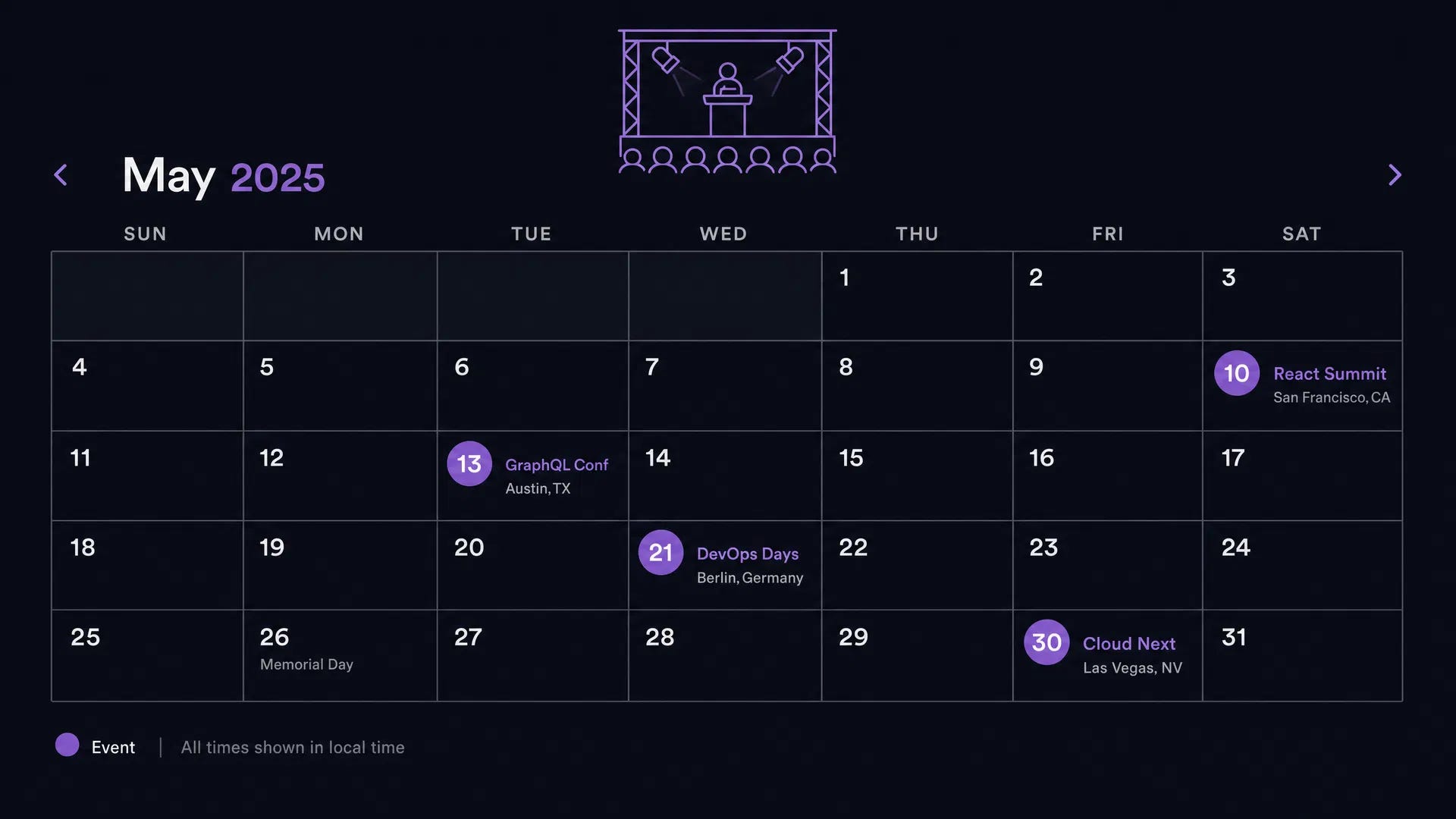
Conference Talk Playbook: The full lifecycle. Identifying conferences (the Resource Center has a curated list), writing CFPs, designing the talk, delivering it, and amplifying after. One talk should produce at least five content pieces.
Hackathon Playbook: Designing hackathons for signal, not swag. Challenge design, support infrastructure, and the follow-through plan that converts participants into active users and community members.
Demos
Demo Engineering Playbook: Demos that convert. Three-act structure (problem, solution, expansion), timed segments, audience targeting, fallback matrices. Pair with the Demo Run-of-Show tool for instant scripts and the Demo to Distribution tool for turning demos into distribution cycles.
Layer #4 - The Safety Net (Set Up Before You Need It)
Crisis Communication Playbook: What to say when your API goes down, when a security incident hits, when a breaking change ships without warning. Templates for first response, ongoing updates, resolution announcements, and public post-mortems. Set this up before a crisis happens. During a crisis is not the time to figure out who writes the status page update.
Why the Sequence Matters
Here’s the pattern I’ve seen fail dozens of times:
Team starts with events and launches (Layer 3)
Events go well but have no measurement framework (Layer 1 was skipped)
Leadership asks “what’s the ROI?” and the team can’t answer
Budget gets questioned. Team gets stressed.
Team tries to build metrics retroactively while also running the next launch
Burnout. Attrition. New person starts the cycle over.
Here’s the pattern that works:
Foundation (Metrics + Feedback): Know what you’re measuring. Know what developers need.
Growth engines (Content + Community + Onboarding): Build the systems that run continuously.
Execution (Launches + Events + Demos): High-impact moments that succeed because the engines support them.
Safety net (Crisis): The protection layer for everything you’ve built.
Start at Layer 1. Build up. Each layer takes 2-4 weeks to implement using the playbook checklists. In 90 days, you have a functioning DevRel system.
How the Workbench Makes This Practical
All 15 playbooks live at 10xdevrel.atharvashah.com/playbooks. Each one has:
Interactive checklists that track your progress locally across sessions
Bookmark capability so you can build a personal collection of the playbooks you use
Shareable URLs so you can send any playbook to your team
Portable frameworks you can adapt to your product, team, and stage
AI-compatible prompts you can take to Claude/GPT with your company context
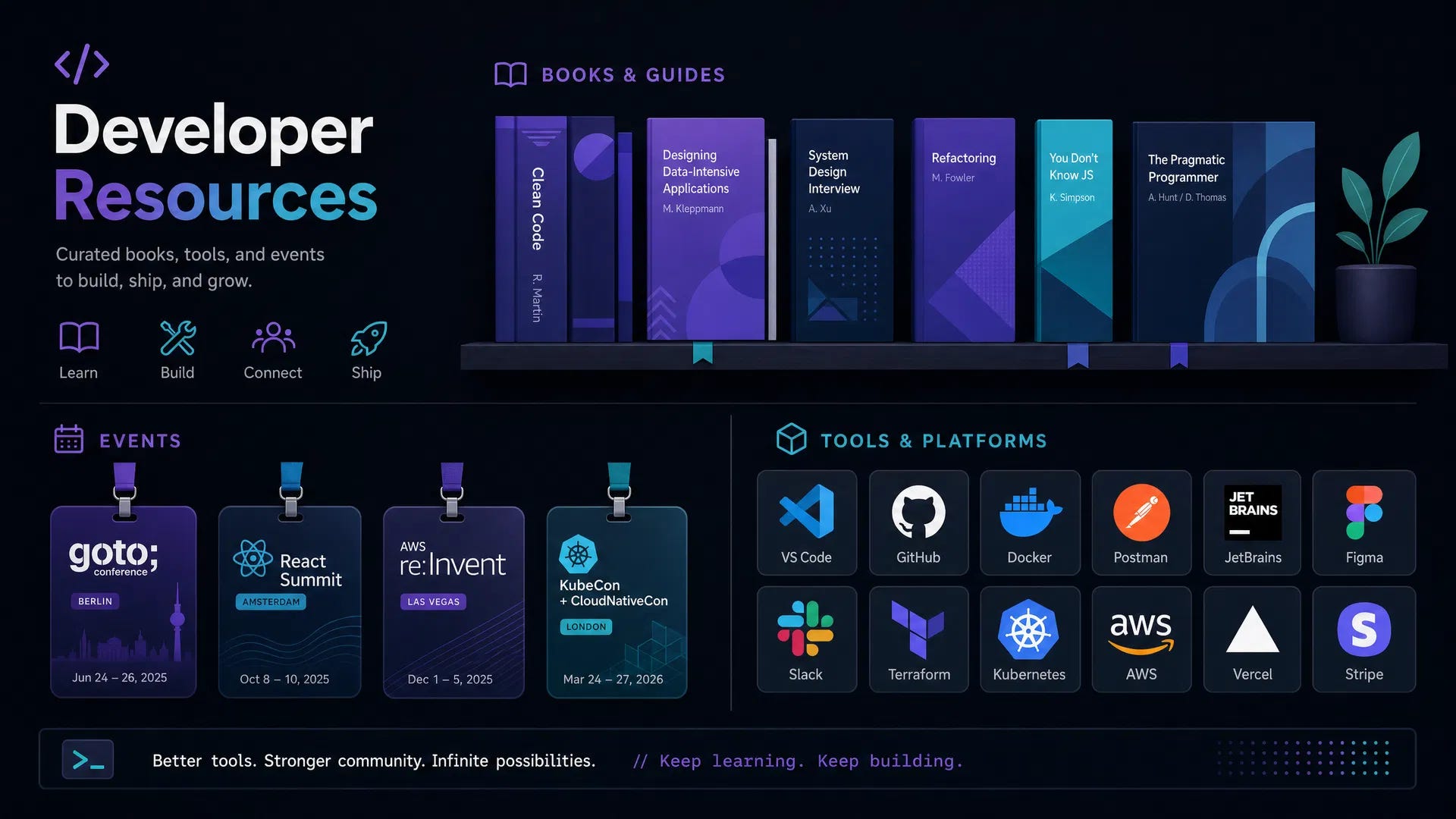
The four AI tools at 10xdevrel.atharvashah.com accelerate the most time-consuming execution tasks. The Resource Center provides 200+ curated resources that the playbooks reference. The Community section lets you share what works and learn from other practitioners.
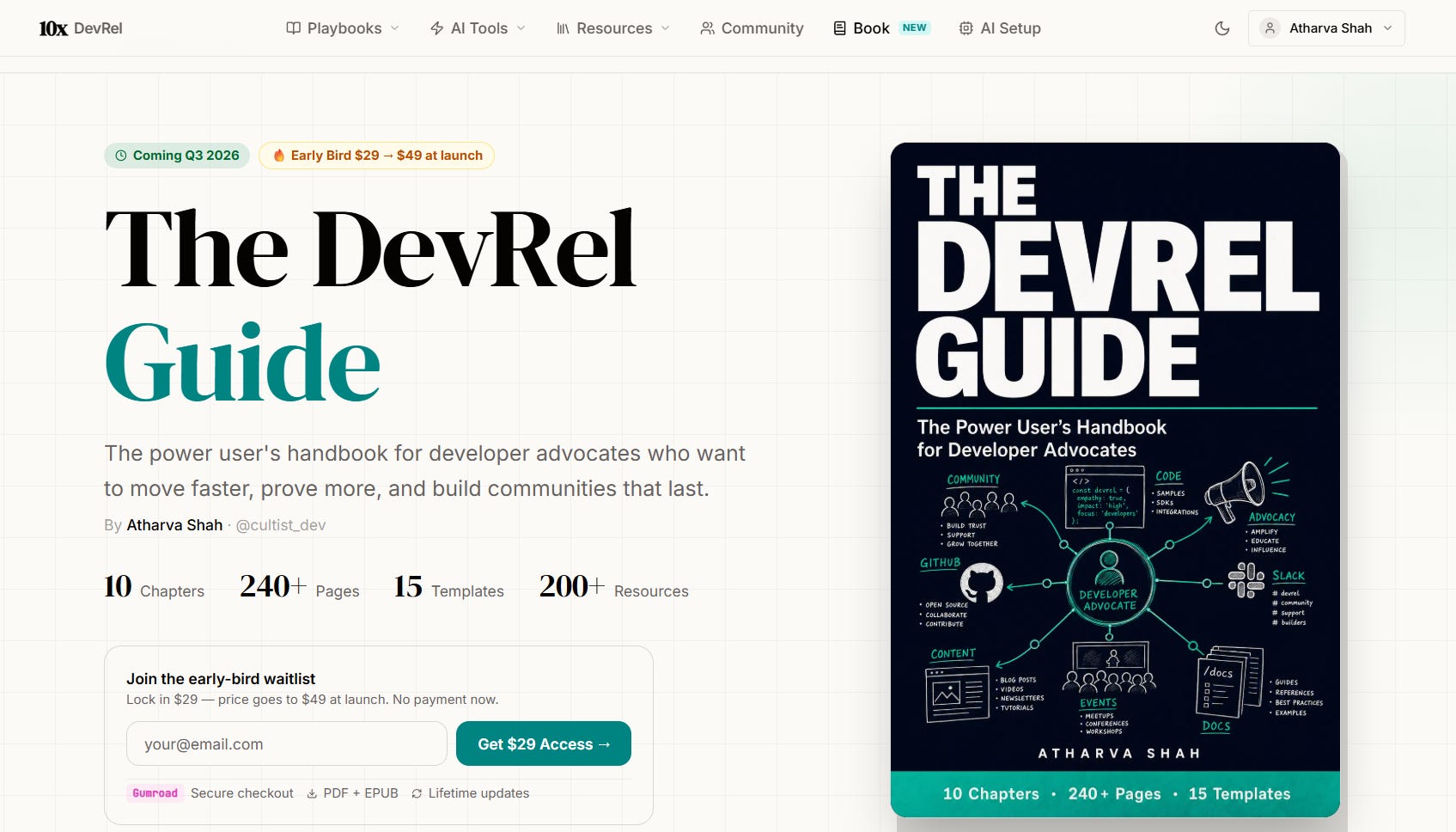
And if you want the comprehensive, portable version of everything, The DevRel Guide compiles all 15 playbooks with deeper frameworks, 15 templates, and case studies. 240+ pages. $29 early bird. Launches Q3 2026.
Your First Move
Don’t try to implement all 15 playbooks at once. Pick one from Layer 1. Open it. Start the checklist. That’s your first move.
If your biggest pain is proving ROI, start with the Metrics playbook.
If your biggest pain is not knowing what developers want, start with the Feedback Loop playbook.
If you’re drowning in content production, start with the Content Strategy playbook and use the Content Repurposing tool to multiply your output immediately.
The workbench is free. The playbooks are ready. Start checking boxes.