Walking into a POC (proof of concept) scoping call with a 79-item checklist and no clear ranking is painful.
That was our reality.
Context, If You Have Never Sat in One
AccuKnox sells cloud-native security to enterprises. The platform covers posture management and runtime protection across Kubernetes clusters and cloud accounts. The buyer is a security team at a company large enough that a breach becomes a board-level event. Deals at that size never close on a demo. They close on a proof of concept.
A POC is a trial run inside the customer's own environment. It runs for weeks, not days, and the product has to prove itself against real infrastructure. Every step burns solution-architect hours and customer engineering time that neither side has much of.

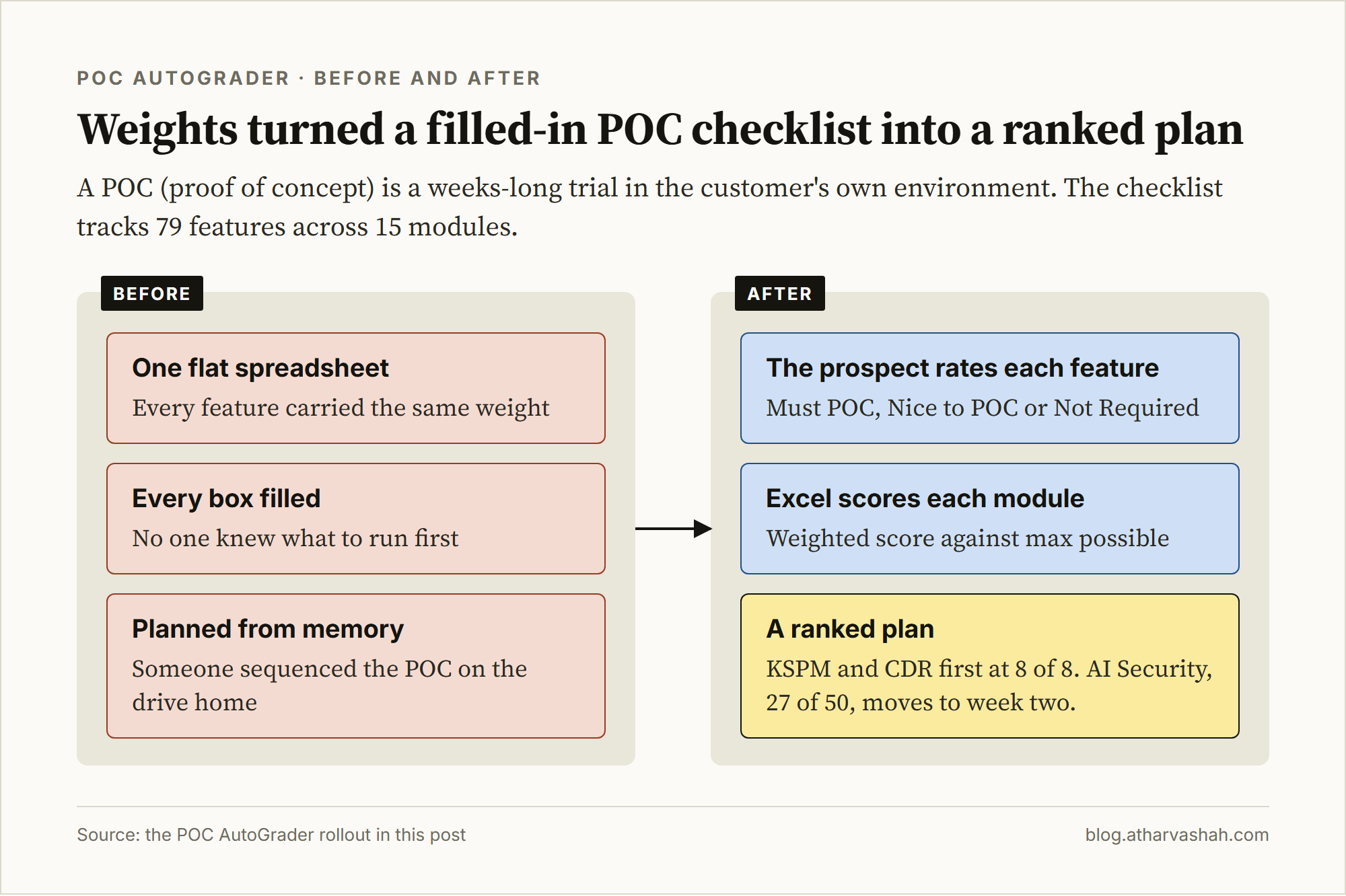
I am a DevRel engineer, so POC scoping is not my job. It landed on my desk because I sat close to the sales engineering team and watched the same failure happen on call after call. We would finish a scoping call with every box filled and no idea which three items to run first. Someone would then sequence the whole POC from memory on the drive home.
The problem was hard to solve inside a meeting and easy to solve in a spreadsheet. Nobody else had built that spreadsheet yet.
The Problem With Flat Checklists
AccuKnox covers a lot of surface area: CSPM, CWPP, KSPM, CDR, GRC, AI Security, ASPM, SAST, DAST, SIEM integrations, and CI/CD. KSPM is Kubernetes security posture management. CDR is cloud detection and response.
Prospects rarely need all of it during a POC. They need a subset that maps to their urgent risks.
Our old process ran on one flat spreadsheet where every feature carried the same weight, so nothing told us where to start.
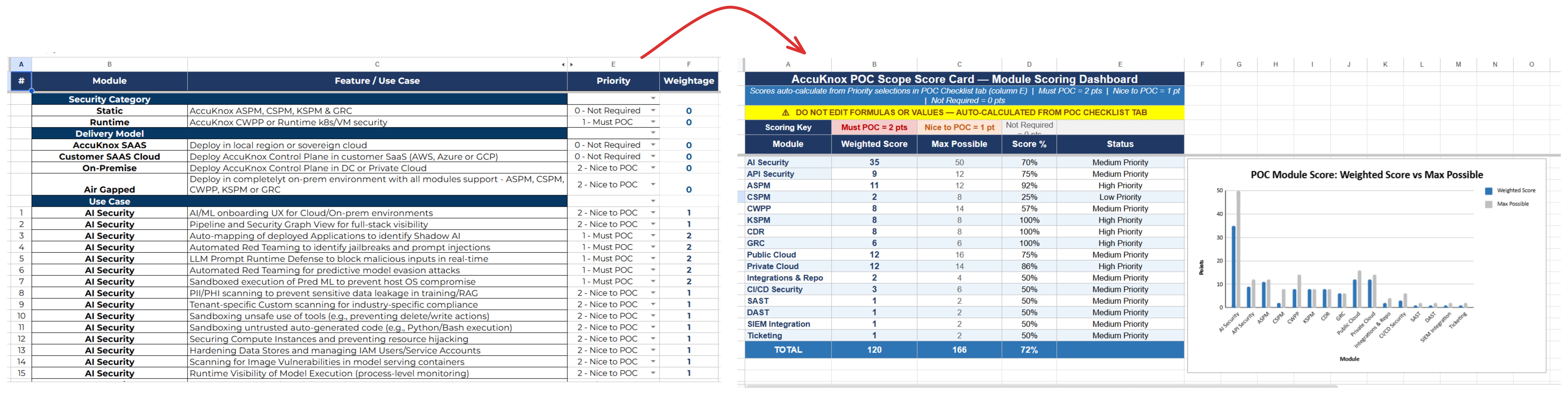
We would leave calls with every box filled and still not know what to prioritize first. We knew what was selected. We did not know what mattered most.
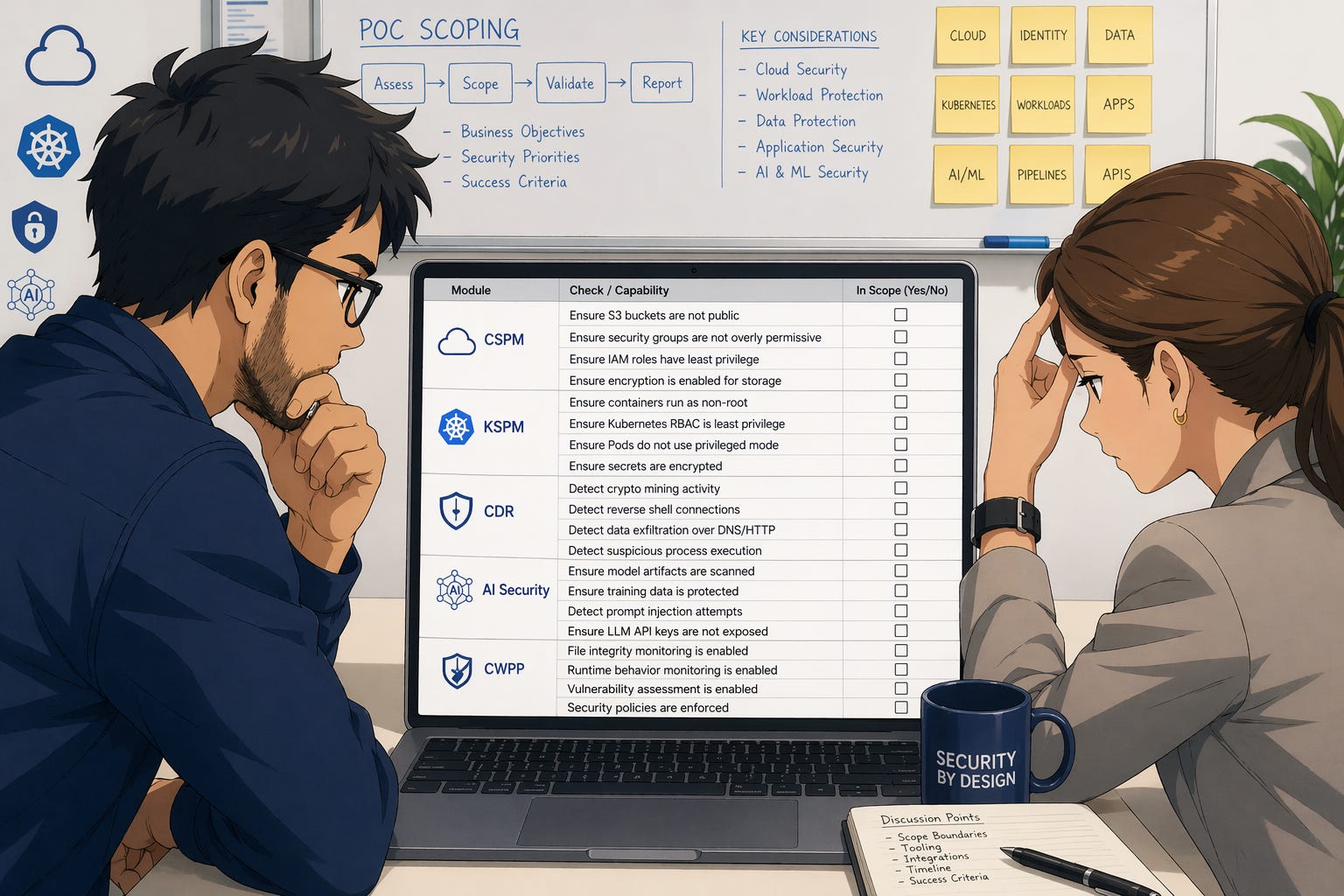
Why This Is a Resource Allocation Problem
Assume a prospect has six weeks and three engineers, with limited bandwidth to spare. We have two solution architects.
Without a way to rank what the prospect cares about, three outcomes show up fast.
We spread too thin and demo everything shallowly.
We go deep on the wrong module.
We miss the one module that could have carried the deal.
The gap was visibility, not sales talent.
What I Built
I converted our POC checklist into a weighted scoring engine in Excel.
Scoring rules:
Must POC=2Nice to POC=1Not Required=0
Each of the 15 modules has its own feature rows. Prospects choose a priority per feature from a dropdown. Excel aggregates those weights by module and produces a weighted score automatically.
We also calculate max possible score per module as:
feature count * 2
Then we compute score percentage and status (High Priority, Medium Priority, Low Priority, Not Scoped).
The dashboard chart puts weighted score and max possible side by side for all modules. One glance gives the ranking. Prospect input now drives that order directly, instead of getting reinterpreted from memory after the call.
The Excel Logic Behind It
This is plain Excel, but structured properly.
1. Controlled Input via Data Validation
Checklist column E accepts only:
1 - Must POC2 - Nice to POC0 - Not Required
No free text means cleaner downstream calculations.
2. Weight Mapping Formula
Checklist column F maps dropdown values to numeric weights:
=IF(E2="1 - Must POC", 2, IF(E2="2 - Nice to POC", 1, 0))3. Module-Level Aggregation
Dashboard weighted score per module:
=SUMIF('POC Checklist'!$B:$B, A6, 'POC Checklist'!$F:$F)4. Max Possible per Module
=COUNTIF('POC Checklist'!$B:$B, A6) * 25. Safe Percentage Calculations
IFERROR prevents divide-by-zero noise.
6. Linked Chart
The chart is bound to the score table, so updates happen immediately when priorities change.
Across 79 features and 15 modules, recalculation is effectively instant.
What Changed After Rollout
Before, the checklist told us what got checked. Now it tells us what to tackle first.
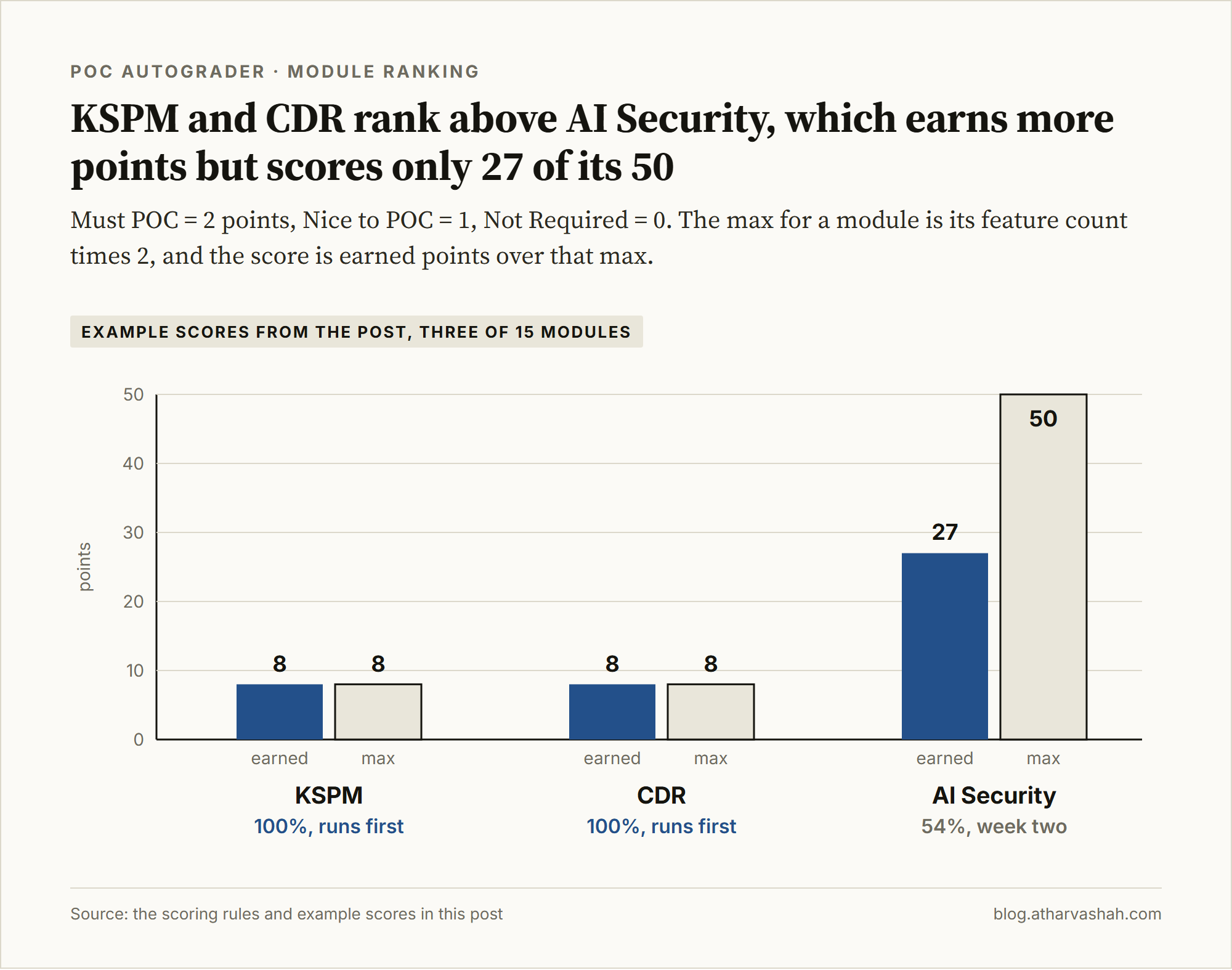
Post-call notes changed from paraphrased impressions to numbers. A module score now reads as KSPM at 8 out of 8, CDR at 8 out of 8, AI Security at 27 out of 50, and the ranking itself tells the team to start with KSPM and CDR and push the AI Security deep dive to week two.
The highest-scoring modules get engineering focus first, and low or zero modules get deprioritized with a clear paper trail behind the decision. The POC that follows mirrors the priorities the prospect picked during scoping, not the priorities we guessed at afterward.
Fifteen Modules Overload Memory, Not Judgment
I built this because I got tired of watching a good team make sequencing decisions from memory and instinct. With 15 modules and 79 tracked features, memory is not a reliable ranking tool. People default to whatever they heard last on the call, not to what actually carried the most weight.
Scoring gives judgment a starting point instead of replacing it. The grader took one afternoon to build, and every formula in it is plain arithmetic.
The result is a priority map that updates with every prospect input and hands the team a ranked agenda before the follow-up call is even booked.
AccuKnox is an AI-native cloud security platform. It covers CNAPP, KSPM, CWPP, CSPM, CDR, AI-SPM, and related domains. If you want to see how we scope POCs, reach out.
Related reading: Local AI Photo Curation Pipeline (No Cloud) and Build an AI Security CTF Platform in One Day.