

How I Built 10xDevRel - From Scattershot Chaos to a Self-Serve Systems (DevRel Workbench)
Turning DevRel chaos into a repeatable workbench for launches, community, and content.


If you’re a solo developer advocate drowning in launch checklists, community threads, and “can you also write the blog post?” requests, this is for you.
If you’re a Head of DevRel trying to prove ROI to a leadership team that thinks your job is “posting on Twitter,” this is for you.
If you’re an engineering manager who just got handed DevRel responsibilities with zero playbook and zero budget for consultants, this is for you.
If you’re a startup founder who knows you need developer relations but can’t justify a full-time hire yet, this is for you.
I built 10x DevRel for all of you. Here’s why, and here’s every decision I made along the way.
The Problem I Couldn’t Stop Seeing
I spent six years in the DevRel orbit. And I kept watching the same painful loop play out.
A new developer advocate joins a company. Day one, they’re excited. Day three, they ask: “Is there a playbook for how we do launches?” The answer is always some version of: “Check with Sarah. She had a doc somewhere. I think it’s in the old Notion.” Sarah left eight months ago. The doc is gone.
So the new advocate builds their own system from scratch. They Google “DevRel launch checklist.” They find a 2019 blog post with generic advice. They ask in the DevRel Collective Slack. Someone shares a personal template. They cobble together something that works for one launch.
Then they leave, and the next person starts the cycle over.
This isn’t a knowledge problem. It’s a systems problem. The knowledge exists. It’s scattered across hundreds of blog posts, conference talks, podcast episodes, and private Notion docs that die when people change jobs.
I kept a list of every repeated question I heard. After a year, that list had 200+ entries. They clustered into about 15 categories. And I realized something that changed everything for me: these categories are the actual operating system of DevRel. Product launches. Community building. Content strategy. Metrics. Onboarding. Crisis communication. Demo engineering. Feedback loops. Conference talks. Hackathons. Open source. Advocacy. Ambassador programs. Technical writing. AI-assisted workflows.
Every DevRel team runs on some subset of these categories. None of them had a standardized, research-backed playbook. Until now.
Why I Didn’t Build Another SaaS
My first instinct was the obvious one. Build a platform. Dashboards. User accounts. Monthly pricing. Integrations. The standard startup playbook.
I killed that idea fast. Here’s the thinking.
The people who need this most can’t pay for it. The solo advocate at a 30-person startup. The community manager who just got “DevRel” added to their title. The developer-first founder running a one-person go-to-market motion. These people have $0 in personal tooling budget and the most urgent need for structured frameworks.
DevRel people don’t need another platform. They’re already managing Slack, Discord, GitHub, Twitter, LinkedIn, dev.to, their blog CMS, their analytics dashboard, their community platform, and their company’s internal tools. Adding another login is the opposite of helpful.
The value is in the thinking, not the software. A well-structured playbook for running a product launch is worth more than a Gantt chart tool that doesn’t understand what a launch DRI is. The frameworks are the product. The software just makes them accessible.
So I made the workbench free and community-driven through the website - contributions are welcome there, with public credit for approved contributors. This was the first and most important decision.
Building the 15 Playbooks
Each playbook took weeks. Not because writing is hard. Because getting the framework right is hard.
Take the Product Launch Playbook. The first draft had 45 steps. Too many. A playbook that nobody finishes is useless. I cut it to the essential sequence: T-30 through post-launch, with every step earning its place through a simple test: “If you skip this, does the launch meaningfully suffer?”
The Community Building Playbook went through four iterations. Version one was too tactical (just a list of tactics). Version two was too strategic (all theory, no steps). Version three found the right level: a staged approach where each stage builds on the previous one, with concrete actions at each stage and the reasoning behind them.
The DevRel Metrics & ROI Playbook was the hardest. Metrics in DevRel are genuinely difficult. Attribution is messy. The developer journey is non-linear. Leadership wants revenue numbers, and the path from “attended our conference talk” to “became a paying customer” has fifteen steps with no clean tracking. I spent weeks on attribution models that are honest about their limitations while still being useful enough to justify budget.
Every playbook has interactive checklists. You open a playbook, start checking off steps, and your progress saves locally. Come back tomorrow and pick up where you left off. Reset when you want to run the playbook again for your next launch, your next community initiative, your next content cycle.
You can bookmark any playbook to your personal collection. You can share a playbook link with your team. You can take the framework and adapt it to your organization, your product, your stage.
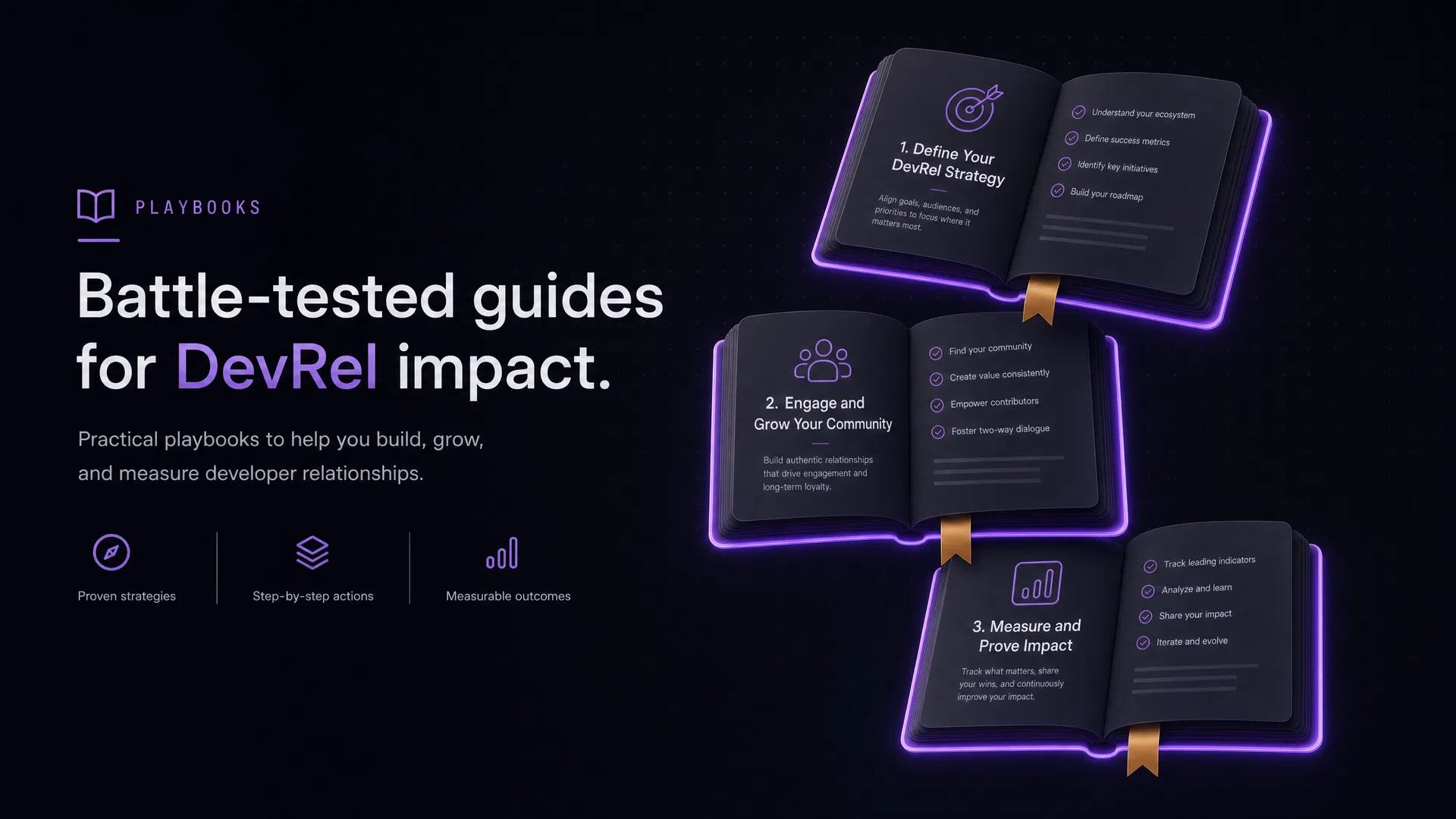
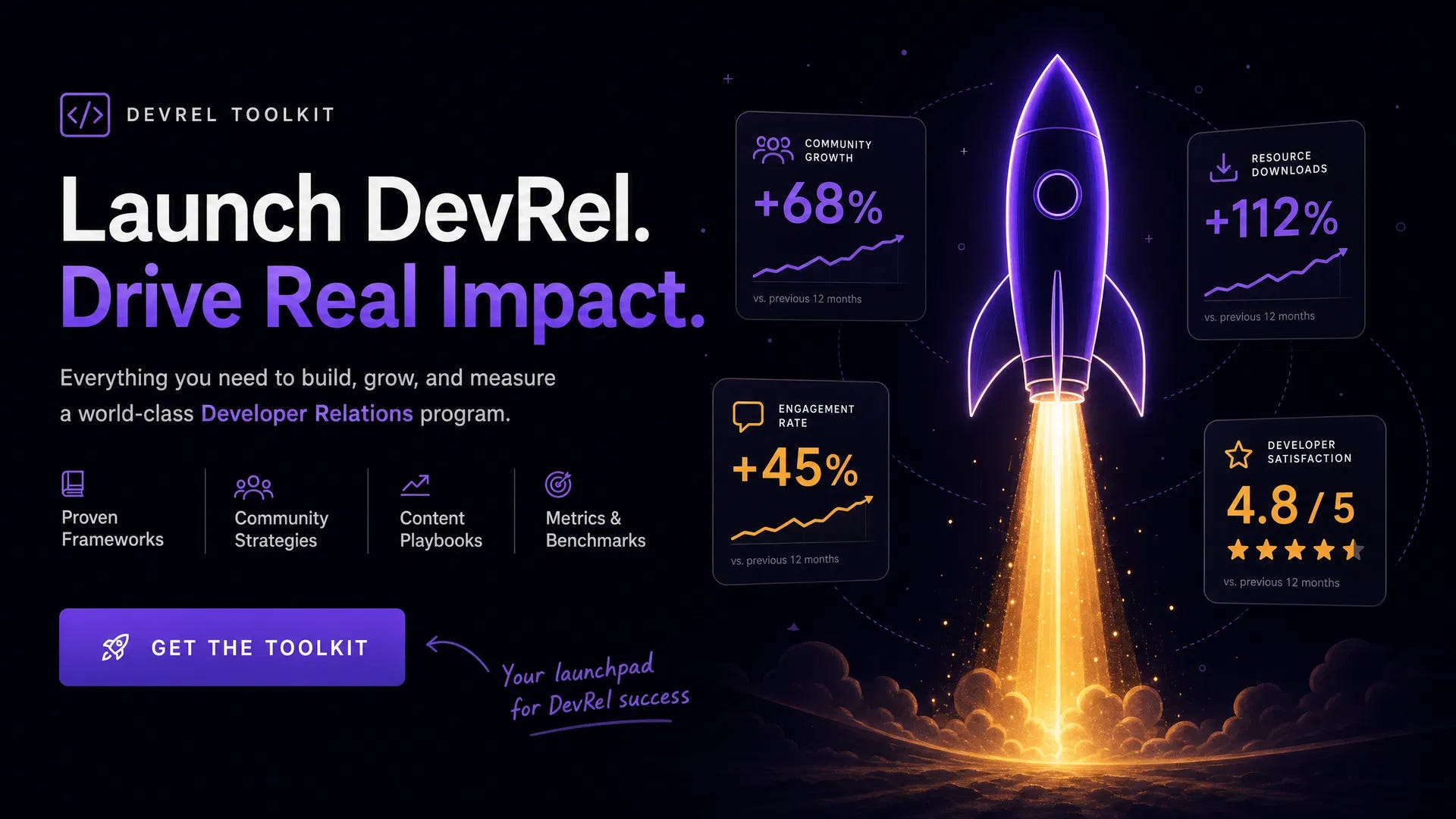
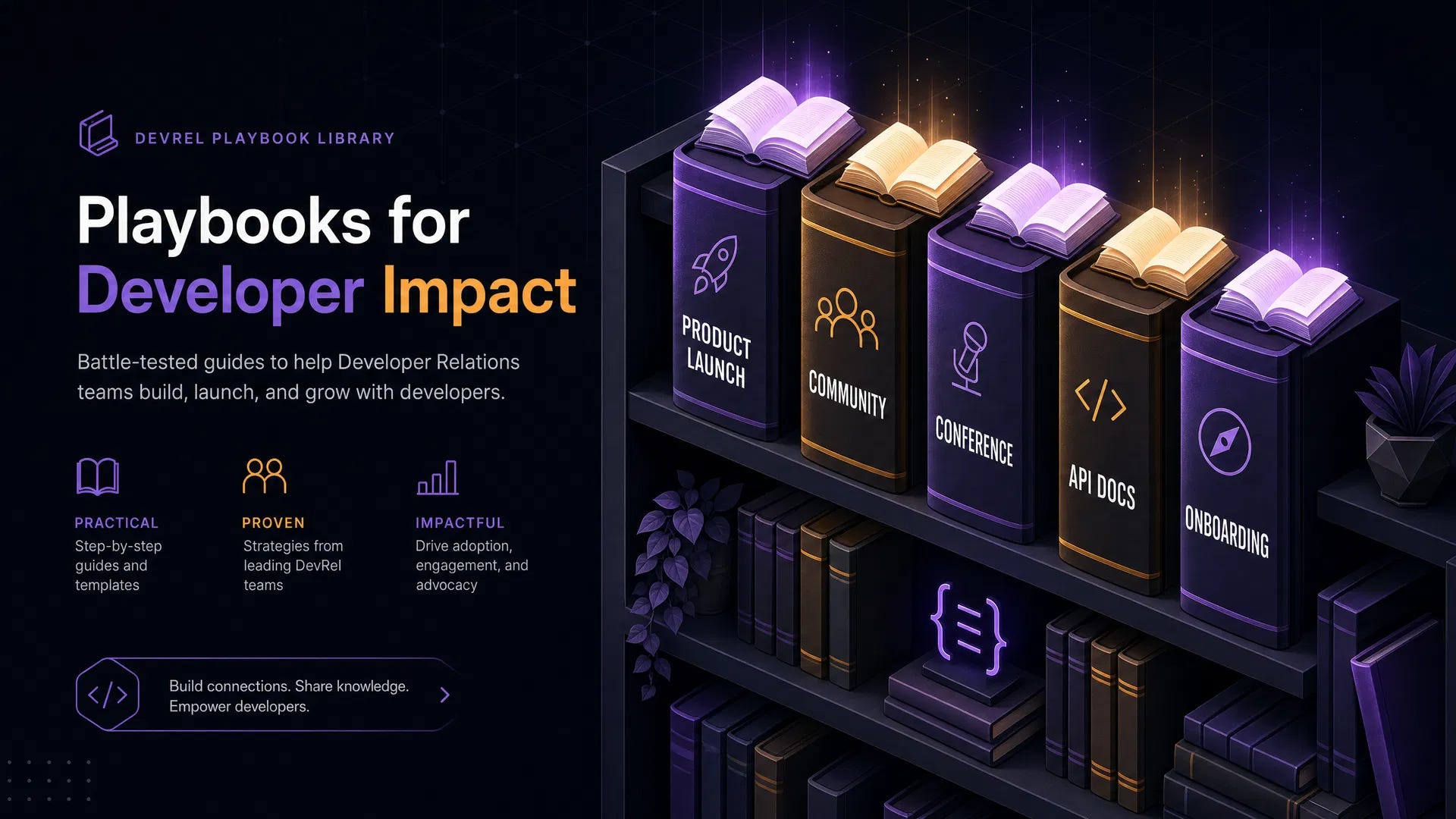
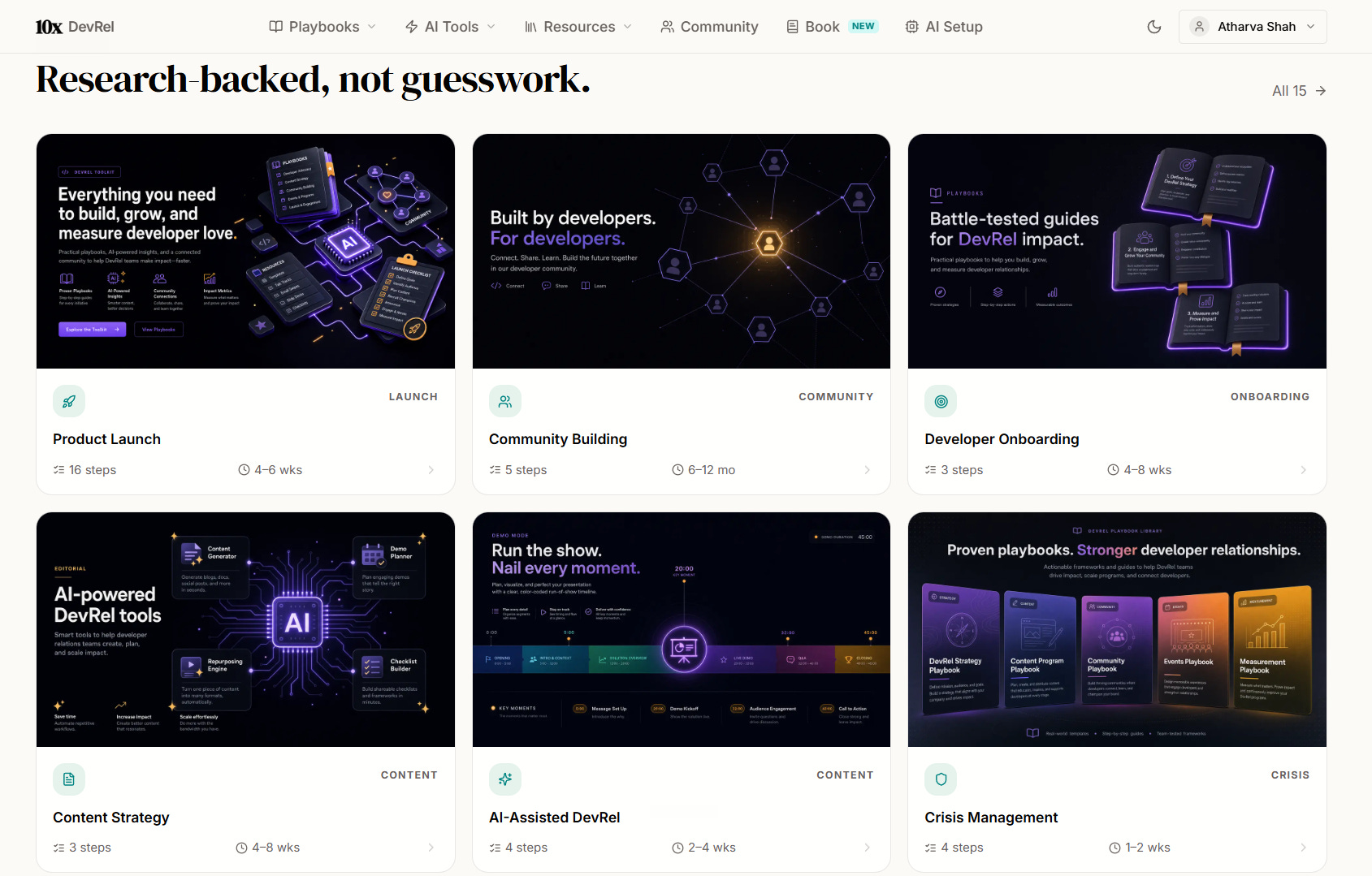
Here’s what the 15 playbooks cover:
Product Launch — T-30 to post-launch with DRI mapping
Community Building — Designing communities that sustain themselves
Developer Content Strategy — Building a content engine, not a blog
Technical Writing — Docs developers actually read
Developer Onboarding — First-run experiences that convert
Developer Feedback Loop — Systematic feedback pipeline
DevRel Metrics & ROI — Proving business impact in leadership language
Conference Talk — CFP through post-talk amplification
Hackathon — Running hackathons that generate signal
Open Source Community — Contributor pipelines and governance
Developer Advocacy — Building advocacy programs from scratch
Developer Ambassador Program — Community-led advocacy at scale
Demo Engineering — Demos that convert developers
Crisis Communication — Communicating when things break
AI-Assisted DevRel — Using AI to scale without scaling headcount
The AI Tools Decision
Playbooks solve “what should I do.” They don’t solve “this still takes forever.”
A developer advocate who knows exactly how to repurpose a blog post into six channel-specific pieces still has to actually do all that repurposing. For every piece of content. Every week. That’s hours of mechanical work that scales linearly with output.
I built four AI tools, each one targeting the highest-frequency, most time-consuming mechanical task in its category.
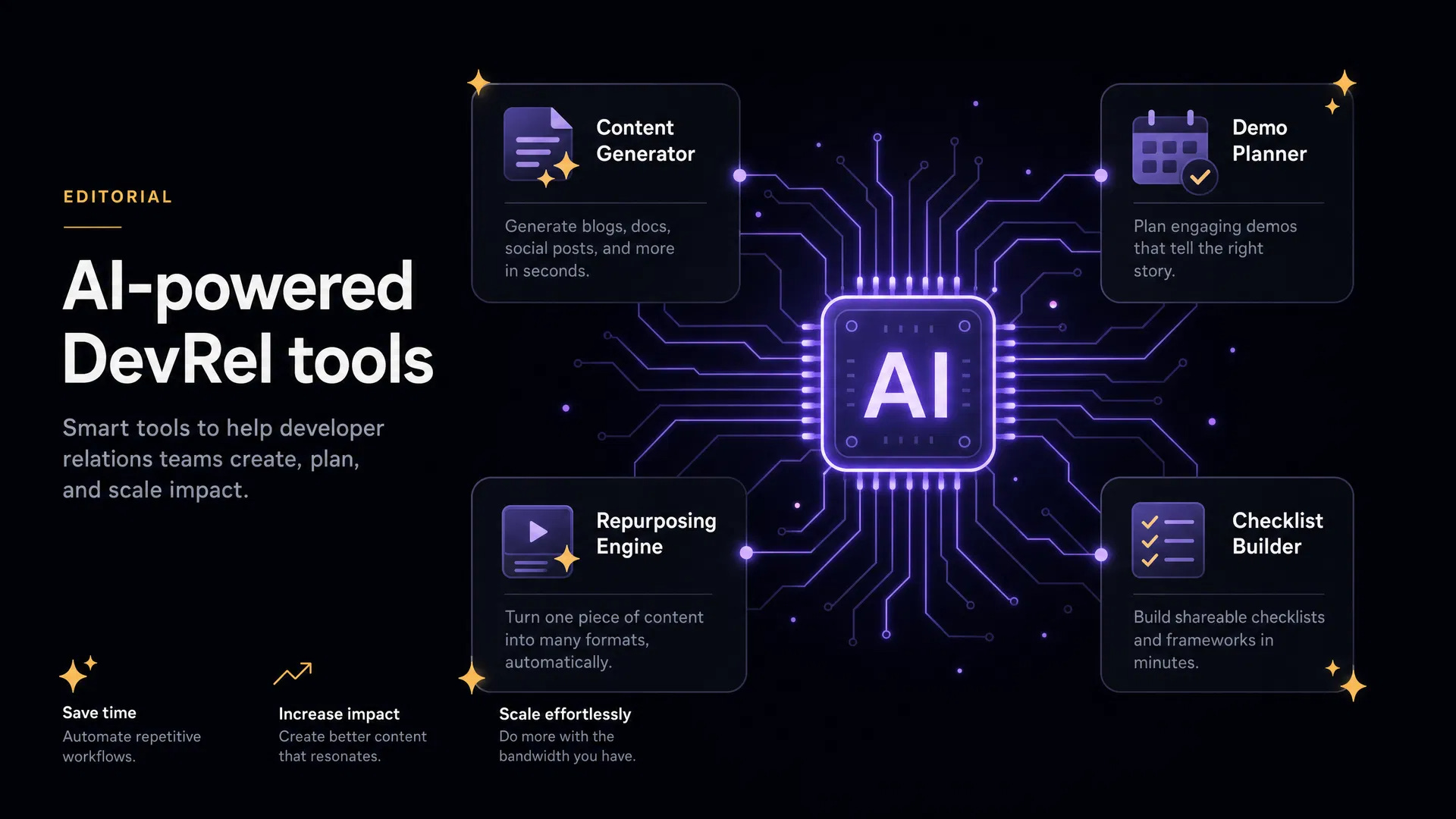
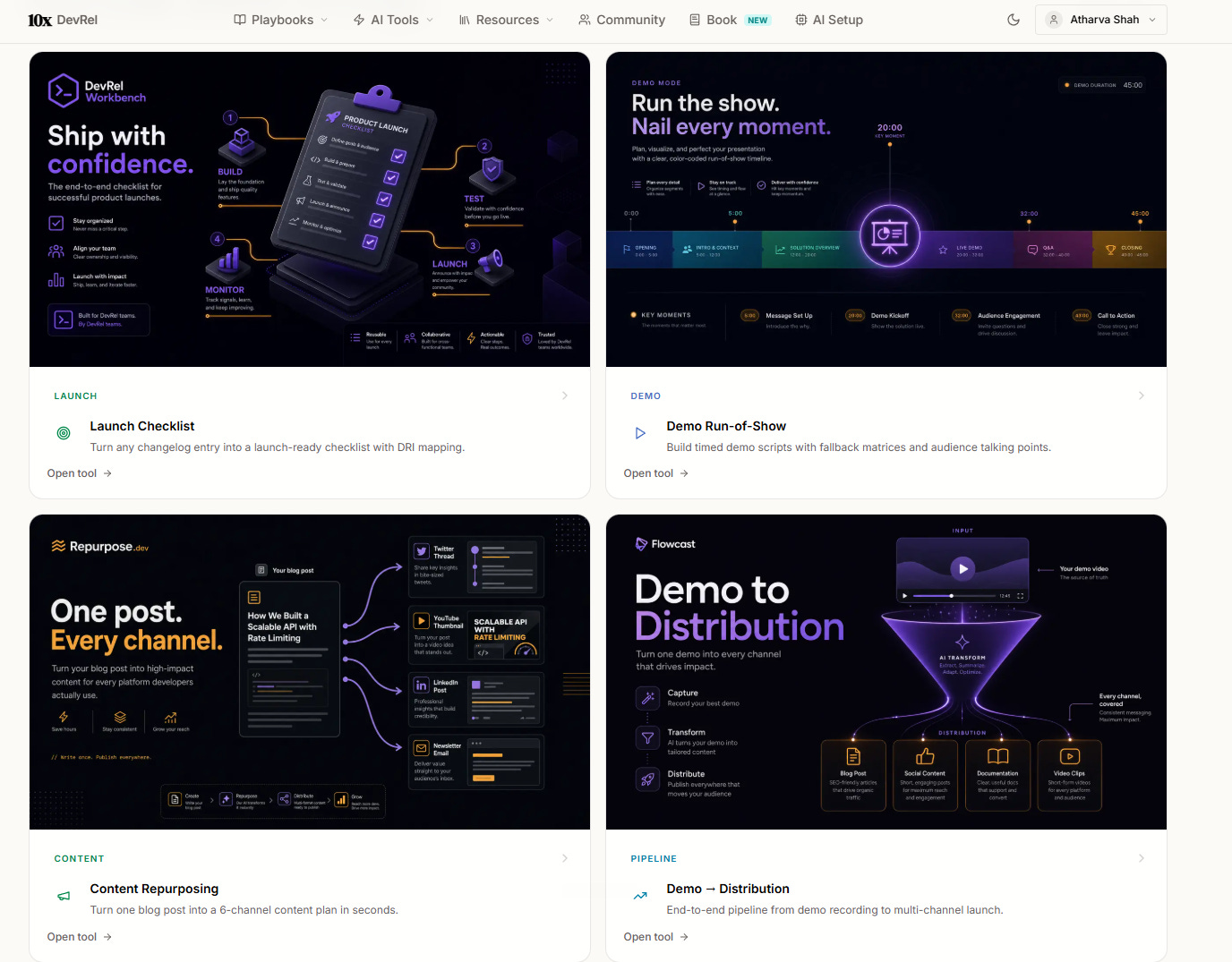
Launch Checklist — Paste a changelog entry or feature description. Get a complete launch plan with task categories, DRI suggestions, and timeline markers. What takes 3 hours manually takes 30 seconds to generate, then 15 minutes to customize. If you’re a DevRel team that launches twice a month, that’s 72 hours per year recovered.
Demo Run-of-Show — Describe your demo and audience. Get a timed script with segment-by-segment talking points, transition cues, and a fallback matrix for when live demos break. No more standing on stage saying “it usually works, let me try again.”
Content Repurposing — Paste a blog post. Get six channel-specific adaptations: Twitter thread, LinkedIn post, newsletter segment, video script outline, community discussion prompt, and Hacker News submission. Not copy-paste. Actual platform-native adaptation.
Demo to Distribution — Describe a recorded demo. Get the complete distribution package: social posts, blog outline, email announcement, community thread, and changelog entry. One demo becomes a full launch cycle.
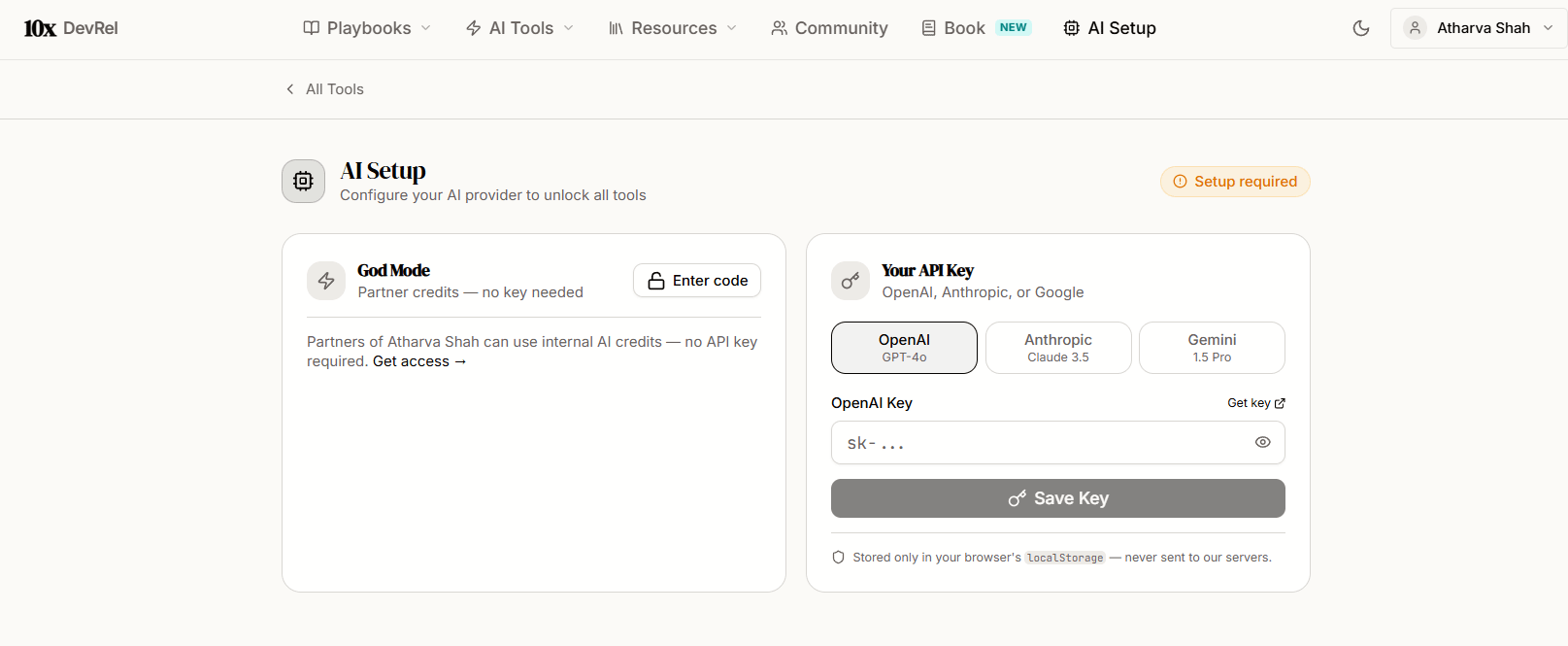
Every tool runs on your own API key. Claude, Gemini, or GPT. You pick. Your data goes directly to the AI provider you chose. Nothing is stored on my servers. No vendor lock-in. Switch providers any time.
I had strong opinions about this. The DevRel community doesn’t need another tool that holds their data hostage. Bring your own key. Control your own workflow.
The Resource Library and Community
Playbooks and AI tools needed connective tissue. When a playbook says “identify target conferences,” you need to know which conferences. When it says “set up community feedback channels,” you need to know which tools exist.
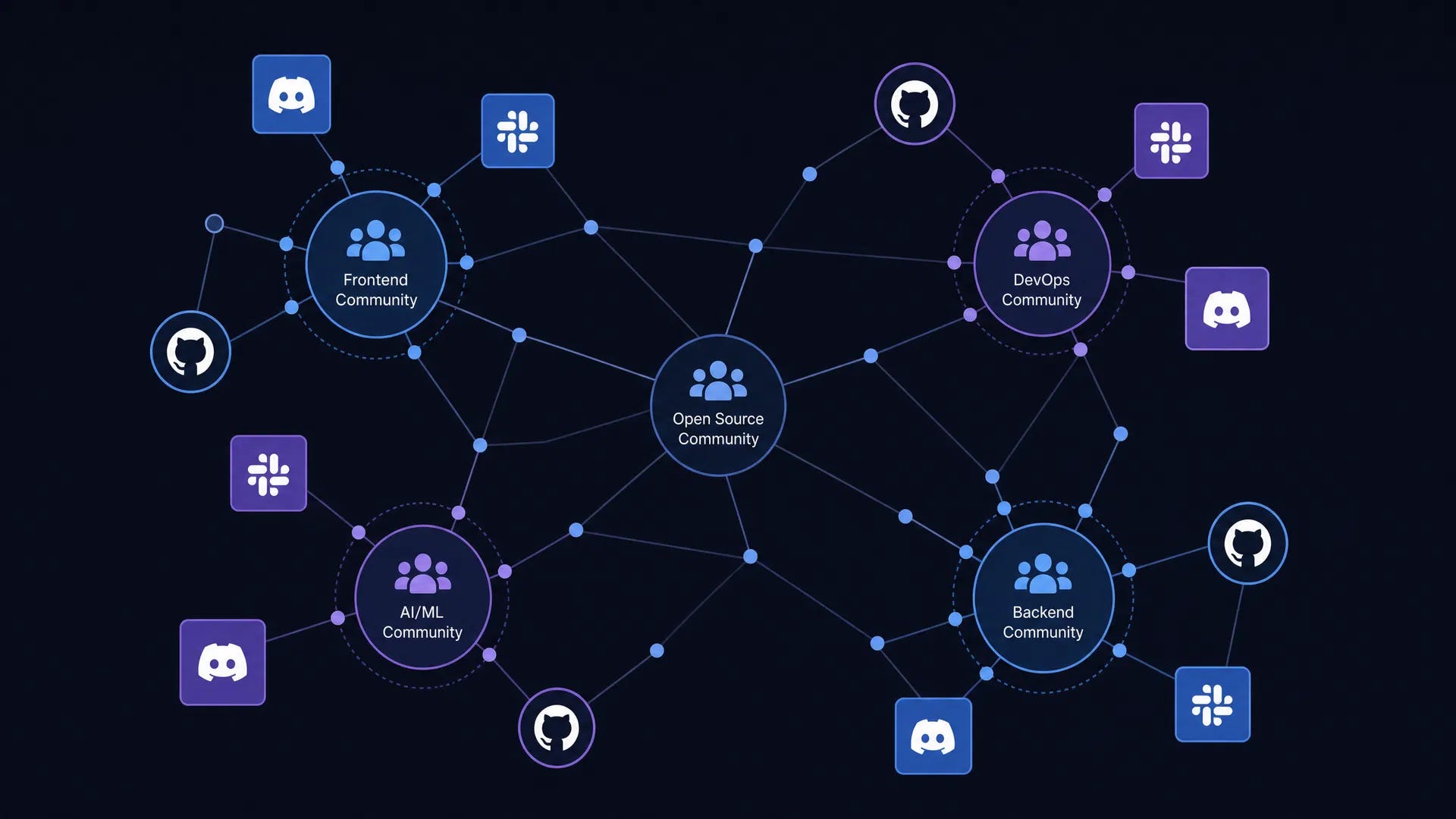
So I curated 200+ resources across six categories: Developer Events, Communities, Learning, Tools & Platforms, Strategy & Metrics, and Reference materials. Every resource is tagged, searchable, and filterable. Not a link dump. A library where every entry earns its place.
Then I built the Community section. Two tabs: Best Practices and Resources. Anyone can submit. Submissions go through moderation. Approved contributions show a Contributor Badge with the submitter’s profile, organization, and social links. You get credit for what you share.
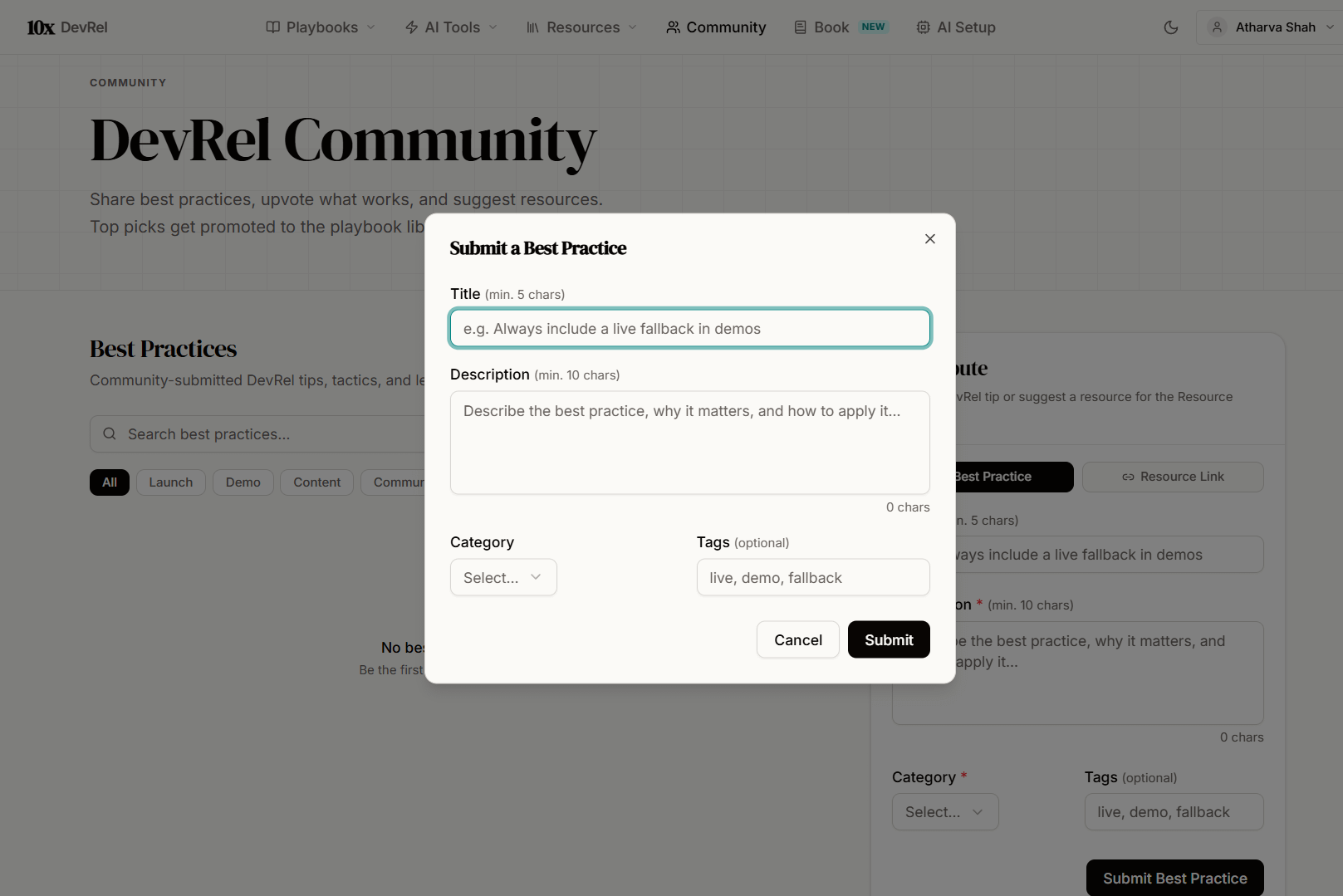
The community section is where the workbench becomes a living resource. The playbooks are curated by me. The community is curated by everyone using it.
What I Got Wrong (And Fixed)
Book preview was too long. The first version showed four chapters of The DevRel Guide as a preview. Overwhelming. I cut it to Chapter 1 only with an accordion layout. Engagement went up.
Testimonial design felt generic. Plain cards with text. I added gold borders, amber star ratings, and stronger visual hierarchy. Small change. Big trust impact.
General AI chatbot underperformed. I built Aria, a DevRel Q&A chatbot. It works, but it’s still in beta. The four scoped AI tools that solve one specific problem each outperform the general assistant by a wide margin. Lesson: specificity beats generality in AI tooling.
Community design took three iterations. Too simple, then too complex, then right. The two-tab structure with moderation and contributor badges hit the sweet spot.
Who This Is Actually For (Be Honest with Yourself)
You should use 10x DevRel if:
You’ve ever spent a Sunday night building a launch checklist from scratch
You’ve ever been asked “what’s the ROI of DevRel?” and fumbled the answer
You’ve ever written a great blog post and then only shared it on one platform because you ran out of time
You’ve ever winged a demo without a script and watched it fall apart
You’re running a one-person DevRel motion and feel like you’re drowning
You’re leading a DevRel team and want your team operating on shared frameworks instead of tribal knowledge
You’re an engineering manager who just got handed “developer relations” with no training
You’re a founder who knows DevRel matters but can’t figure out where to start
The Book (Coming Q3 2026)
Everything in the workbench is free. The playbooks, the AI tools, the resources, the community. Free forever.
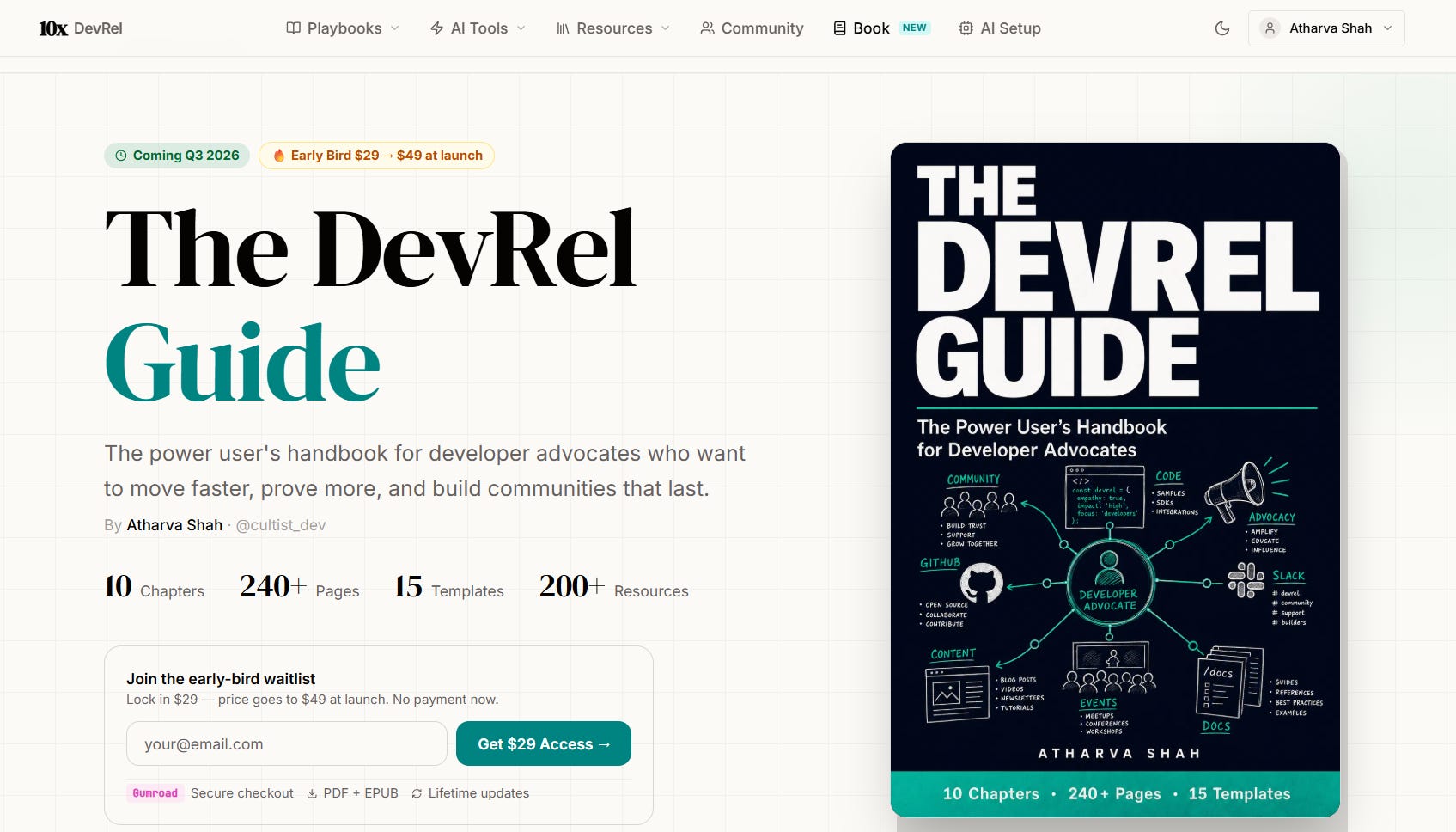
The DevRel Guide is the portable, comprehensive version. 400+ pages. 10 chapters. 15 templates. All 15 playbooks compiled with deeper frameworks, case studies, and examples you can adapt. Chapter 1 is free to read on the book page.
Early bird price is $29. Goes to $49 at launch. If the free workbench helps you ship one better launch, the book is where you go deep.

Go Use It
10x DevRel is live. Everything is free. No signup required for playbooks or AI tools. Bookmark what you need. Track your progress through the checklists. Try the AI tools with your own API key. Join the community and share what works.
If a playbook helps you ship a better launch, run a better hackathon, or finally prove your DevRel ROI to leadership, tell one person about it. This field gets better when we stop reinventing wheels.