I am starting a new series called Film School in Scenes.
Each entry picks one idea about craft and tests it against five real scenes from five different films. The full run has seven entries and thirty-five scenes, with no filler between them.
Cinematographer Owen Roizman mounted a camera to the bumper of the lead car for the chase scene in The French Connection (1971). He shot it undercranked, so the footage reads faster than it really was. Director William Friedkin started out making documentaries, and he wanted the danger to feel real instead of staged. That is the kind of choice this series exists to name, one decision, made on purpose, that changes how a scene lands.
Seven Episodes, Thirty-Five Scenes
Every entry covers one theme and five scenes that test it from different angles.
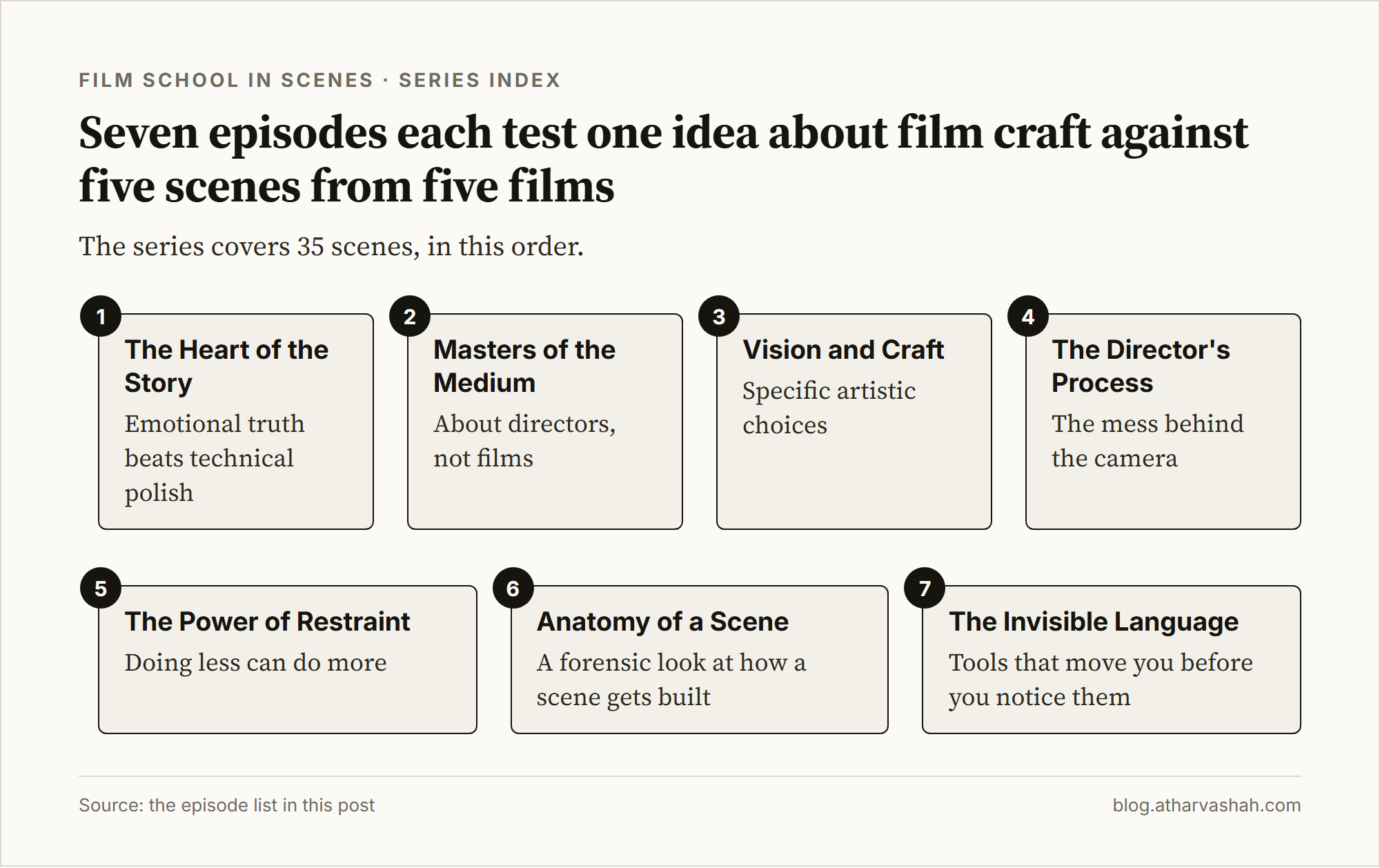
This list gets a link added for each episode the moment it publishes. Bookmark this page to reach every entry in the series.
EP #1, The Heart of the Story. Emotional truth beats technical polish. The proof runs from the shadows in The Muppet Christmas Carol. It continues through the strange gap in Eyes Wide Shut and the chaos of Good Time.
EP #2, Masters of the Medium. This one is about directors, not films. Paul Thomas Anderson builds suspense his way. Martin Scorsese builds compassion his way. Anime does the same job on a fraction of the budget.
EP #3, Vision and Craft. It gets into specific choices, like Robert Bresson's rules for sound and picture, or Sofia Coppola directing through controlled improvisation. Stop-motion gets its own look, for the strangeness that makes it work.
EP #4, The Director's Process. It is about the mess behind the camera. One entry studies a director's weakest film for what still works in it. Another follows the fight that made Wes Anderson sharper, and how strong Andrei Tarkovsky's first feature already was.
EP #5, The Power of Restraint. Doing less can do more. Stanley Kubrick proves it with quiet tension. Old studio horror proves the same thing by keeping the monster off screen. Safe takes the idea furthest, with a color palette that feels almost starved.
EP #6, Anatomy of a Scene. This one goes forensic on how a scene actually gets built. Alfred Hitchcock builds anticipation through repetition. Uncut Gems compresses hours into minutes without losing you. Dune explains a whole universe without stopping to lecture.
EP #7, The Invisible Language. It looks at the tools that move your emotions before you notice them working. David Fincher uses color to show a character's decline. Scorsese keeps reinventing his own style to stay honest to the story he's telling. Anime does more with less because its budget forces it to.
How Each Breakdown Works
For each scene, I slow down and show you the actual choice: the shot, the cut, the sound decision, or the performance beat. Then I explain the technique behind it in plain terms. I cover what a telephoto lens does that a wide lens cannot, and why overlapping dialogue works even though it breaks a rule.
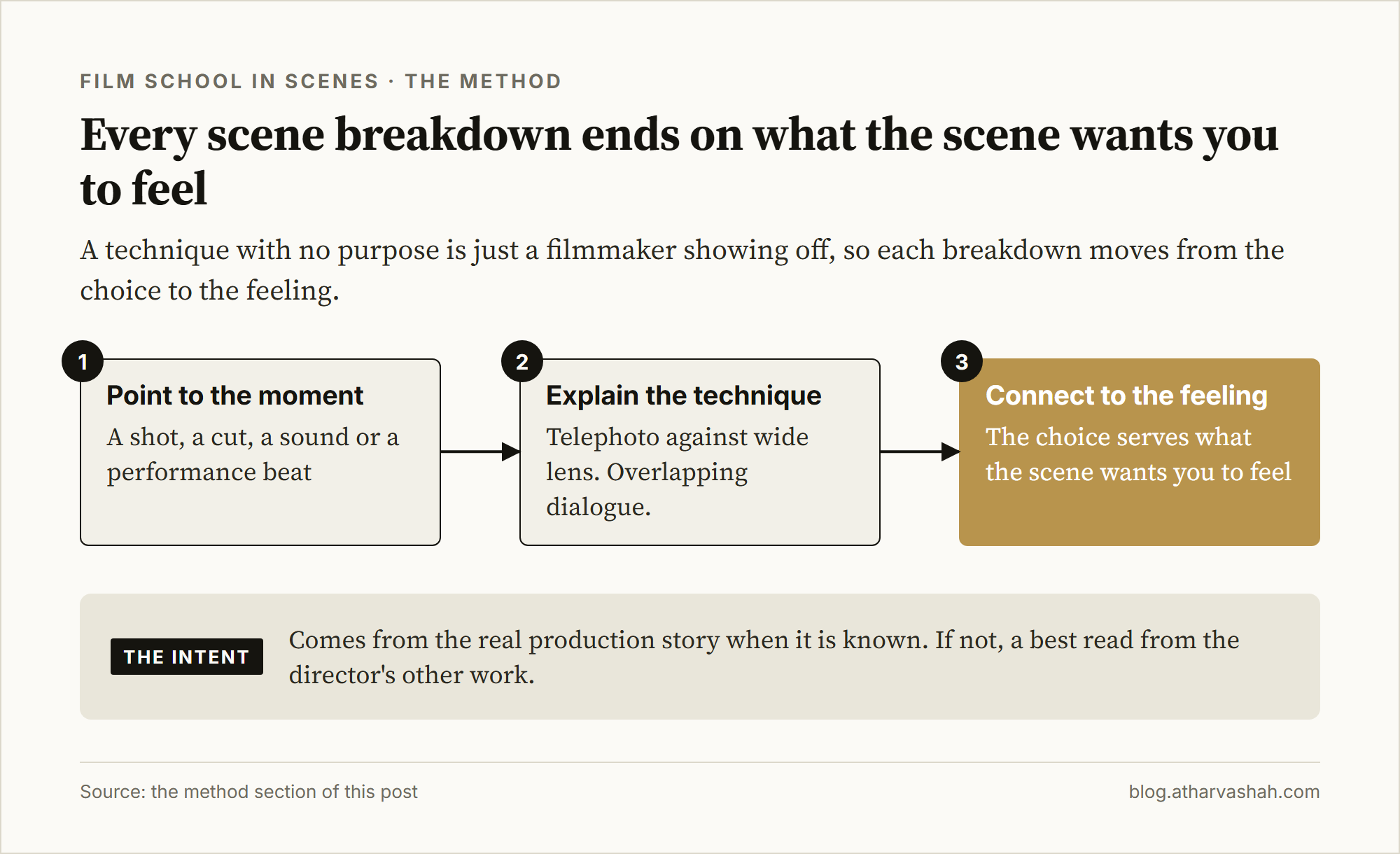
Last, I connect the choice back to what the scene wants you to feel. A technique with no purpose is just a filmmaker showing off. Sometimes I know the real production story behind a choice. Other times I give you my best read on it, built from watching that director's other work.
Six Things You Start Noticing
The goal is to train your eye to see the architecture behind a scene, the part most people never look at directly.
You start noticing:
Why certain scenes feel tense even when nothing happens on screen
How directors manipulate time and space to control what you feel
When breaking the textbook approach actually makes a scene stronger
The difference between staging a scene for a stage and staging it for a camera
How sound design carries half the emotional work in a scene
Why some "mistakes" become the most memorable moments in a film
The Point Is to Watch Differently
I want you to watch a scene and ask why the director framed it that way, and why the cut feels good. Once you start asking, you stop watching passively. A frame becomes a decision someone made on purpose, not scenery.
This series is for anyone who wants to see that decision instead of just feeling it. Episode one is posted below.

Film School in Scenes: the run starts with The Heart of the Story, and ends with The Invisible Language.