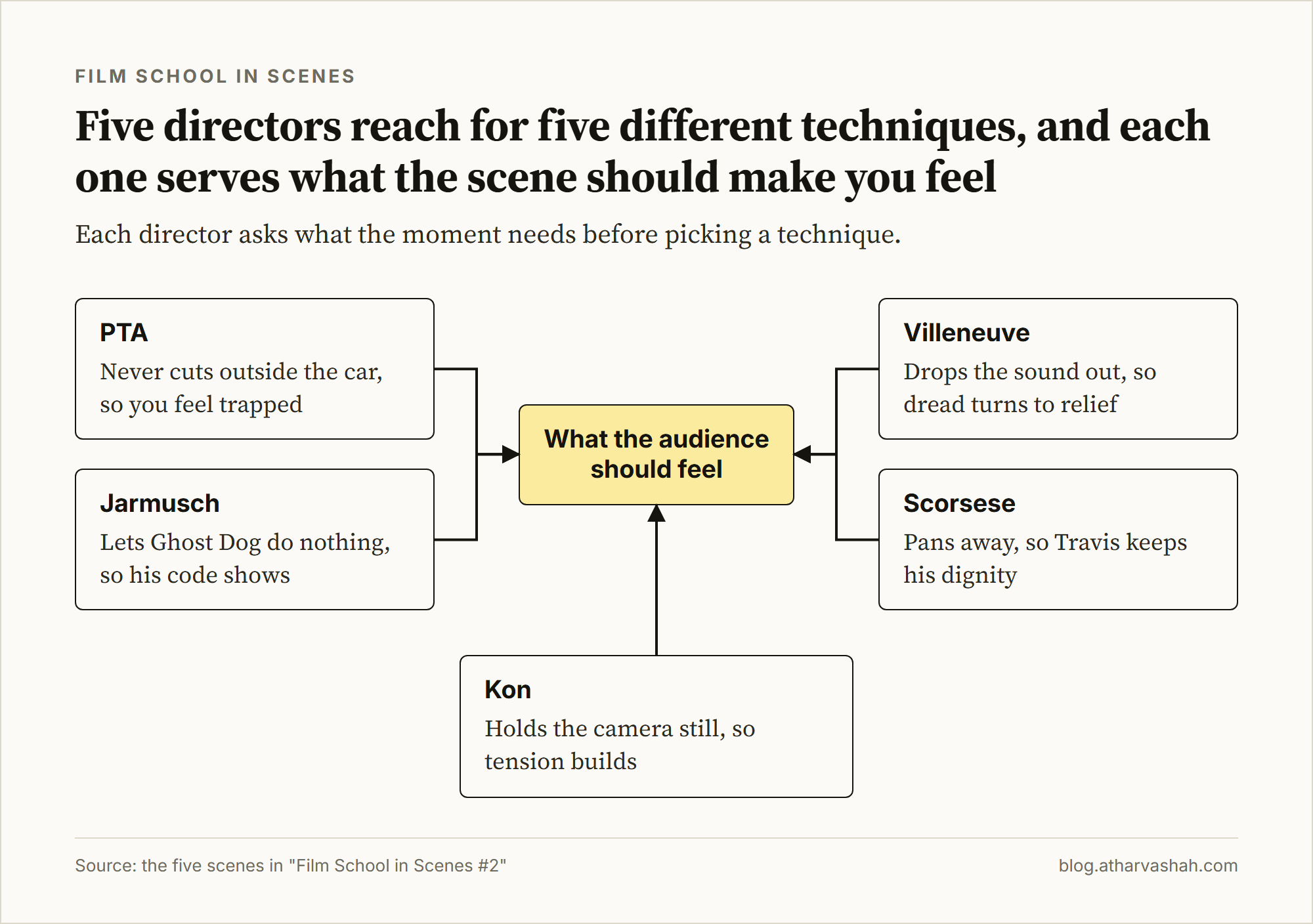
Anyone can learn filmmaking technique: the dolly zoom, the long take, the POV cut. Deciding which technique to use in a specific moment takes real instinct. That instinct is what separates the five directors below from everyone else.
Five sections follow, one director each. Every one of them breaks a different rule on purpose, and each built a technique around exactly what they want the audience to feel.
If you have not read the first post in this series, it is linked at the end of this post.
Read the full series index to see every post in this series.
PTA Traps You Inside the Car
Watch the car chase in One Battle After Another. Benicio del Toro is driving, and Leonardo DiCaprio is in the passenger seat. They pass a cop, the chase begins, and DiCaprio has to bail from the moving car.
Most directors would shoot the standard grammar of a chase: the car speeding, the cop closing in, the speedometer climbing, the rearview mirror filling the frame. Paul Thomas Anderson (PTA) skips every bit of that.
Watch the scene again and notice what is missing. The camera never cuts outside the car. It never shows what is ahead or what is behind. It stays locked inside with these two men, and you feel the claustrophobia of that space along with them.
This is pure PTA. He cares more about what happens on an actor's face under pressure than about the mechanics of the chase around it. In the theater, you do not notice the formal constraint. You just feel wound tight, waiting for the release.
By refusing to cut away, PTA denies the audience the spatial orientation a normal chase scene gives you. That denial is what makes you feel what the characters feel instead of just watching what they do. When DiCaprio finally jumps from the car, it lands harder because the tension had nowhere else to go.
PTA knows where his real strength sits: performance and facial detail under real pressure. He built this entire sequence around that strength instead of around the chase-movie playbook.
Jarmusch Lets a Character Do Nothing
Ghost Dog walks through a park in Ghost Dog: The Way of the Samurai. He sees two men harassing a young girl. He watches. He considers stepping in. He does not.
Scene ends.
If you submitted this scene to a screenplay contest, the notes would be brutal: protagonist passive, no clear objective, does not advance the plot, cut this whole sequence. Those notes would be wrong.
Jim Jarmusch is doing something quieter and stranger than plot mechanics. He lets the audience learn who Ghost Dog is by watching him not act. His restraint on screen is the point: his code, his particular way of moving through the world, and the specific violence he saves for people who actually deserve it.
This is where film can do something a novel struggles to do. It shows you a person through pure observation, with no internal monologue and no exposition, just a man in a park weighing intervention against his own code and choosing stillness.
This scene resists the standard screenwriting formula. No three-act beat sheet accounts for the moment when your assassin-with-a-code watches an injustice and walks away. Jarmusch knows his character lives inside small moral calculations like this one, so he gives Ghost Dog one and lets it sit.
Sometimes character is plot. The sharpest way to reveal a character is to hand him a decision no one is watching him make.
Villeneuve Scripts the Sound Like a Second Camera
Watch the space-battle sequence from Dune: Part Two without sound first.
Paul dodges incoming fire, and the camera cuts to the enemy's point of view. A scope finds Chani in the crosshairs, but she has already fired her rocket. The projectile strains against the shield, held back by the energy field. The shield gives out with a small pop. A beat passes, then a massive secondary explosion follows.
Now watch the same sequence with sound.
The visual beats already work on their own, but listen to what Denis Villeneuve does with the audio. Right before the first pop, Harkonnen soldiers laugh, an ugly and confident cackle. The sound drops out completely as the shield fails. That same laugh returns for a split second before the score crashes back in with the explosion.
A competent action sequence moves you through space clearly. A great one moves you through an emotional arc, from dread to relief, and each beat sets up the next to land harder. Villeneuve scripts the feelings as precisely as he scripts the stunts.
That laugh does two jobs. The first time, it signals enemy confidence and builds dread in the audience. The second time, returning right before the blast, it signals reversal and delivers relief. Villeneuve uses sound design to create that whiplash, and the explosion becomes punctuation on an emotional arc built entirely with audio.
Scorsese Turns the Camera Away From Travis Bickle
The camera moves maybe nine feet. That is the whole shot, and it stands as one of the most devastating moments in Scorsese's career.
Travis Bickle is on the phone with Betsy in Taxi Driver. She is rejecting him after their disastrous date, and he is spiraling, making things worse with every word he says.
Martin Scorsese's camera slowly pans right, away from Travis, to stare at an empty hallway instead. The audience looks away with it. Scorsese gives Travis privacy in his humiliation.
Compare that instinct to Stanley Kubrick's in A Clockwork Orange. Kubrick keeps Alex centered in symmetrical, static frames through the film's most violent scenes, and he never lets the audience look away from him. Kubrick wants you to sit inside that discomfort. Scorsese wants the opposite.
Travis Bickle is delusional and dangerous, a broken man making everything worse with every word. In his lowest moment, Scorsese gives him dignity by turning away. Then Scorsese does it again: another slow pan, further down the hall, giving Travis even more privacy.
For a film this dark, about a man this disturbed, that choice says something essential about Scorsese as a director. He never punishes his characters with the audience's gaze, even the ones who deserve it least.
Kon Builds Tension With a Camera That Will Not Move
In Tokyo Godfathers, the second shot of one scene does the real work. A door opens. A large man steps aside with ceremony. The camera holds, perfectly still, as he reveals the film's three homeless protagonists.
The first hero enters the frame, then the second. The third stops dead, and a close-up shows his shocked face. Flashbulbs pop, and the shot cuts to his point of view: the crowd, the press.
Satoshi Kon died in 2010 at 46, from pancreatic cancer. From his debut in 1997 until then, he built some of the most tightly constructed scenes in animation, working inside a real constraint: every character movement and every camera move in animation costs an artist real time to draw, so economy was never optional.
That constraint shows in this scene. Kon holds the camera locked and static as the three heroes enter one by one, and that stillness builds a formal tension you can feel. He releases it only with the close-up and the point-of-view cut, and that is the moment you understand why the third man froze.
Kon treated economy and impact as the same problem instead of opposing ones. The more carefully he chose when the camera should move, the more weight that movement carried when it finally did.
The Same Pan, Two Different Reasons
Quentin Tarantino reaches for the same camera move Scorsese uses in that phone booth, for the opposite reason. In Reservoir Dogs, the camera pans away from Michael Madsen's character while he tortures a captured cop, and holds instead on an empty corner of the warehouse while a pop song plays over what the audience cannot see. Tarantino withholds the violence because the version an audience imagines beats anything he could put on screen. Scorsese withholds Travis Bickle's humiliation because he refuses to abandon a character at his lowest point.
Both directors reach for the identical instinct: they turn the camera away from the subject. But they use it for opposite reasons. Tarantino and Scorsese each asked what their specific scene needed, and the answer sent the camera in the same direction for two different purposes.
That is the real instinct behind every scene in this piece. Each director asks what a moment needs before reaching for a technique that already worked somewhere else.
Learn the grammar of filmmaking first. Then learn to ask, in each specific moment, what the scene actually needs from you instead of what the grammar defaults to.
Your turn: think of a scene where a director held back. A cut that did not happen, a shot that stayed still when you expected movement, a sound that dropped out instead of swelling. What did the restraint tell you that the obvious choice would not have?