



Most marketing teams in 2026 run a bloated stack. They pay for a dozen tools. Three dashboards sit open and nobody checks them. A CRM costs more than the junior marketer who feeds it data. Every quarter ends with the same question. Where did the pipeline actually come from?
The answer, for most teams, is "we're not sure."
That uncertainty costs money and time. High-effort campaigns chase low-intent leads. The waste compounds every quarter.
Teams already own enough tools. Their tools do not talk to each other. Marketing writes content in one silo. Sales runs prospecting in a second silo. Social engagement sits in a third. No stage feeds the next, so no effort compounds.
Magi founder Bhavana Thudi wrote about the same silo problem before she built the tool.

At AccuKnox, a cloud-native security company, I evaluated and rejected two tools before I built the stack this essay describes. Factors.ai had too many features on top of a 10-seat limit. Bombora matched fewer than 10 percent of leads to the right account. Neither tool survived a second look.
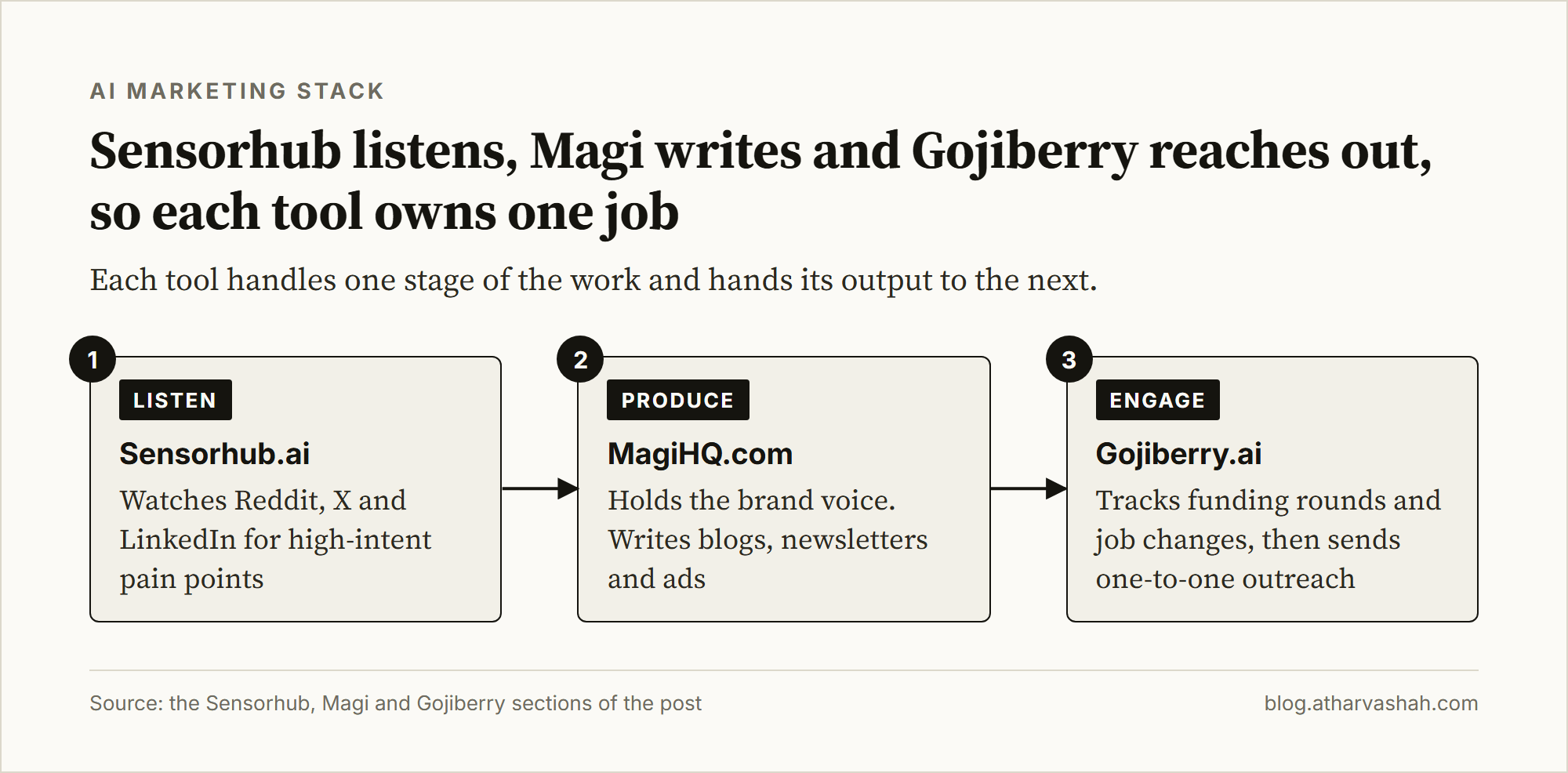
This essay breaks down the three-tool stack that took their place. Each tool handles one job, and each tool feeds the next.
Sensorhub Tracks 1,700 Conversations a Day, Not Brand Mentions
The first layer is signal capture. Sensorhub.ai monitors Reddit, X, and LinkedIn in real time. At AccuKnox, we point it at roughly 1,700 conversations a day across the three platforms. It skips brand mentions and vanity metrics. It reports buying signals. People ask for alternatives, compare vendors, or describe a pain point our product solves.

This is Answer Engine Optimization (AEO) in practice. AEO means you earn the answer slot instead of the search ranking. You find the conversation where someone already asks the question your product answers, then you answer it with something useful before you pitch anything.

That volume is the whole case for the tool. At 1,700 conversations a day, the team sees a live buying signal every few minutes, not once a quarter by luck. Sensorhub finds the conversation. A person on the team still has to write the answer.
Guide and use case. The 3-Step Workflow to Intercept High-Intent Leads on Reddit & LinkedIn

Magi's Brand Brain Turned 33 Personas Into 648 Ideas

Signal capture means nothing without content behind it. MagiHQ.com handles the production layer. It writes blogs, newsletters, ads, and social posts, and it holds a stored brand voice.

Magi calls that stored voice the Brand Brain. You feed it your positioning, your tone guidelines, your product language, and your competitive differentiators. At AccuKnox, that profile covers 11 markets and 33 personas, built on a seven-layer knowledge base. The Brand Brain generated 648 campaign ideas from that base, and each one still reads like a person on the team wrote it.
I do not trust content that sounds like every other company's AI output, and neither does the person reading it. That is the AI slop problem. AI slop is model output that no person fed context or edited, and it is a skill issue, not a tooling one. Magi's answer is context depth, not a longer prompt. The brand profile is the difference between a paragraph that sounds like your company and a paragraph that sounds like anyone's.

Content speed helps only when quality scales with it. Otherwise you produce noise faster.
Gojiberry Sends When the Signal Happens, Not on a Schedule
The third layer is precision outreach. Gojiberry.ai runs account-based marketing, or ABM, against a named list of accounts instead of a broad audience. It tracks real-time triggers such as new funding rounds, leadership changes, security-engineer job postings, and product launches, then it matches each trigger to your ideal customer profile.
When a target account raises a signal, Gojiberry drafts the outreach and sends it while the trigger is still fresh. The message names the specific trigger, ties it to a pain point, and proposes a next step.
Gojiberry co-founder Dylan Txa describes the intent-first process the tool runs on.


Timing is the argument for ABM, not the tool itself. Most outreach arrives at random. A message that lands the week of the trigger reads as relevant. The same message sent at random reads as noise.

The Three Tools Cost $400 a Month, Not $4,000
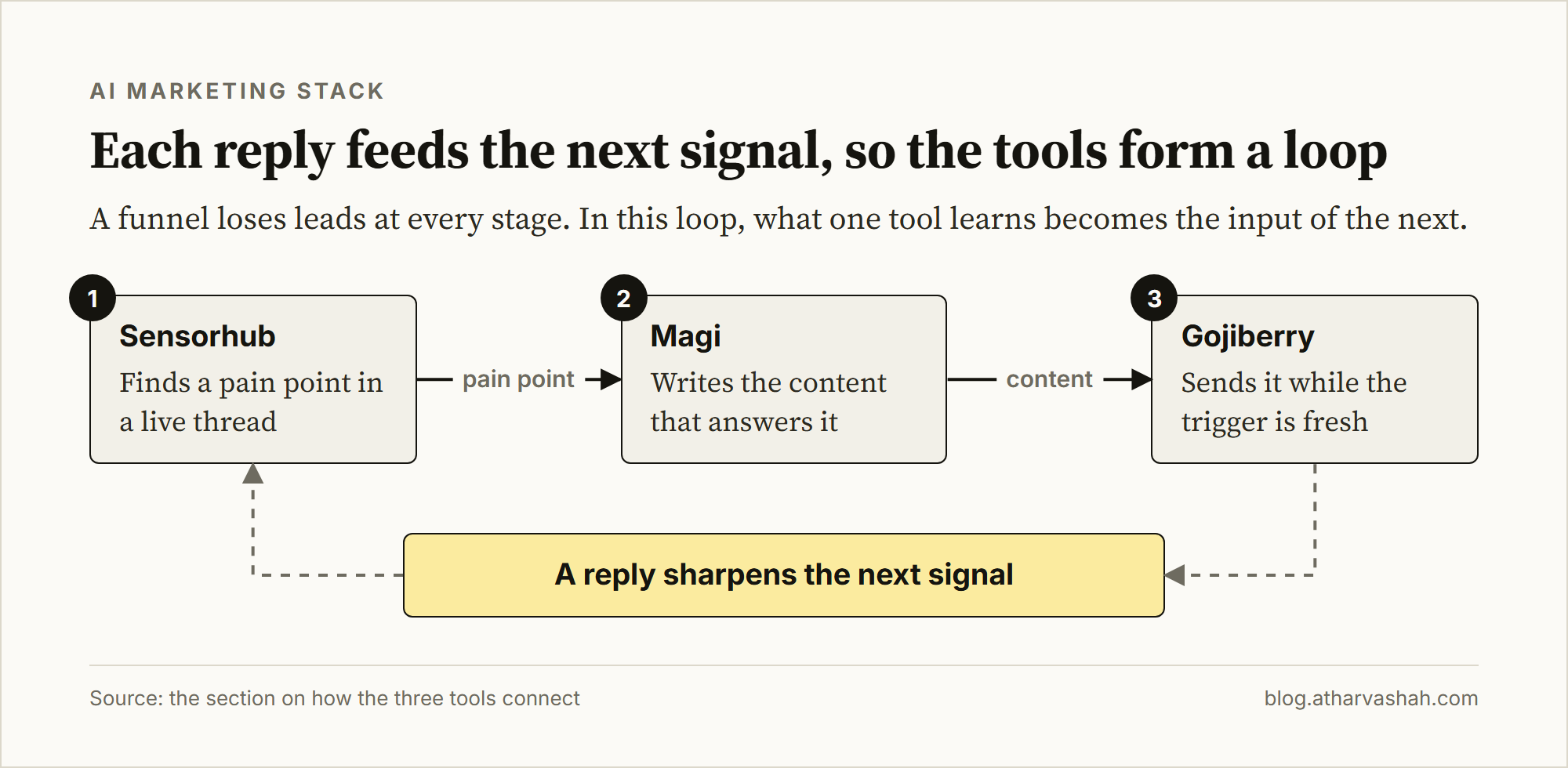
Each tool works on its own. Together, they run as a loop instead of a funnel that loses leads at every stage.
Sensorhub finds the pain point. Magi writes the content that answers it. Gojiberry delivers that content to the person who raised the signal, timed to the trigger.
Data moves between the tools too, not just outreach. What Sensorhub hears shapes what Magi writes next, and what Gojiberry learns from a reply flows back to sharpen Sensorhub's next signal.
At AccuKnox, this stack replaced a marketing setup that cost about $4,000 a month in agency fees. The new stack runs about $400 a month, a drop of roughly 90 percent. A marketing stack that does not close the gap between listening and acting is just motion, not pipeline.
Related Reading
